Emergency (1975-1977)

Content
- Introduction
- National Emergency under the Constitution
- Background
- Proclamation of Emergency
- Major Features
- Constitutional Amendments 1976
- End of the Emergency
- Significance
- Conclusion
- FAQs
Introduction
The Emergency of 1975-1977 remains one of the most controversial and debated phases in independent India’s political history. It represented a period during which democratic institutions were severely constrained, civil liberties were curtailed, opposition leaders were imprisoned, and the authority of the Union government expanded significantly. Although India had witnessed two earlier National Emergencies in 1962 and 1971 due to external threats, the Emergency proclaimed on 25 June 1975 was fundamentally different because it was imposed on the grounds of “internal disturbance” and directly affected the functioning of democracy within the country.
It lasted for 21 months, from 25 June 1975 to 21 March 1977, and is often regarded as the greatest test of India’s constitutional democracy. Its consequences led to major constitutional reforms, judicial reassessment of fundamental rights, and a renewed emphasis on protecting democratic institutions.
National Emergency under the Constitution
The Constitution of India provides for the declaration under Article 352. A National Emergency can be proclaimed by the President when the security of India or any part of its territory is threatened by:
- War
- External aggression
- Armed rebellion
Once proclaimed, the Union government acquires extraordinary powers to deal with the crisis, and the federal structure becomes highly centralized.
National Emergencies Declared in India:
| Emergency | Period | Ground |
| First National Emergency | 26 October 1962 – 10 January 1968 | Chinese aggression during the Sino-Indian War |
| Second National Emergency | 3 December 1971 – 21 March 1977 | External aggression during the Indo-Pakistan War |
| Third National Emergency | 25 June 1975 – 21 March 1977 | Internal disturbance |
The Emergency of 1975 is particularly significant because it was the only Emergency imposed primarily due to domestic political developments rather than an external military threat.
Political Background
The roots can be traced to the political and economic turmoil that characterized India during the early 1970s.
Following India’s victory in the 1971 Indo-Pakistan War and the creation of Bangladesh, Prime Minister Indira Gandhi enjoyed immense popularity. However, this political dominance gradually faced serious challenges due to rising inflation, unemployment, corruption allegations, food shortages, and economic distress aggravated by the 1973 global oil crisis.
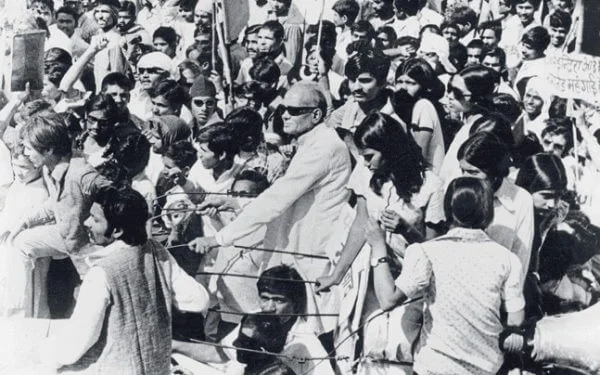
Simultaneously, opposition movements emerged across different parts of the country. Student-led protests in Gujarat and Bihar evolved into broader anti-government agitations. These movements eventually came under the leadership of Jayaprakash Narayan, who called for “Total Revolution” and demanded the resignation of the Prime Minister.
The immediate trigger came on 12 June 1975, when the Allahabad High Court Judgment against Indira Gandhi invalidated Indira Gandhi’s election to the Lok Sabha on charges of electoral malpractice. The verdict threatened her continuation as Prime Minister and intensified political instability.
Against this backdrop, the government advised the President to proclaim an Emergency under Article 352 on the ground of internal disturbance.
Proclamation of Emergency (25 June 1975)
On the night of 25 June 1975, President Fakhruddin Ali Ahmed signed the proclamation of it under Article 352.
The government justified the decision by citing threats to national stability, public order, and governance. However, critics viewed it as an attempt to preserve the political position of the Prime Minister and suppress growing opposition movements.
Immediately after the proclamation, opposition leaders, activists, journalists, and trade union leaders were arrested across the country. Fundamental rights were suspended, and extensive restrictions were imposed on political activities and media freedom.
Major Features of the Emergency
Suspension of Fundamental Rights
One of the most significant consequences was the suspension of several Fundamental Rights.
The government issued orders under Articles 358 and 359, restricting the ability of citizens to approach courts for the enforcement of fundamental rights. The right to challenge preventive detention was effectively suspended, leading to large-scale arrests under preventive detention laws.
The famous ADM Jabalpur v. Shivkant Shukla Case upheld the government’s position that citizens could not seek judicial remedies against unlawful detention during the period. This judgment is often regarded as one of the most criticized decisions in Indian constitutional history.
Arrest of Political Opponents
Thousands of opposition leaders were detained under the Maintenance of Internal Security Act (MISA), 1971.
Prominent leaders such as Jayaprakash Narayan, Morarji Desai, Atal Bihari Vajpayee, and Lal Krishna Advani were imprisoned.
The detention of opposition figures significantly weakened democratic opposition and reduced political competition.
Press Censorship
It witnessed unprecedented restrictions on press freedom.
Newspapers were required to submit material for government approval before publication. Critical reports against the government were prohibited. Several publications faced censorship, and many journalists were detained or intimidated.
On the night of the Emergency proclamation, power supply to newspaper offices in Delhi was reportedly interrupted to prevent the publication of critical news reports.
Centralization of Power
The Emergency resulted in an extraordinary concentration of power in the hands of the executive.
Parliament functioned with limited opposition, state governments became increasingly dependent on the Centre, and administrative machinery was brought under stricter political control. Decision-making became highly centralized around the Prime Minister’s Office.
Constitutional Amendments During the Emergency
39th Constitutional Amendment Act, 1975
The 39th Amendment placed the election of the President, Vice-President, Prime Minister, and Speaker of the Lok Sabha beyond judicial scrutiny.
Its immediate objective was to protect the Prime Minister from the consequences of the Allahabad High Court judgment.
42nd Constitutional Amendment Act, 1976
Often described as the “Mini-Constitution,” the 42nd Amendment was one of the most extensive constitutional amendments in Indian history.
The amendment strengthened parliamentary supremacy, curtailed the powers of the judiciary, expanded the authority of the Union government, and introduced several significant constitutional changes. It also added the words “Socialist,” “Secular,” and “Integrity” to the Preamble and inserted Fundamental Duties under Part IVA.
The amendment substantially altered the balance between different organs of government and is often viewed as a symbol of executive dominance during the Emergency.
Economic and Social Dimensions
The Emergency period witnessed a mixed economic record.
The government launched the Twenty-Point Programme, aimed at controlling inflation, increasing agricultural production, reducing poverty, and improving public distribution systems. Administrative efficiency improved in certain sectors, and inflation was temporarily controlled.
However, controversial measures such as forced sterilization campaigns associated with Sanjay Gandhi generated widespread public resentment. Reports of coercive population control measures and slum clearance drives damaged the government’s credibility.
Thus, while some developmental objectives were pursued, the methods adopted often raised serious concerns regarding individual rights and human dignity.
End of the Emergency
In January 1977, Indira Gandhi unexpectedly announced general elections and lifted restrictions on political activity.
The Emergency was formally revoked on 21 March 1977.
The subsequent general election witnessed a historic political outcome. For the first time since independence, the Indian National Congress lost power at the Union level. The Janata Party secured a decisive victory, and Morarji Desai became India’s first non-Congress Prime Minister.
The election result demonstrated the resilience of democratic institutions and the electorate’s commitment to constitutional freedoms.
Significance
Impact on Democracy
The Emergency exposed the vulnerability of democratic institutions when constitutional safeguards are weakened. It highlighted the importance of checks and balances, an independent judiciary, a free press, and an active opposition.
Judicial Transformation
Following the Emergency, the judiciary adopted a more rights-oriented approach. The Supreme Court expanded the interpretation of Article 21 (Right to Life and Personal Liberty) and developed the doctrine of substantive due process.
The rise of Public Interest Litigation (PIL) in subsequent decades reflected the judiciary’s determination to protect civil liberties more effectively.
Constitutional Safeguards
The experience of the Emergency led to the enactment of the 44th Constitutional Amendment Act, 1978, which introduced important safeguards against misuse of emergency powers.
The amendment replaced the phrase “internal disturbance” with “armed rebellion” as a ground for National Emergency, making future proclamations more difficult. It also strengthened protections for fundamental rights and imposed stricter parliamentary approval requirements.
Political Consequences
The Emergency transformed Indian politics by strengthening opposition unity and fostering a culture of greater vigilance against executive overreach. It remains a crucial reference point in debates concerning civil liberties, constitutionalism, and democratic accountability.
Conclusion
The Emergency of 1975-1977 represents a defining moment in India’s constitutional and political history. While it was proclaimed within the constitutional framework, its implementation resulted in the suspension of civil liberties, concentration of executive power, suppression of dissent, and weakening of democratic institutions. At the same time, the experience generated important constitutional reforms, judicial activism, and stronger safeguards for fundamental rights. Consequently, the Emergency serves both as a cautionary episode about the fragility of democratic freedoms and as a reminder of the resilience of Indian democracy in restoring constitutional governance through the electoral process.
FAQs
Q1. What was the Emergency (1975-1977)?
The The Emergency was a 21-month period during which a National Emergency was proclaimed in India, leading to the suspension of several democratic freedoms and concentration of power in the executive.
Q2. When was the Emergency declared in India?
The Emergency was declared on 25 June 1975 and remained in force until 21 March 1977.
Q3. Under which constitutional provision was the Emergency declared?
It was proclaimed under Article 352 of the Constitution of India on the ground of “internal disturbance” (later replaced by “armed rebellion” through the 44th Amendment).
Q4. Who declared the Emergency?
The Emergency was proclaimed by Fakhruddin Ali Ahmed on the advice of Prime Minister Indira Gandhi.
Q5. What were the major reasons behind the Emergency?
Key factors included:
Movements led by Jayaprakash Narayan
Political instability and opposition protests
The Allahabad High Court Judgment of 1975
Economic challenges such as inflation and unemployment
Click on the question to see the Answers
Visit LevelUp IAS- Click Here