How to Read NCERTs for UPSC: Subject-Wise Strategy & Notes Making
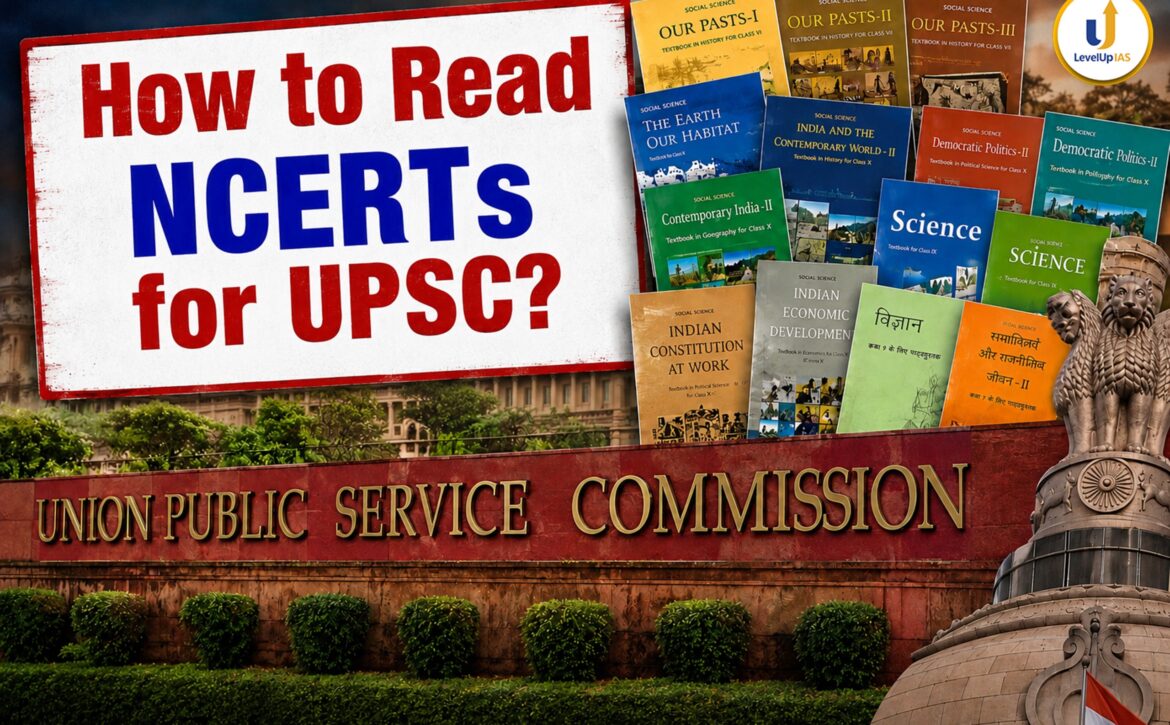
For every new aspirant, the first question is simple: How to read NCERTs for UPSC in the right way? NCERTs are the base of UPSC preparation. They help students understand basic concepts before moving to advanced books, current affairs, test series, and answer writing.
NCERTs are important for UPSC preparation for beginners because they build clarity. They help in Polity, History, Geography, Economy, Environment, Society, Science, and form the foundation of all GS Papers. Good NCERT notes for UPSC revise easy and help build a strong foundation for standard books.
This blog will explain how to read NCERTs for UPSC, how to make NCERT notes for UPSC, how to build GS Foundation basics, and how to start UPSC preparation for beginners simply.
Why NCERTs Are Important for UPSC Beginners
Before asking how to read NCERTs for the UPSC, students must understand why NCERTs matter. NCERTs are not just school books. They explain concepts in simple language. UPSC questions are often based on basic concepts, not just facts.
For UPSC preparation for beginners, NCERTs help in four ways:
- They build conceptual clarity.
- They help in understanding standard books.
- They improve basic language for Mains Answer Writing.
- They support Prelims Elimination Skills.
A student with strong GS Foundation basics can understand advanced topics faster. A student with weak GS Foundation basics may struggle even after reading big books.
This is why how to read NCERTs for UPSC is not only about reading books. It is about building a base. Proper NCERT notes for UPSC help students revise before Prelims and Mains.
Common Mistakes While Reading NCERTs
Many students start UPSC preparation for beginners with energy but without direction. They make some common mistakes while reading NCERTs.
The first mistake is reading every NCERT line by line without knowing the UPSC syllabus. To understand how to read NCERTs for UPSC, the syllabus must come first.
=>>>Read Our Latest UPSC Syllabus Blog<<<=
The second mistake is making very long NCERT notes for the UPSC. Notes should be short and revision-friendly. If your notes become bigger than the book, they will not help.
The third mistake is ignoring revision. Reading once is not enough. For strong GS Foundation basics, repeated revision is important.
The fourth mistake is reading NCERTs without linking them to PYQs. For UPSC preparation for beginners, previous year questions show what UPSC actually asks.
So, if you want to learn how to read NCERT for UPSC, follow this rule: syllabus first, NCERT second, notes third, revision fourth, PYQ fifth.
Step-by-Step Method: How to Read NCERTs for UPSC
The best way to understand how to read NCERTs for UPSC is to follow a simple 5-step method.
Step 1: Read the UPSC Syllabus First
Before opening NCERTs, read the UPSC Prelims and Mains syllabus. This helps you know what is important. For UPSC preparation for beginners, the syllabus gives direction.
=>>>Download Syllabus Here<<<=
Step 2: Read NCERTs for Concept Clarity
In the first reading, do not make detailed notes. Just understand the chapter. This step builds the GS foundation basics.
Step 3: Mark Important Areas
In the second reading, underline key terms, definitions, examples, timelines, maps, and basic concepts. This helps in making NCERT notes for UPSC.
Step 4: Make Short Notes
Your NCERT notes for UPSC should be short. Use headings, bullets, flowcharts, tables, and keywords. Do not copy full paragraphs.
Step 5: Revise and Solve PYQs
After reading, solve the previous year’s questions. This helps you understand how to read NCERTs for the UPSC from the UPSC exam point of view.
This method is useful for UPSC preparation for beginners and helps in building a strong GS Foundation.
Subject-Wise Strategy to Read NCERTs for UPSC
Now, let us understand how to read NCERTs for the UPSC subject-wise.
History NCERT Strategy
For History, students should read the latest NCERTs on Ancient, Medieval, Modern, and Art & Culture. In UPSC preparation for beginners, History NCERTs help in building timelines and basic understanding.
While reading History NCERTs, focus on:
- Important Events and Dates
- Chronology
- Causes and effects of Events
- Art, culture, architecture, religion and paintings,
- Freedom struggle themes
For NCERT notes for UPSC, make timeline-based notes. For example, make separate notes for Buddhism, Jainism, the Mauryan Empire, the Gupta Age, the Bhakti Movement, the Mughal period, British policies, and the freedom struggle.
For a strong GS foundation, History should not be memorised randomly. It should be understood through timeline, cause, effect, and continuity.
If a beginner asks how to read NCERTs for History, the answer is simple: read for chronology, concepts, and themes.
Geography NCERT Strategy
Geography NCERTs are very important for UPSC preparation for beginners. They explain physical geography, Indian geography, climate, resources, agriculture, and maps.
While reading Geography NCERTs, focus on:
- Diagrams and Maps
- Terms and Definitions
- Climate concepts
- Rivers, mountains, soils, minerals
- Agriculture and resources
For NCERT notes for UPSC in Geography, make diagram-based notes. Draw simple maps and flowcharts. UPSC often asks conceptual questions from Geography, so GS foundation basics must be clear.
To understand how to read NCERTs for UPSC for Geography, students must read slowly to understand complex concepts and revise maps regularly.
Geography is not only theory. It needs visual understanding. Good NCERT notes for UPSC should include maps, diagrams, and examples.
Polity NCERT Strategy
For Polity, NCERTs help students understand the Constitution, democracy, rights, Parliament, judiciary, local government, and political concepts.
For UPSC preparation for beginners, Polity NCERTs are important before reading standard books. They build GS Foundation basics in simple language.
While reading Polity NCERTs, focus on:
- Constitution basics
- Fundamental Rights
- Directive Principles
- Parliament
- Judiciary
- Federalism
- Local government
- Democracy and citizenship
For NCERT notes for Polity, write definitions in simple words. Make tables for Articles, institutions, and constitutional bodies.
If you are confused about how to read NCERTs for UPSC for Polity, remember this: focus on concepts and interlinkages, not just articles.
Strong GS Foundation basics in Polity help in Prelims, Mains GS Paper 2, Essay, and Interview.
Economy NCERT Strategy
Economy is difficult for many students in UPSC preparation. NCERTs make it easier. They explain basic ideas like GDP, money, banking, budget, poverty, development, and planning.
To understand how to read NCERTs for UPSC for Economy, students should focus on concepts, not data which is given in newspapers or Books randomly.
While reading Economy NCERTs, focus on:
- GDP and national income
- Money and banking
- Budget
- Inflation
- Poverty
- Employment
- Development
- Agriculture and industry.
Strong gs foundation basics in Economy help in understanding newspapers, budget, economic survey, and Mains answers.
For UPSC preparation for beginners, Economy NCERTs should not be skipped.
Environment NCERT Strategy
The Environment is important for both Prelims and Mains. Many students ask how to read NCERT for UPSC for Environment because the syllabus is broad.
For UPSC preparation for beginners, NCERTs help in understanding ecology, biodiversity, pollution, climate change, and natural resources.
While reading Environment-related NCERTs, focus on:
- Ecosystem
- Food chain
- Biodiversity
- Pollution
- Climate change
- Conservation
- Natural resources
- Sustainable development
For NCERT notes for Environment, make short definitions, examples, diagrams, and current affairs linkages.
The Environment requires strong GS Foundation basics because UPSC questions are often conceptual and application-based.
Science and Technology NCERT Strategy
Science NCERTs help students understand basic science. For UPSC preparation for beginners, Class 6 to 10 Science NCERTs are useful for basic clarity.
While reading Science NCERTs, focus on:
- Basic biology
- Human body
- Diseases
- Nutrition
- Physics basics
- Chemistry basics
- Everyday science
To learn how to read NCERTs for Science, avoid going too deep. UPSC does not need school-level technical detail everywhere. Focus on basic understanding and current relevance.
How to Make NCERT Notes for UPSC
Making NCERT notes for UPSC is more important than simply reading. Notes should help in revision, not create an extra burden.
Follow these rules:
- Keep notes short.
- Use bullets, not paragraphs.
- Write keywords.
- Add diagrams where needed.
- Make separate notes for Prelims facts and Mains concepts.
- Revise notes every week.
- Add PYQ references.
For UPSC preparation for beginners, notes should be simple. Do not make decorative notes. Do not copy the full book.
Good NCERT notes for UPSC should answer three questions:
- What is the concept?
- Why is it important for UPSC?
- How can it be revised quickly?
This is the practical way to learn how to read NCERTs for UPSC and build GS foundation basics.
Watch Full Video Here :=> How to Make Upsc Notes?
How Many Times Should You Read NCERTs?
For UPSC preparation for beginners, NCERTs should be read at least 2 to 3 times.
First reading: Understand the topic.
Second reading: Underline and make NCERT Notes for UPSC
Third reading: Revise and link with PYQs.
This is the best method for how to read ncerts for UPSC without wasting time.
Strong GS Foundation basics are not built in one reading. They need revision. Beginners should not rush NCERTs. A clear base saves time later.
How NCERTs Help in the GS Foundation Course

A GS Foundation course is useful when students want structured guidance. Many students begin UPSC preparation as beginners but do not know what to read, what to skip, and how to revise.
NCERTs are the first layer of GS basics. After NCERTs, students can move to standard books, current affairs, tests, and answer writing.
A good GS Foundation program helps students understand how to read NCERTs for UPSC, how to prepare NCERT notes for UPSC, and how to connect NCERTs with Prelims and Mains.
For beginners, guided preparation saves time. It also reduces confusion. UPSC is a long journey, and strong GS Foundation basics make the journey more manageable.
NCERTs for Prelims and Mains
NCERTs are useful for both Prelims and Mains.
For Prelims, your NCERT notes for UPSC should include facts, maps, terms, and definitions.
For Mains, your NCERT notes for UPSC should include concepts, flowcharts, diagrams, examples, causes, impacts, and solutions.
This is important for UPSC preparation for beginners because many students separate Prelims and Mains too early. NCERTs help in integrated preparation.
Final Tips for UPSC Beginners
Here are simple final tips on how to read NCERTs for UPSC:
- Read the syllabus before NCERTs.
- Do not read all NCERTs cover to cover.
- Make short NCERT notes for UPSC.
- Link NCERTs with PYQs.
- Do not ignore maps and diagrams.
- Build GS Foundation basics before advanced books.
- Follow a timetable and revision schedule.
NCERTs are not enough alone, but they are the base. Without strong GS foundation basics, students struggle in standard books and current affairs.
So, the right answer to how to read NCERTs for UPSC is simple: read with the syllabus, revise with notes, connect with PYQs, and build clarity.
Conclusion
NCERTs are the starting point of serious UPSC preparation. For UPSC preparation for beginners, they give direction and clarity. If students understand how to read NCERTs for the UPSC, they can build a strong base for the entire exam.
Good NCERT notes for UPSC help in quick revision. Strong GS Foundation basics help in Prelims, Mains, and Interview.
Beginners should not run behind too many books in the first stage. First complete NCERTs, understand the syllabus, prepare NCERT notes for UPSC, revise regularly, and then move to standard sources.
If you are starting your UPSC journey, focus first on GS Foundation basics. A strong foundation makes advanced preparation easier.
For structured UPSC preparation for beginners, join a GS Foundation program that teaches NCERTs, standard books, current affairs, test practice, and answer writing in an integrated way.
People Also Ask:-
1. How to read NCERTs for UPSC as a beginner?
Ans. To understand how to read NCERTs for the UPSC, start with the UPSC syllabus, read NCERTs subject-wise, make short notes, revise regularly, and solve PYQs. This is the best method for UPSC preparation for beginners.
2. Are NCERT notes for UPSC important?
Ans. Yes, NCERT notes for UPSC are important because they help in quick revision. Good NCERT notes for UPSC should be short, clear, and linked with Prelims and Mains.
3. Do NCERTs help in GS Foundation basics?
Ans. Yes, NCERTs are the base of GS Foundation basics. Without GS Foundation basics, students may find standard books difficult.
4. How many times should beginners read NCERTs?
Ans. For UPSC preparation for beginners, NCERTs should be read 2 to 3 times. First for understanding, second for making NCERT notes for UPSC, and third for revision.
5. Is NCERT enough for UPSC preparation?
Ans. NCERTs are not enough alone, but they are very important. They help students understand how to read NCERTs for UPSC, build GS foundation basics, and begin UPSC preparation for beginners in the right way.