AIR 49’s Brutally Honest UPSC Strategy Session | Tarun Kumar Yadav
1. Philosophy of Preparation (Integrated Approach)
The strategy shared by Tarun Kumar Yadav revolves around understanding UPSC as a single continuous process rather than three separate stages—Prelims, Mains, and Interview. An aspirant should integrate preparation in such a way that facts and concepts help in Prelims, analytical understanding supports Mains, and clarity of thought builds personality for the Interview. For example, while studying Polity from Laxmikanth, one should simultaneously focus on factual aspects like articles and amendments for Prelims, and analytical issues like federalism and governance for Mains.
2. Importance of PYQs and Smart Study Approach
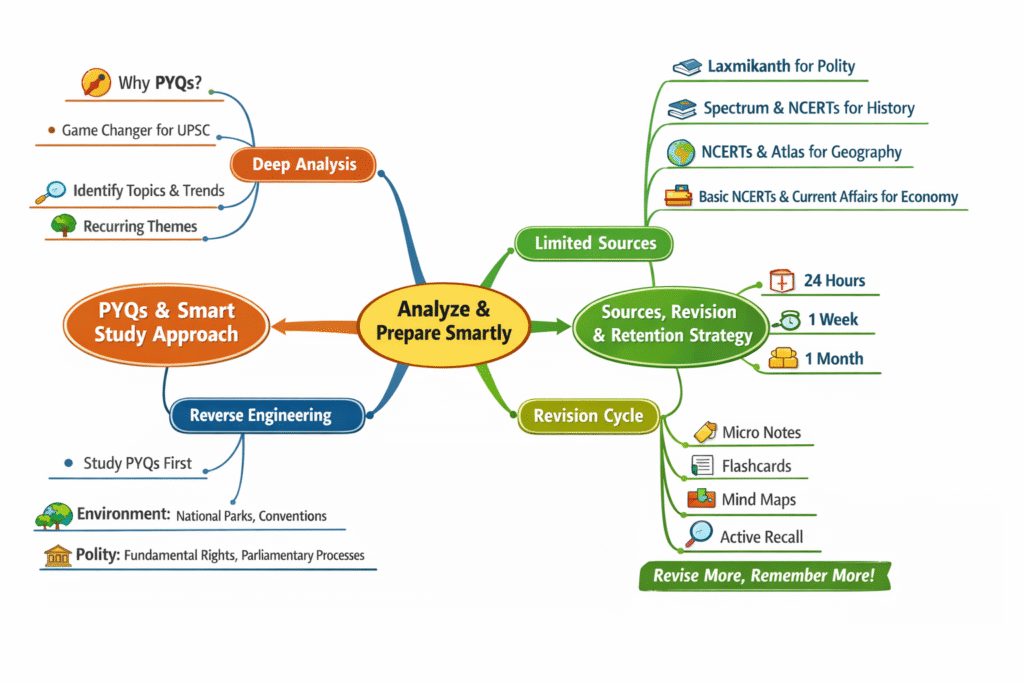
Previous Year Questions (PYQs) are considered a “game changer” because UPSC often repeats concepts, themes, and question patterns. Instead of just solving them, aspirants should analyze PYQs deeply by identifying topics, sub-topics, and recurring trends. For instance, Environment questions frequently revolve around national parks and conventions, while Polity focuses on fundamental rights and parliamentary processes. A reverse engineering approach—studying PYQs first and then preparing topics—helps in gaining direction and avoiding irrelevant content.
3. Sources, Revision & Retention Strategy
A key principle is “less sources, more revision.” Instead of referring to multiple books, aspirants should stick to limited standard sources like Laxmikanth for Polity, Spectrum and NCERTs for History, NCERTs and Atlas for Geography, and basic NCERTs with current affairs for Economy. Revision plays the most decisive role, as UPSC tests retention under pressure. A structured revision cycle—within 24 hours, one week, and one month—helps strengthen memory. Techniques like micro notes, flashcards, mind maps, and active recall ensure better retention. Ultimately, what is revised repeatedly is what stays in memory.
4. Mains Answer Writing & Essay Strategy
Answer writing should begin early, ideally after 2–3 months of basic preparation. A well-structured answer includes a short introduction, a multi-dimensional body (covering social, economic, political, and environmental aspects), and a forward-looking conclusion. Use of bullet points, subheadings, diagrams, flowcharts, and examples enhances quality. Essay writing, being a high-scoring area, requires clarity and structure rather than heavy vocabulary. A good essay flows with a narrative, starting with an engaging introduction, followed by a multi-dimensional analysis, and ending with an optimistic conclusion. It should not be reduced to a General Studies answer.
5. Prelims Strategy & Use of Technology
For Prelims, the preparation should focus around 60–70% on static subjects and 30–40% on current affairs. Daily MCQ practice (20–50 questions) and weekly mock tests are essential. Developing elimination techniques—such as removing extreme or partially incorrect options—helps improve accuracy. Aspirants should focus on accuracy rather than attempting excessive questions. Technology and AI can be used for concept clarity, answer evaluation, and note-making, but over-dependence should be avoided. It should act as an assistant, not a replacement for independent thinking.
6. Common Mistakes, Consistency & Final Strategy
Many aspirants make academic mistakes like ignoring PYQs, answer writing, and revision, along with strategic errors such as changing sources frequently and blindly following toppers. Psychological challenges like comparison, burnout, and inconsistency also hinder preparation. The key to success lies in consistency and discipline—studying 5–6 hours daily, setting weekly targets, and following revision cycles. UPSC is not just about intelligence or hard work; it requires smart work, patience, and consistency. The final strategy is to start with PYQs, use limited sources, revise multiple times, practice answer writing early, and integrate Prelims and Mains preparation. An ideal daily routine should include time for static subjects, current affairs, revision, and practice to maintain balance and effectiveness.
To know his strategy in detail, watch-AIR 49’s Brutally Honest UPSC Strategy Session | Tarun Kumar Yadav #upsctopper