
Mains Articles
Anglo-Mysore Wars, Modern History
Content
- Introduction
- Rise of Mysore
- Rise of Haidar Ali
- First Anglo-Mysore War
- Second Anglo-Mysore War
- Third Anglo-Mysore War
- Fourth Anglo-Mysore War
- Overall Assessment of Anglo-Mysore Wars
- Conclusion
- FAQs
Introduction
The Anglo-Mysore Wars represent a crucial phase in the consolidation of British power in India during the late eighteenth century. These wars were fought between the Kingdom of Mysore and the British East India Company, along with its Indian allies such as the Marathas and the Nizam of Hyderabad. Spread across four major conflicts between 1767 and 1799, the wars reflect the intense struggle for political and economic supremacy in South India.
The rise of Mysore under the dynamic leadership of Haidar Ali and Tipu Sultan transformed it into a formidable military power, capable of challenging British expansion. However, despite their resistance, the eventual defeat of Mysore marked a decisive turning point in the establishment of British dominance in the region.
Wodeyar Dynasty and the Rise of Mysore
The origins of Mysore’s rise can be traced back to the decline of the Vijayanagara Empire after the Battle of Talikota in 1565, which led to the emergence of several regional powers in South India. Among these, the Wodeyar dynasty established a Hindu kingdom in Mysore in 1612. Over time, however, the authority of the Wodeyar rulers weakened, particularly during the reign of Chikka Krishnaraja Wodeyar II, when real power came to be exercised by influential ministers such as Nanjaraj and Devaraj. This political instability created an opportunity for ambitious military leaders to assert control.
In the second half of the eighteenth century, Mysore witnessed a transformation under the leadership of Haidar Ali and later his son Tipu Sultan. They consolidated power, expanded territorial control, and built a strong military apparatus, which allowed Mysore to emerge as one of the most powerful states in South India.
Rise of Haidar Ali
Haidar Ali’s rise to power is a remarkable example of social mobility and military leadership in early modern India. Born in 1721 into a relatively humble family, he began his career as a soldier in the Mysore army. Despite lacking formal education, he possessed exceptional strategic insight, organisational ability, and determination. He gradually rose through the ranks and capitalised on the political weakness of the Wodeyar rulers to become the de facto ruler of Mysore by 1761.
Haidar Ali undertook significant military reforms that strengthened Mysore’s position. He recognised the importance of modern warfare and established an arms factory at Dindigul, where weapons were manufactured using techniques inspired by European models. He also sought French assistance to train his army, thereby introducing modern artillery and disciplined infantry formations. His military campaigns led to the expansion of Mysore’s territory, including regions such as Bednur, Sera, Hoskote, and Dod Ballapur. Although he faced setbacks against the Marathas, particularly under Peshwa Madhavrao, he later regained lost territories and consolidated his authority through a combination of military strength and diplomatic skill.
First Anglo-Mysore War (1767-1769)
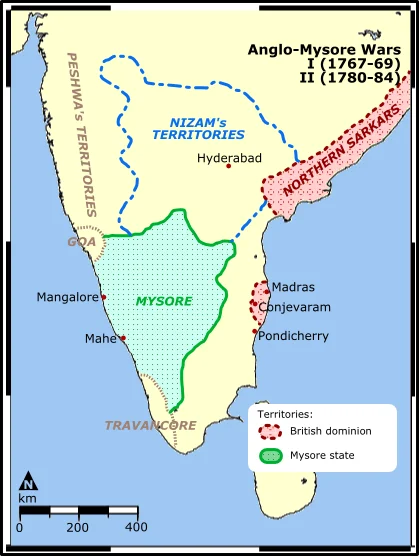
The First Anglo-Mysore War emerged in the context of growing British ambitions in South India following their success in Bengal. The British sought to expand their influence and entered into an alliance with the Nizam of Hyderabad in 1766, gaining control over the strategically important Northern Circars. This development led to the formation of a triple alliance comprising the British, the Nizam, and the Marathas against Haidar Ali.
However, Haidar Ali displayed remarkable diplomatic acumen in breaking this alliance. He succeeded in persuading the Nizam to join his side and ensured the neutrality of the Marathas through financial inducements. The war itself remained largely indecisive, with neither side able to secure a decisive victory. In a bold and unexpected move, Haidar Ali advanced rapidly and appeared at the gates of Madras, which created panic among the British authorities.
The war concluded with the Treaty of Madras in 1769. The terms of the treaty provided for the mutual restoration of conquered territories and the exchange of prisoners. Importantly, the British agreed to support Haidar Ali in the event of an external attack. The treaty demonstrated Mysore’s strength and exposed the limitations of British military power at that stage.
Second Anglo-Mysore War (1780-1784)
The Second Anglo-Mysore War was triggered primarily by British violation of the Treaty of Madras. The British failed to assist Haidar Ali when he was attacked by the Marathas in 1771, which deeply angered him. Additionally, the British capture of Mahe, a French settlement on the Malabar Coast that was crucial for Mysore’s access to French military supplies, was perceived by Haidar Ali as a direct threat.
In response, Haidar Ali formed a coalition with the Marathas and the Nizam and launched a powerful offensive against the British in the Carnatic region. He achieved significant early successes, including the capture of Arcot and a major victory over British forces at the Battle of Pollilur in 1780, which remains one of the worst defeats suffered by the British in India.
Despite these successes, the British, under the leadership of Sir Eyre Coote, managed to recover and weaken the alliance by detaching the Marathas and the Nizam from Haidar’s side. Haidar Ali continued the war until his death in 1782, after which his son Tipu Sultan took over the leadership. The prolonged conflict eventually ended with the Treaty of Mangalore in 1784. This treaty restored the status quo ante bellum, with both sides agreeing to return captured territories and prisoners. It is significant as one of the few instances where an Indian power negotiated with the British on equal terms.
Third Anglo-Mysore War (1789-1792)
The Third Anglo-Mysore War began as a result of tensions between Tipu Sultan and the state of Travancore, which was an ally of the British. Travancore had acquired certain territories that Tipu considered to be under his suzerainty, leading him to attack the state in 1789. This provided the British with a pretext to intervene.
The British, under Governor-General Lord Cornwallis, formed a strong alliance with the Marathas and the Nizam of Hyderabad. Although Tipu Sultan initially managed to resist the British forces, the combined strength of the allied forces eventually proved overwhelming. Cornwallis led a well-organised campaign, capturing key locations such as Bangalore and advancing towards the Mysorean capital of Seringapatam.
The war ended with the Treaty of Seringapatam in 1792. Under the terms of the treaty, Tipu Sultan was forced to cede nearly half of his territory, which was distributed among the British, the Marathas, and the Nizam. He was also required to pay a heavy war indemnity of three crore rupees and to send two of his sons as hostages to the British. This treaty marked a significant decline in Mysore’s power and a major step forward in British expansion.
Fourth Anglo-Mysore War (1798-1799)
The Fourth Anglo-Mysore War was the final and decisive conflict between Mysore and the British. After the Treaty of Seringapatam, Tipu Sultan made efforts to rebuild his strength and sought alliances with foreign powers, particularly France. His diplomatic contacts with France and other regions such as Afghanistan and Arabia alarmed the British, especially under the aggressive leadership of Governor-General Lord Wellesley.
Wellesley was determined to eliminate Tipu Sultan as a threat and sought to impose the Subsidiary Alliance system on Mysore. Tipu’s refusal to accept British dominance led to the outbreak of war. The British formed alliances with the Nizam, who had already accepted the Subsidiary Alliance, and the Marathas.
The British forces, led by General Harris and supported by Arthur Wellesley, advanced rapidly into Mysore. The campaign culminated in the siege and capture of Seringapatam in 1799. Tipu Sultan died defending his capital, marking the end of Mysore’s resistance.
Following the war, a portion of Mysore’s territory was annexed by the British, while the remaining areas were restored to the Wodeyar dynasty under British supervision through the Subsidiary Alliance. This effectively ended Mysore’s independence.
Overall Assessment of Anglo-Mysore Wars
The Anglo-Mysore Wars had far-reaching consequences for the political and economic landscape of India. From a military perspective, Mysore demonstrated significant innovation, particularly in the use of rocketry and modern artillery, which temporarily checked British expansion. However, the inability of Indian powers to maintain a united front ultimately weakened resistance against the British.
Politically, the defeat of Mysore removed one of the strongest obstacles to British expansion in South India. It also highlighted the growing dominance of the British East India Company and its ability to manipulate alliances with Indian states. Economically, the wars weakened Mysore through territorial losses and financial burdens, while the British gained access to valuable resources and trade routes.
The wars also had a lasting historical significance. Tipu Sultan emerged as a symbol of resistance against colonial rule, remembered for his courage, administrative reforms, and determination to preserve independence. At the same time, the Anglo-Mysore Wars laid the foundation for the consolidation of British imperial authority in India.
Conclusion
The Anglo-Mysore Wars represent a decisive chapter in India’s colonial history, illustrating both the strength of indigenous resistance and the strategic superiority of the British in alliance-building and resource mobilisation. While Haidar Ali and Tipu Sultan succeeded in challenging British authority for several decades, the eventual defeat of Mysore marked the beginning of unchallenged British dominance in South India and paved the way for further expansion across the Indian subcontinent.
FAQs
Q1. What were the Anglo-Mysore Wars?
The Anglo-Mysore Wars were a series of four conflicts fought between the East India Company and the Kingdom of Mysore in South India.
Q2. Who were the key leaders in these wars?
The main leaders of Mysore were Hyder Ali and Tipu Sultan, who resisted British expansion.
Q3. How many Anglo-Mysore Wars were fought?
There were four wars:
Fourth Anglo-Mysore War (1799)
First Anglo-Mysore War (1767–69)
Second Anglo-Mysore War (1780–84)
Third Anglo-Mysore War (1790–92)
Q4. What was the outcome of the Anglo-Mysore Wars?
The wars ended with the defeat of Mysore and the death of Tipu Sultan in 1799, leading to British dominance in South India.
Q5. Why were these wars significant?
They marked a major step in the expansion of British power and demonstrated strong resistance by Indian rulers against colonial forces.
Click on the question to see the Answers
Visit LevelUp IAS- Click Here
Related reads.
How to Read NCERTs for UPSC: Subject-Wise Strategy & Notes Making
22 Jun 2026 10 min
PSIR Topper's Answer Copies
22 Jun 2026 1 min
Sociology Optional PYQs (2009-2024)
22 Jun 2026 1 min
Philosophy Optional PYQs
22 Jun 2026 1 min
PSIR Optional PYQs
22 Jun 2026 1 min
History Optional PYQs (2009-2025) – Free PDF & Video
22 Jun 2026 1 min
Put it into practice
Reading is step one.
Turn what you've just read into exam-ready answers with mentor-led practice and our structured test series.