
Current Affairs
Mecca Defence Pact
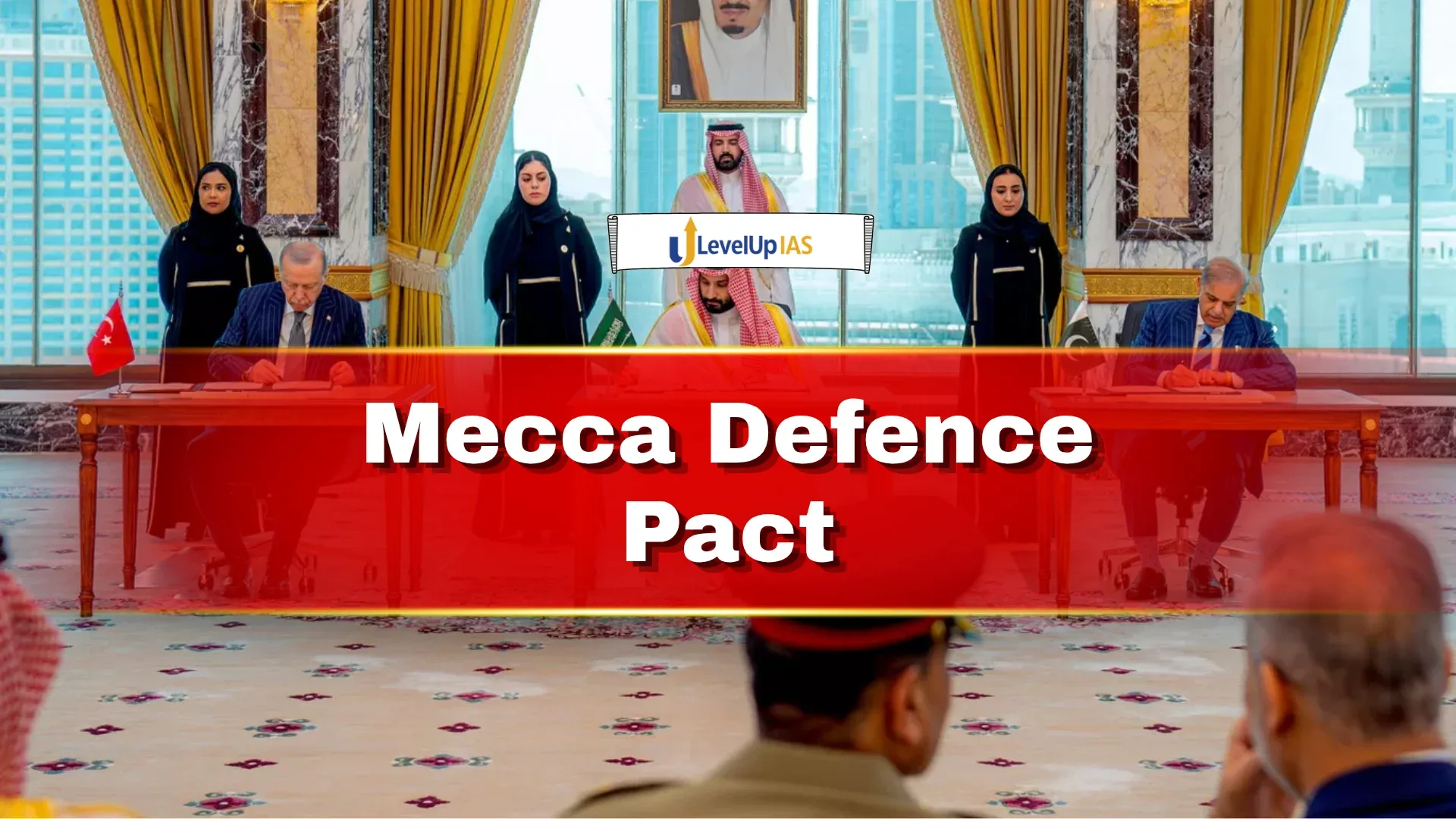
Why in News?
The Mecca Defence Pact, formally known as the Mecca Joint Defence Agreement, was signed by Saudi Arabia, Türkiye and Pakistan on 7 August 2026 in Mecca. The agreement seeks to institutionalise defence cooperation and strengthen collective deterrence among the three countries.
A key provision of the pact states that an armed attack against any one of the three members would be regarded as an attack against all three, making it significant for the evolving security architecture of West Asia and South Asia.
About the Mecca Defence Pact
The pact brings the existing defence relationships among Saudi Arabia, Türkiye and Pakistan under a broader trilateral security framework.
The three countries bring complementary strategic strengths:
- Saudi Arabia contributes financial resources, strategic influence and its crucial geographical position in the Gulf.
- Pakistan contributes military manpower, operational experience, nuclear capability and longstanding defence ties with Saudi Arabia.
- Türkiye contributes NATO experience and a rapidly expanding indigenous defence industry.
The agreement builds upon the Saudi-Pakistan Strategic Mutual Defence Agreement (SMDA) of September 2025.
However, the detailed text of the pact has not been made public, leaving uncertainty regarding the exact nature and extent of the mutual defence obligations.
Key Features
Collective Defence: The central provision is that an armed attack against one member would be treated as an attack against all members, creating a framework of mutual deterrence.
Enhanced Defence Cooperation: The agreement seeks greater cooperation in military affairs, defence capabilities and strategic planning.
Complementary Capabilities: The pact combines Saudi financial resources, Pakistani military expertise and Turkish defence technology, creating a potentially significant strategic partnership.
Defence-Industrial Cooperation: It could encourage cooperation in defence production, technology transfer and military-industrial development.
Regional Security Focus: The pact is primarily linked to the changing security environment in West Asia. Importantly, it does not explicitly identify India as an adversary.
Why was the Pact Signed?
The agreement reflects several overlapping strategic considerations.
Rising Regional Tensions: Conflicts and tensions involving Iran, Israel, the United States and regional armed groups have increased security uncertainties in West Asia. A collective framework can provide greater deterrence against external threats.
Saudi Arabia’s Strategic Autonomy: Riyadh has sought to diversify its strategic partnerships and reduce excessive dependence on any single external power. Closer defence relations with Türkiye and Pakistan support this broader pursuit of strategic autonomy.
Pakistan’s Strategic Value: Pakistan offers Saudi Arabia military manpower, operational experience and defence expertise, while the agreement strengthens Islamabad's strategic and economic relationship with Riyadh.
Türkiye’s Regional Ambitions: Türkiye is seeking a greater role in West Asian geopolitics. Its expanding indigenous defence industry also makes it an important partner for countries seeking to develop defence capabilities.
Defence-Industrial Development: Saudi Arabia can potentially benefit from Turkish defence technology and Pakistani military expertise as it seeks to strengthen its domestic defence-production capabilities.
Collective Deterrence: Mutual defence commitments increase the potential strategic cost for an external actor contemplating aggression against any member.
Is it a ‘NATO of the Muslim World’?
The collective-defence provision of the Mecca Pact has similarities with NATO’s Article 5, which treats an attack on one member as an attack on all. However, describing the Mecca Pact as a “NATO of the Muslim World” would be premature.
NATO has an integrated military command, permanent institutions, joint planning mechanisms and decades of operational experience. The Mecca Pact currently does not have a unified military command or a permanently deployed joint force.
Moreover, the strategic priorities of its members differ. Saudi Arabia primarily focuses on Gulf security, Türkiye has wider European and West Asian interests, while Pakistan's principal security concern remains India.
Therefore, the actual deterrence value of the pact will depend on how its members respond to a genuine security crisis rather than simply on the wording of the agreement.
Implications for India
The pact does not immediately alter India's military balance, but its institutionalisation could have implications for India's interests in South Asia and West Asia.
Pakistan’s Strategic Space: Stronger institutionalised defence relations with Saudi Arabia and Türkiye could increase Pakistan's diplomatic leverage and access to financial and defence resources.
India-Saudi Relations: India has developed strong partnerships with Saudi Arabia in energy, trade, investment and strategic cooperation. Greater Saudi security dependence on Pakistan could potentially introduce complications into this relationship.
West Asian Security Architecture: A closer Saudi-Pakistan-Türkiye grouping could influence the emerging regional security architecture, an area where India is seeking greater strategic engagement.
Energy and Maritime Security: India depends heavily on the Gulf and Red Sea regions for energy supplies, trade and maritime connectivity. Any instability arising from increased regional rivalries could therefore affect Indian interests.
Limited Immediate Impact on India-Pakistan Relations: Since the pact does not name India as an adversary and its detailed obligations remain undisclosed, it does not automatically imply Saudi or Turkish military intervention against India in a future India-Pakistan conflict.
Way Forward
India should adopt a strategy of strategic balancing and calibrated diplomacy rather than treating the pact as an immediate threat.
New Delhi should deepen its strategic partnership with Saudi Arabia in energy, trade, investment and defence, while simultaneously strengthening relations with other Gulf partners. India must also safeguard its energy security, maritime connectivity and the interests of its diaspora.
At the same time, India should closely monitor Pakistan-Türkiye defence cooperation and maintain strategic autonomy. Since the Mecca Pact does not explicitly target India, sustained diplomatic engagement remains more effective than an unnecessarily confrontational response.
Conclusion
The Mecca Defence Pact represents an important development in the evolving security architecture of West Asia, bringing together the financial strength of Saudi Arabia, military capabilities of Pakistan and defence-industrial expertise of Türkiye. However, its long-term significance will depend on the institutional mechanisms created and the manner in which the three countries implement their mutual defence commitments.
For India, the appropriate response is vigilance without alarm, strategic diversification and deeper engagement with the Gulf, while preserving its traditional policy of strategic autonomy.
Related reads.

Satkosia Tiger Reserve
23 Sep 2026 2 min

EU’s Carbon Border Adjustment Mechanism (CBAM)
22 Sep 2026 4 min
ASEAN: Association of Southeast Asian Nations
16 Sep 2026 6 min

National Food Security Act (NFSA), 2013
16 Sep 2026 6 min

Borophene
15 Sep 2026 3 min

WTO Agreement on Fisheries Subsidies
14 Sep 2026 3 min
Put it into practice
Reading is step one.
Turn what you've just read into exam-ready answers with mentor-led practice and our structured test series.