
Current Affairs
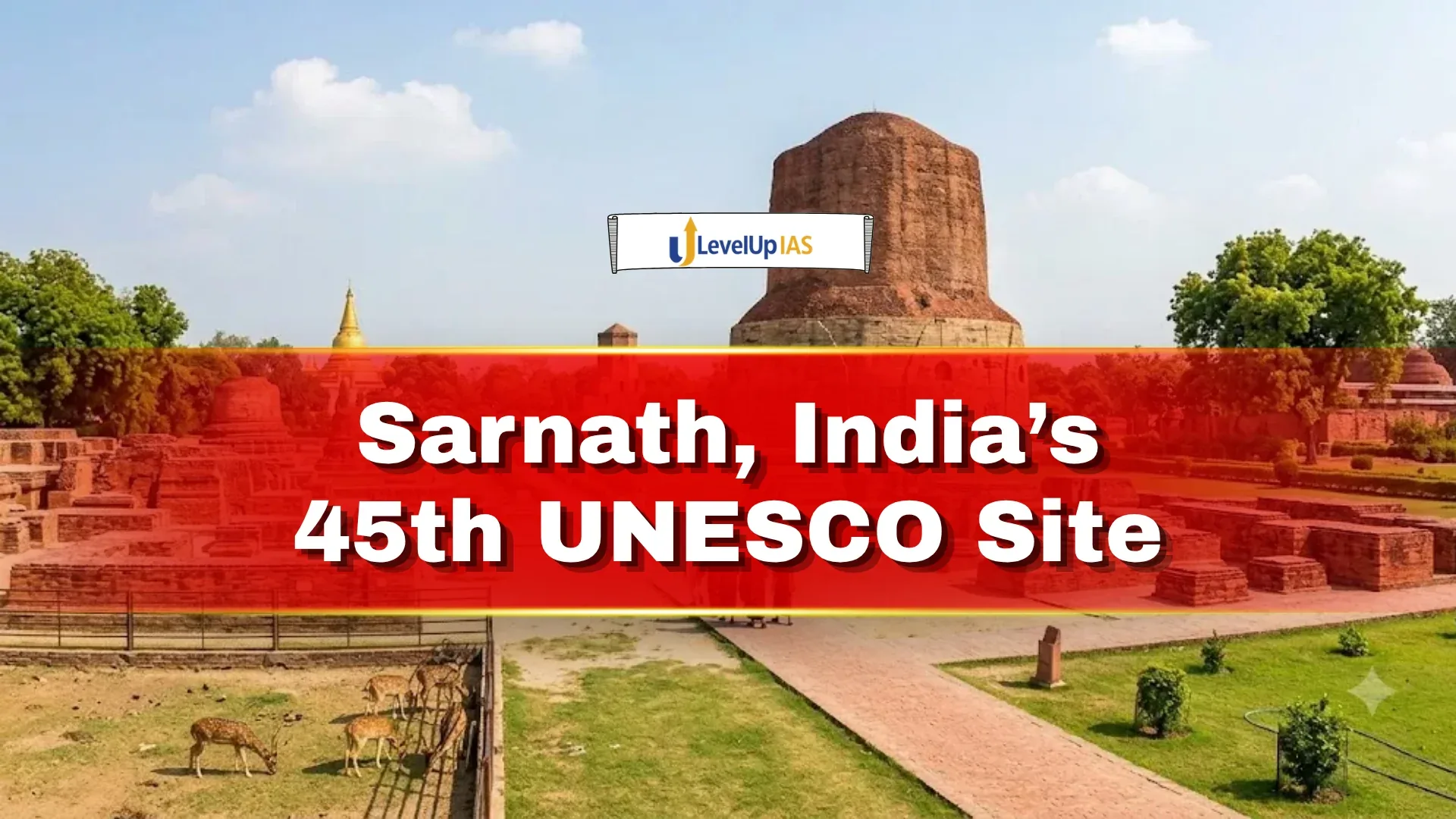
Sarnath, India’s 45th UNESCO Site
Why in News?
The Ancient Buddhist Site of Sarnath in Uttar Pradesh was inscribed on the UNESCO World Heritage List on 25 July 2026 during the 48th session of the World Heritage Committee held in Busan, South Korea. With this inscription, Sarnath became India’s 45th World Heritage property.
Sarnath had been on India’s UNESCO Tentative List since 1998, and its nomination was formally submitted for consideration in January 2025.
Introduction
Sarnath, located about 8 km from Varanasi in Uttar Pradesh, is one of the most important Buddhist pilgrimage and archaeological sites in the world. It is here that Gautama Buddha delivered his first sermon after attaining enlightenment, setting the Wheel of Dharma in motion and laying the foundation of the Buddhist Sangha.
The UNESCO inscription recognises Sarnath for its Outstanding Universal Value, particularly its association with the origins and spread of Buddhism and its remarkable archaeological remains. UNESCO has inscribed it under Criteria (iii) and (vi).
Historical Significance
Sarnath has a history spanning more than 2,500 years. In ancient times, it was known as Isipatana or Rishipattana, meaning the “place of sages.”
After attaining enlightenment at Bodh Gaya, Buddha travelled to Sarnath, where he delivered his first sermon, the Dhammacakkappavattana Sutta, to his five former companions. This event marked the beginning of the organised Buddhist monastic community or Sangha.
During the Mauryan period, Emperor Ashoka visited Sarnath and patronised Buddhism by constructing stupas, monasteries and the famous Ashokan Pillar. Sarnath subsequently flourished as an important centre of Buddhist learning and art, particularly during the Gupta period.
The site declined after the 12th century due to invasions and gradually fell into neglect. Archaeological excavations in the 19th century brought its monuments, sculptures and inscriptions to light.
Teachings of Buddha at Sarnath
The first sermon at Sarnath forms the philosophical foundation of Buddhism. Buddha explained the Four Noble Truths, which identify suffering, its cause, its cessation and the path leading to liberation.
He also taught the Noble Eightfold Path, comprising:
- Right View
- Right Intention
- Right Speech
- Right Action
- Right Livelihood
- Right Effort
- Right Mindfulness
- Right Concentration
The sermon also emphasised the Middle Path, avoiding both extreme luxury and severe self-mortification. Through these teachings, Sarnath became closely associated with Buddhist principles of compassion, non-violence, wisdom and ethical living.
Major Archaeological Remains
Sarnath contains important monuments representing different phases of Buddhist architecture and art.
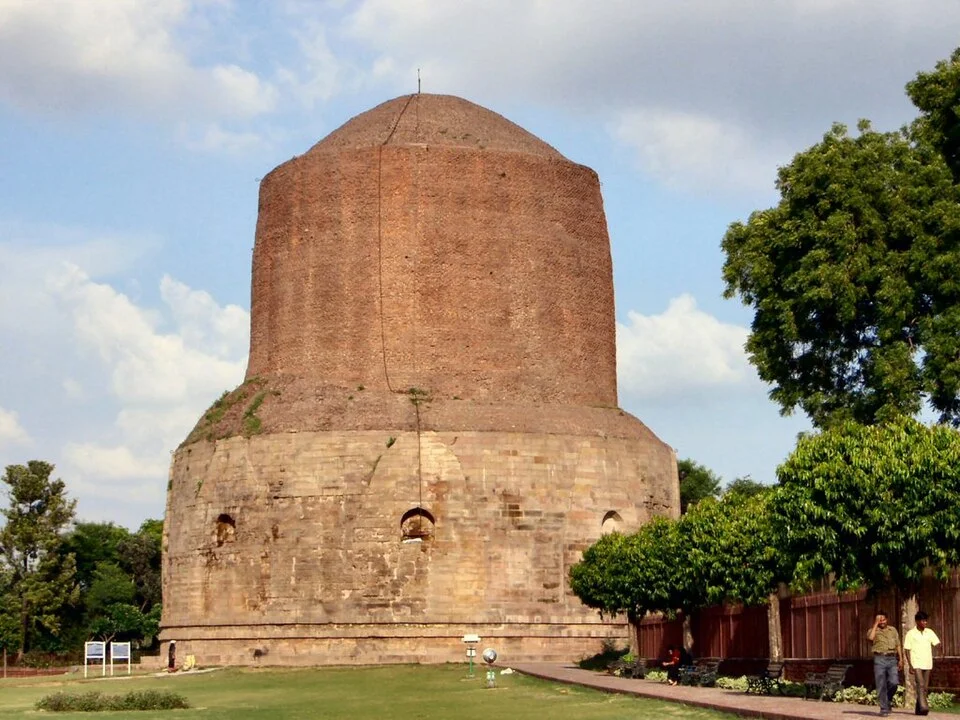
Dhamek Stupa: The most prominent monument at Sarnath, it commemorates Buddha’s first sermon. Its lower portion contains intricate carvings associated with the Gupta artistic tradition.
Chaukhandi Stupa: It marks the place where Buddha is believed to have met his first five disciples before delivering his first sermon. An octagonal Mughal-period tower was later added to it.
Ashokan Pillar: Erected during the reign of Emperor Ashoka, its famous Lion Capital is preserved in the Sarnath Archaeological Museum and serves as the National Emblem of India.
Dharmarajika Stupa: Traditionally associated with Ashokan patronage, it was built to enshrine Buddhist relics.
Monasteries and Viharas: Excavated remains demonstrate Sarnath’s importance as a centre of Buddhist education, monastic life and intellectual activity.
Sarnath Archaeological Museum: It houses important Buddhist sculptures, inscriptions and the Lion Capital of Ashoka.
Sarnath and the Spread of Buddhism
Sarnath played a crucial role in the institutionalisation and spread of Buddhism. The establishment of the first Sangha here transformed Buddha’s teachings into an organised religious tradition.
Over centuries, Sarnath emerged as a major centre of Buddhist learning and pilgrimage. Monks and scholars associated with the site contributed to the transmission of Buddhist ideas across Sri Lanka, China, Tibet, Myanmar, Thailand, Japan and Korea.
Chinese travellers such as Faxian and Xuanzang also recorded the importance and prosperity of Sarnath, providing valuable historical evidence about the site.
Sarnath also became renowned for its Gupta-period Buddhist sculptures, particularly its distinctive depiction of Buddha, which influenced Buddhist art across Asia.
UNESCO World Heritage Convention
The UNESCO World Heritage Convention, adopted in 1972, seeks to identify, protect and conserve cultural and natural heritage possessing Outstanding Universal Value.
World Heritage properties are classified as Cultural, Natural or Mixed sites and are inscribed on the basis of specific UNESCO selection criteria.
India ratified the Convention in 1977. With Sarnath’s inscription in 2026, India now has 45 World Heritage properties. UNESCO lists the Ancient Buddhist Site of Sarnath as a cultural property with a property area of 8.05 hectares and a buffer zone of 72.2 hectares.
Significance of the UNESCO Recognition
The recognition strengthens the global visibility of India’s Buddhist and civilisational heritage. It also places Sarnath alongside other major Buddhist World Heritage sites such as Bodh Gaya, Sanchi and Nalanda.
Beyond heritage conservation, the inscription can promote responsible cultural tourism, international Buddhist pilgrimage and greater awareness of India’s contribution to Asian intellectual and religious history.
Most importantly, Sarnath represents a heritage that extends beyond a physical monument. It symbolises the historical transmission of ideas of peace, compassion, wisdom and harmony from India to the wider world.
Related reads.

Satkosia Tiger Reserve
23 Sep 2026 2 min

EU’s Carbon Border Adjustment Mechanism (CBAM)
22 Sep 2026 4 min

ASEAN: Association of Southeast Asian Nations
16 Sep 2026 6 min

National Food Security Act (NFSA), 2013
16 Sep 2026 6 min

Borophene
15 Sep 2026 3 min

WTO Agreement on Fisheries Subsidies
14 Sep 2026 3 min
Put it into practice
Reading is step one.
Turn what you've just read into exam-ready answers with mentor-led practice and our structured test series.