
GS-III (Economy, S&T, Environment)
Ecological succession (primary & secondary)
Content
- Introduction
- Concept and Key Features
- Important Terminology in Succession
- Types of Ecological Succession
- Other Types of Succession
- Stages of Ecological Succession
- Causes of Ecological Succession
- Ecological Significance
- Conclusion
- FAQs
Introduction
Ecological Succession is the gradual and directional change in the species composition and structure of an ecological community over time. It is a fundamental ecological process through which ecosystems develop, mature, and stabilize. This process is not random but follows a definite sequence of stages, beginning from a bare or disturbed area and culminating in a stable and self-sustaining climax community.
Succession reflects how living organisms interact with their physical environment and modify it in such a way that it becomes suitable for subsequent communities. Thus, ecosystems are not static; they are dynamic systems constantly undergoing change and adaptation.
Concept and Key Features
Ecological succession involves both structural changes, such as variation in species composition, and functional changes, including energy flow, nutrient cycling, and biomass accumulation. The process is typically gradual and may take anywhere between 1 to 500 years, depending on environmental conditions and the type of succession.
One of the defining characteristics of succession is its directional nature, meaning that communities change in a predictable manner toward greater complexity and stability. Another important feature is that organisms themselves actively participate in modifying the environment, thereby influencing the course of succession.
Important Terminology in Succession
The process of succession is better understood through its key terms. It begins with a bare area, which refers to a habitat devoid of vegetation. Such areas may be classified based on moisture conditions into hydric (wet), xeric (dry), or mesic (moderate).
The first organisms to colonise this area are known as the pioneer community. These species are highly adaptable and capable of surviving in harsh conditions. As succession proceeds, a series of intermediate communities develop, known as seral communities, each representing a stage in ecological development.
The entire sequence of these communities is called a sere, which reflects the progressive replacement of species over time. Ultimately, succession culminates in the formation of a climax community, which is stable, self-perpetuating, and in equilibrium with the prevailing climate.
Types of Ecological Succession
Primary Succession
Primary succession occurs in areas that are completely devoid of life and soil, such as newly exposed rock surfaces, volcanic lava flows, or glacial retreats. Since there is no pre-existing soil, the process begins from the most primitive conditions and is therefore extremely slow.
The initial stage is marked by the colonisation of pioneer species such as lichens and algae. These organisms play a critical role in breaking down rocks through biological weathering and contributing organic matter, which gradually leads to soil formation. As soil depth and fertility improve, grasses and small plants begin to grow, followed by shrubs and eventually trees.
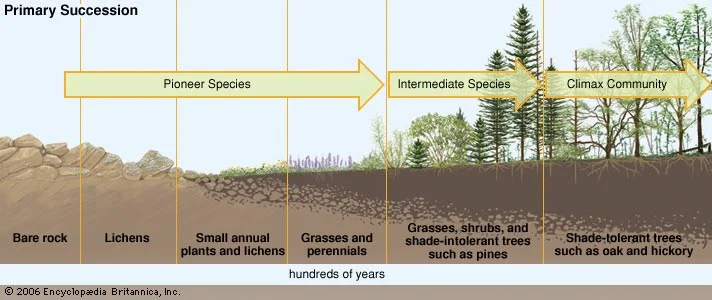
Depending on environmental conditions, primary succession may proceed as hydrarch succession in aquatic environments like ponds and lakes, or xerarch succession in dry habitats such as deserts and rocky terrains. Over time, the ecosystem becomes increasingly complex, supporting a diverse range of plant and animal species, and ultimately reaches a climax community.
Secondary Succession
Secondary succession takes place in areas where vegetation previously existed but has been destroyed due to disturbances such as wildfires, floods, storms, or human activities like deforestation and agriculture. Unlike primary succession, the soil in such areas remains intact and often contains seeds, roots, and microorganisms.
Because of the presence of pre-existing soil and biological components, secondary succession proceeds at a much faster rate. The process typically begins with fast-growing grasses and herbaceous plants, followed by shrubs and trees. Over time, if the area is left undisturbed, it gradually returns to a stable climax community similar to the original ecosystem.
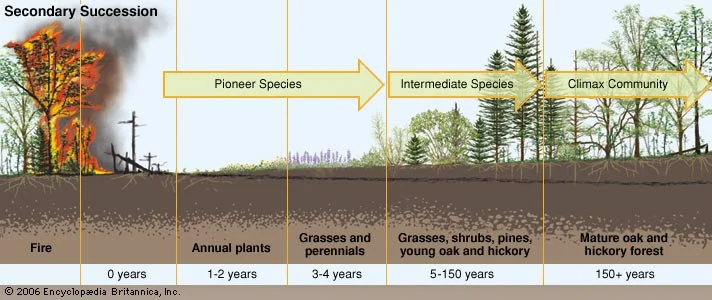
Secondary succession highlights the resilience of ecosystems and their ability to recover from disturbances while restoring ecological balance.
Examples of Ecological Succession
Ecological succession can be observed in various natural settings. Coral reefs develop from small coral colonies into complex ecosystems over time. Tropical forests regenerate through secondary succession after deforestation. Similarly, areas affected by wildfires, such as forests in Acadia National Park, demonstrate how ecosystems recover and transition through different stages before reaching stability.
Other Types of Succession
Ecological succession can also be classified based on the factors driving it and the direction of change.
- In autogenic succession, changes in the ecosystem are brought about by the organisms themselves, such as through shading or accumulation of organic matter. In Contract, Allogenic succession is driven by external environmental factors like floods, fires, or climatic shifts.
- Succession may also be progressive, where there is an increase in biomass, biodiversity, and ecological complexity, or retrogressive, where environmental degradation leads to simplification of the ecosystem.
- Additionally, succession can be directional, showing a consistent trend over time, or cyclic, where communities undergo repeated changes without reaching a stable climax.
Stages of Ecological Succession
The process of ecological succession unfolds through several well-defined stages. It begins with nudation, which involves the formation of a bare area due to climatic, topographic, or biotic factors. This is followed by invasion, during which species migrate into the area, establish themselves through a process called ecesis, and increase in population through aggregation.
As populations grow, competition and coaction occur among species for limited resources such as light, water, and nutrients. This leads to the dominance of more competitive species. Subsequently, in the reaction stage, organisms modify the environment by altering soil composition, moisture levels, and temperature, making it suitable for new species while rendering it less favourable for earlier ones.
Finally, the process culminates in stabilization, where a climax community is established. This community remains relatively stable and self-sustaining as long as environmental conditions remain unchanged.
Causes of Ecological Succession
Ecological succession is driven by a combination of factors that can be broadly classified into initiating, continuing, and stabilizing causes.
- Initiating causes include factors such as erosion, deposition, fire, and human activities that create bare areas.
- Continuing causes involve processes like migration, competition, and environmental modification that drive changes in species composition.
- Stabilizing causes, primarily climate, determine the nature of the climax community and maintain ecosystem stability.
Ecological Significance
Ecological succession plays a crucial role in maintaining ecological balance and supporting biodiversity. It contributes to soil formation, nutrient cycling, and the development of habitats for various organisms. It also enhances the resilience of ecosystems by enabling them to recover from disturbances and adapt to changing environmental conditions.
Furthermore, succession is important in the context of environmental conservation and climate change mitigation, as it supports processes such as carbon sequestration and ecosystem restoration.
Conclusion
Ecological succession is a fundamental ecological process that explains how ecosystems originate, develop, and achieve stability. The distinction between primary and secondary succession highlights the varying pathways through which ecosystems evolve under different conditions.
A thorough understanding of succession is essential for addressing contemporary environmental challenges, including habitat degradation, biodiversity loss, and climate change.
FAQs
Q1. What is ecological succession?
Ecological succession is the natural process by which different communities of organisms replace one another over time in an ecosystem.
Q2. What is primary succession?
Primary succession occurs on bare surfaces where no life existed before, such as after volcanic eruptions or glacial retreat. It begins with pioneer species like lichens and mosses.
Q3. What is secondary succession?
Secondary succession occurs in areas where life previously existed but was disturbed (e.g., forest fires, floods). It progresses faster due to the presence of soil and organic matter.
Q4. What are the stages of ecological succession?
The main stages include:
Climax community (stable, mature ecosystem)
Pioneer stage (initial colonisers)
Intermediate stages (grasses, shrubs, small trees)
Q5. What is the difference between primary and secondary succession?
Primary succession starts from bare rock with no soil, while secondary succession starts on existing soil after disturbance, making it faster.
Click on the question to see the Answers
Visit LevelUp IAS- Click Here
Related reads.

Inflation and its Types, GS 3
21 Aug 2026 8 min
Daily Current Affairs & Important Editorials
25 Apr 2026 3 min
Environment & Ecology Module for Prelims 2026
25 Apr 2026 9 min
PSIR Optional Foundation Batch 2027
25 Apr 2026 9 min
Strategy For Political Science & International Relation (PSIR)
25 Apr 2026 1 min
Government Bidget Economic Survey
25 Apr 2026 1 min
Put it into practice
Reading is step one.
Turn what you've just read into exam-ready answers with mentor-led practice and our structured test series.