Rajput Period, Medieval History
Content
- Introduction
- Origin and Evolution of the Rajputs
- Political Structure and Nature of Rule
- Major Rajput Dynasties
- Society and Culture
- Literature and Intellectual Developments
- Decline of Rajput Powers
- Conclusion
- FAQs
Introduction
The Rajput Period refers to the phase in early medieval Indian history (approximately 6th to 12th century CE) when numerous Rajput clans emerged as dominant political powers across northern, western, and central India. The term “Rajput” is derived from Rajaputra, meaning “son of a king”, indicating their claim to royal lineage and warrior status. This period is marked by feudal polity, valor-centric culture, regional kingdoms, and continuous military conflicts, especially against invading forces.
Origin and Evolution of the Rajputs
The origin of the Rajputs remains a debated subject in historiography, as it combines mythological traditions, literary evidence, and socio-political developments. Rather than a sudden emergence, the Rajputs evolved gradually between the 6th and 9th centuries as a distinct warrior aristocracy.
One prominent explanation is the Kshatriya lineage theory, which asserts that Rajputs were descendants of ancient Kshatriyas mentioned in Vedic texts and epics. They associated themselves with prestigious lineages like the Suryavanshi (Solar) and Chandravanshi (Lunar) dynasties, thereby legitimising their political authority.
Another widely known explanation is the Agnikula theory, mentioned in the work Prithviraj Raso by Chand Bardai. According to this tradition, major Rajput clans such as the Parmars, Chauhans, Pratiharas, and Chalukyas originated from a sacrificial fire pit at Mount Abu. Though largely symbolic, this narrative strengthened clan identity and social prestige.
Modern historians tend to accept the assimilation theory, which suggests that several foreign tribes like the Sakas, Kushanas, Hunas, and Gurjaras entered India and gradually integrated into the Hindu social order. Through Brahmanical rituals and political power, they were absorbed into the Kshatriya fold and later identified as Rajputs. This indicates that Rajput identity was more socio-political than purely racial.
Political Structure and Nature of Rule
The political system during the Rajput period was predominantly feudal and decentralised. Power was distributed among various clans and local chiefs, who held land in return for military service. Kingdoms were divided into jagirs, administered by feudal lords known as jagirdars.
While this system ensured local autonomy and loyalty, it also resulted in constant inter-clan conflicts and political fragmentation. Unlike earlier empires like the Guptas, there was no strong central authority, which made Rajput states vulnerable to external invasions.
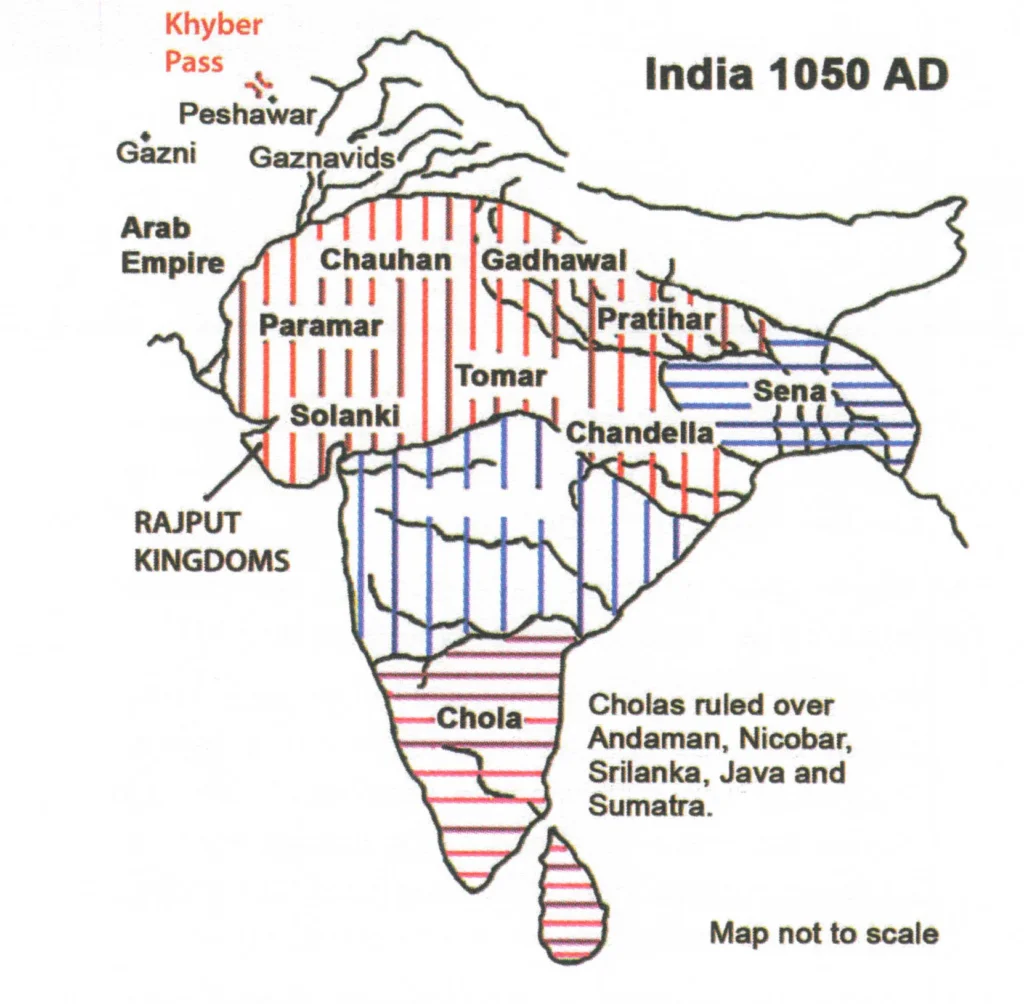
Major Rajput Dynasties and Kingdoms
The Rajput period witnessed the emergence of multiple regional kingdoms across northern and central India. These dynasties were politically independent, often engaged in warfare with each other, yet collectively represented the dominant ruling elite of early medieval India. A detailed understanding of these dynasties is crucial for UPSC preparation, especially for mapping political developments, cultural contributions, and the eventual decline of Rajput power.
1. Hindushahi Dynasty (North-West Frontier)
The Hindushahi dynasty ruled over parts of present-day Afghanistan and Punjab and acted as a buffer state against invasions from Central Asia. This dynasty is important because it was among the first to face repeated Islamic invasions.
The rule of Jayapala marked the beginning of Rajput dominance in this region. He resisted invasions by Mahmud of Ghazni but suffered defeat in 1001 CE. His decision to immolate himself after defeat reflects the Rajput code of honour.
His successor, Anandapala, continued resistance and fought the Battle of Waihind (1008 CE), but the dynasty gradually weakened. The last ruler, Bhimpala, marked the end of this line by the early 11th century.
This dynasty symbolises the early resistance of Indian powers to Turkish invasions, though it eventually succumbed due to military and strategic disadvantages.
2. Chauhan (Chahamana) Dynasty
The Chauhans were one of the most prominent Rajput dynasties, ruling over eastern Rajasthan and later expanding into Delhi and surrounding regions. Their capital was Ajmer.
Founded by Simharaj, the dynasty reached its zenith under Prithviraj Chauhan. He is celebrated for his military prowess and resistance against Muhammad of Ghori.
The First Battle of Tarain (1191 CE) demonstrated Rajput strength, where Prithviraj defeated Ghori. However, the Second Battle of Tarain (1192 CE) resulted in his defeat, which marked a decisive shift in Indian history, leading to the establishment of Turkish rule in North India.
The Chauhans represent the last major line of defence against Turkish conquest, and their fall opened the gates for the Delhi Sultanate.
3. Solanki (Chalukya) Dynasty of Gujarat
The Solanki dynasty ruled Gujarat from its capital at Anhilwara (modern Patan). It was founded by Mulraj I and became a powerful regional kingdom.
This dynasty is notable for its economic prosperity and maritime trade, making Gujarat a thriving commercial hub. The rulers were patrons of both Hinduism and Jainism, fostering religious harmony.
The period saw remarkable advancements in temple architecture, especially intricate stone carvings and structural innovations.
The Solankis highlight the economic and cultural prosperity of western India during the Rajput period and the role of trade in strengthening regional kingdoms.
4. Paramara Dynasty (Malwa Region)
The Paramaras ruled the Malwa region with capitals at Dhar and Ujjain. The most illustrious ruler was Raja Bhoja.
Raja Bhoja is remembered as a scholar-king, who promoted literature, science, and architecture. He established the Bhojshala, a centre of Sanskrit learning, and founded the city of Bhojpur.
The Paramaras were strong patrons of Shaivism but also supported Jain scholars, indicating cultural inclusivity.
The dynasty represents the intellectual and cultural zenith of Rajput rule, where governance was combined with scholarship.
5. Chandela Dynasty (Bundelkhand Region)
The Chandelas ruled Bundelkhand with Mahoba as their capital. They are best known for constructing the world-famous Khajuraho temples, which are masterpieces of Indian art and architecture.
These temples depict both religious and secular themes, reflecting religious tolerance and social life of the time. The dynasty patronised both Shaiva and Vaishnava traditions.
However, repeated invasions weakened their power, and they were eventually defeated by Delhi Sultanate forces.
The Chandelas contributed immensely to Indian architecture and cultural heritage, making them one of the most artistically significant Rajput dynasties.
6. Gahadavala Dynasty (Kannauj Region)
The Gahadavalas ruled the strategically important region of Kannauj, which had been a centre of power since ancient times.
The most notable ruler, Jayachandra, is often remembered in popular narratives for his rivalry with Prithviraj Chauhan. However, historically, he was a powerful ruler who defended his kingdom against external threats.
He was eventually defeated and killed by Qutb al-Din Aibak in the Battle of Chandawar (1194 CE), marking the decline of Rajput power in the Gangetic plains.
The fall of this dynasty symbolises the collapse of major Rajput resistance in North India.
7. Tomara Dynasty (Delhi Region)
The Tomaras were among the early rulers of Delhi. Their most notable ruler, Anangapala, is credited with founding the city of Dhillika (Delhi).
Later, Delhi came under the control of the Chauhans, and the Tomaras became their feudatories. Eventually, Turkish invasions ended their rule.
The Tomaras laid the foundation for Delhi as a major political centre, which later became the capital of successive empires.
8. Bundela Dynasty (Later Phase)
The Bundelas ruled Bundelkhand in the later medieval period, with Orchha as their capital. They often resisted Mughal authority but also entered into alliances when necessary.
Though not part of the early Rajput phase, they represent the continuity of Rajput political influence into the Mughal era.
The Bundelas demonstrate how Rajput power adapted to changing political conditions, balancing resistance and cooperation.
Society and Culture under the Rajputs
Rajput society was deeply rooted in hierarchy, honour, and martial traditions. Warfare was considered the primary occupation, and values like bravery, loyalty, and sacrifice were central to their identity. Practices such as Jauhar (mass self-immolation) and Sati reflected extreme notions of honour and social customs of the time.
Religion played a significant role in shaping society. The Rajputs were staunch followers of Hinduism, particularly Shaivism and Vaishnavism, but they also extended patronage to Jainism and Buddhism, indicating a degree of religious tolerance. The rise of the Bhakti movement during this period brought devotional practices into prominence and influenced both elite and common populations.
Temples functioned not only as places of worship but also as centres of education, culture, and economic activity. This led to the flourishing of temple architecture and sculpture.
Literature and Intellectual Developments
The Rajput period witnessed significant contributions to literature, philosophy, and science. Works such as Rajatarangini by Kalhana provide valuable historical insights into regional politics and society.
Similarly, Gita Govindam by Jayadeva reflects the devotional traditions of the Bhakti movement. Texts like Kathasaritsagara by Somadeva preserved folklore and cultural narratives.
Scientific and mathematical advancements were also evident in works like Siddhanta Shiromani by Bhaskara II, highlighting intellectual growth during this period.
Decline of Rajput Power
The decline of the Rajputs was not sudden but gradual. Internal weaknesses such as political fragmentation, lack of unity, and feudal rivalries weakened their collective strength. These divisions made it easier for external forces to defeat them individually.
The repeated invasions by Turkish rulers, especially after the defeat in the Second Battle of Tarain, accelerated their decline. The establishment of the Delhi Sultanate marked the end of Rajput political dominance in northern India, although many Rajput states continued to exist as regional powers.
Conclusion
The Rajput Period represents a significant phase in Indian history characterised by regional kingdoms, feudal polity, and a strong martial ethos. While their political fragmentation limited their ability to resist foreign invasions, their contributions to culture, architecture, literature, and social traditions remain enduring.
FAQs
Q1. What is the Rajput Period in Indian history?
The Rajput Period refers to the phase when various Rajput clans ruled northern and western India after the decline of earlier empires.
Q2. Which were the major Rajput dynasties?
Important dynasties included the Chauhans, Pratiharas, Paramaras, Tomaras and Solankis.
Q3. What were the main features of Rajput polity?
Rajput polity was characterised by feudal structure, decentralised administration, clan-based loyalty, and frequent warfare among kingdoms.
Q4. What was the socio-cultural life during the Rajput Period?
It saw the growth of temple architecture, patronage of art and literature, and the development of a strong warrior ethos and honour code (Rajputana tradition).
Q5. What led to the decline of Rajput power?
The decline was due to internal conflicts, lack of unity, and invasions by Turkic forces, particularly after the Second Battle of Tarain.
Click on the question to see the Answers
Visit LevelUp IAS- Click Here