
Mains Articles
Relief of the Ocean Floor, Oceanography UPSC
Content
- Introduction
- Evolution of Ocean Relief
- Major Ocean Relief Features
- Minor Ocean Relief Features
- Other Ocean Relief Features
- Conclusion
- FAQs
Introduction
The ocean floor represents one of the most complex and least explored physiographic divisions of the Earth. Contrary to earlier assumptions of it being a flat and featureless expanse, modern oceanographic studies reveal that the seafloor is highly diversified, comprising mountains, ridges, plains, trenches, plateaus, and volcanic structures.
These features are the result of long-term geological processes operating over millions of years. The study of ocean floor relief is crucial for understanding plate tectonics, marine ecosystems, mineral resources, and the evolution of Earth’s lithosphere.
Genesis and Evolution of Ocean Relief
The relief of the ocean floor is shaped by the combined action of endogenic (internal) and exogenic (external) forces. Among the endogenic forces, tectonic activity plays a dominant role. Processes such as seafloor spreading at divergent plate boundaries, subduction at convergent boundaries, and transform faulting are responsible for the formation of major structural features like mid-ocean ridges, trenches, and fracture zones. Volcanic activity further contributes to the formation of seamounts, guyots, and island arcs.
Exogenic processes also play a significant role in modifying ocean relief. Rivers transport sediments from continents, which are deposited along continental margins and deep ocean basins. Turbidity currents, underwater density flows, carry sediments to great depths, forming continental rises and abyssal plains. Additionally, marine erosion, chemical deposition, and biological processes (such as coral growth) continuously reshape the ocean floor. Thus, the oceanic landscape is dynamic, reflecting the interplay between constructive and destructive forces.
Classification of Ocean Relief Features
Ocean relief features are broadly classified into major features, which form the primary physiographic divisions, and minor features, which are comparatively smaller but equally significant in understanding oceanic processes.
Major Ocean Relief Features
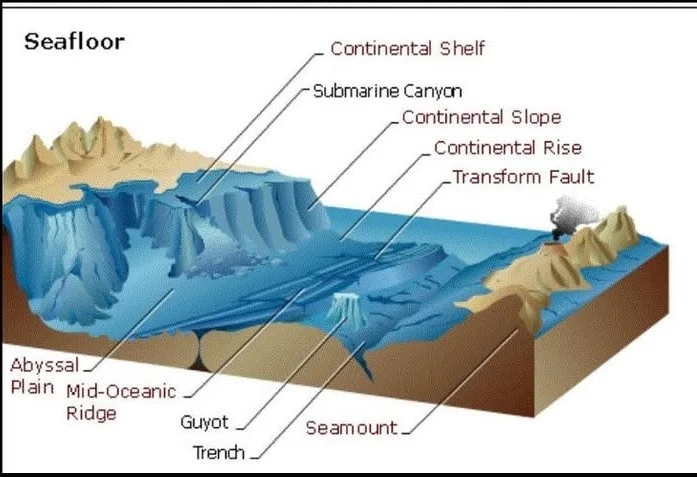
1. Continental Shelf
The continental shelf is the submerged extension of the continental landmass and forms the shallowest part of the ocean floor. As per the United Nations Convention on the Law of the Sea, it extends up to 200 nautical miles from the baseline or to the edge of the continental margin.
This region is characterised by a very gentle slope, generally less than 1°, and shallow depths ranging between 100 and 200 metres. The width of the continental shelf varies significantly, from narrow margins along tectonically active coasts to very wide shelves in stable regions. For instance, shelves are almost absent along subduction zones but are extensive in regions like the Arctic Ocean. The Siberian Shelf is the largest continental shelf in the world.
The continental shelf is economically and ecologically significant. It contains thick sedimentary deposits rich in hydrocarbons such as petroleum and natural gas. Moreover, it supports rich marine biodiversity and is the primary zone for fishing activities. Its formation is attributed to a combination of marine transgressions, sediment deposition, and tectonic subsidence.
2. Continental Slope
The continental slope marks the transition between the shallow continental shelf and the deep ocean basin. It represents the true edge of the continent and is characterised by a relatively steep gradient ranging from 2° to 5°. This region is often dissected by submarine canyons, which act as conduits for sediment transport from the continental shelf to deeper parts of the ocean.
The continental slope is geologically active and frequently associated with tectonic movements, earthquakes, and landslides. It signifies a major boundary in oceanic morphology, separating the continental crust from the oceanic crust.
3. Continental Rise
The continental rise is a depositional feature located at the base of the continental slope. It is formed by the accumulation of sediments transported from the continents through turbidity currents and underwater landslides. These sediments gradually build up to form a gently sloping surface, connecting the continental slope with the abyssal plains.
The slope of the continental rise is much gentler compared to the continental slope, typically ranging between 1:50 and 1:500. This region acts as a major sedimentary basin and provides valuable information about past climatic and geological conditions.
4. Abyssal Plains (Deep Sea Plains)
Abyssal plains are among the flattest and most extensive features on Earth’s surface. Located at depths ranging from 3,000 to 6,000 metres, they cover nearly 40% of the ocean floor. These plains are formed by the deposition of fine sediments such as clay, silt, and microscopic organic remains, which gradually bury the irregular topography of the ocean basin.
Despite their apparent uniformity, abyssal plains may contain features such as abyssal hills and hydrothermal vents. Their vast extent and smoothness make them important for studying sedimentation processes and oceanic circulation patterns.
5. Oceanic Trenches (Deeps)
Oceanic trenches are the deepest parts of the ocean and represent zones of intense tectonic activity. They are long, narrow, and steep-sided depressions formed at convergent plate boundaries where one tectonic plate is subducted beneath another.
These trenches are often associated with volcanic activity and earthquakes, forming part of the “Ring of Fire” in the Pacific Ocean. The deepest known trench is the Mariana Trench, which reaches depths of over 11,000 metres. Trenches are crucial for understanding plate tectonics, crustal recycling, and seismic activity.
Minor Ocean Relief Features
1. Mid-Oceanic Ridges
Mid-ocean ridges are continuous underwater mountain chains extending across all major oceans. They are formed at divergent plate boundaries where tectonic plates move apart, allowing magma to rise and solidify to form new oceanic crust.
These ridges typically consist of two parallel mountain chains separated by a central rift valley. The Mid-Atlantic Ridge is a classic example, parts of which emerge above sea level in Iceland. These ridges are key evidence for seafloor spreading and play a central role in the theory of plate tectonics.
2. Seamounts and Guyots
Seamounts are isolated submarine volcanic mountains rising more than 1,000 metres above the ocean floor. When these mountains undergo erosion and subsidence, their peaks become flat, forming structures known as guyots.
These features are significant indicators of volcanic activity and plate movement. They also serve as important habitats for marine organisms and help scientists trace the movement of tectonic plates over geological time.
3. Submarine Canyons
Submarine canyons are deep, narrow valleys that cut across continental shelves and slopes. They are often extensions of river valleys and are formed through processes such as erosion, turbidity currents, and mass wasting.
These canyons play a vital role in transporting sediments from continental regions to the deep sea and influence oceanic circulation patterns.
4. Atolls
Atolls are ring-shaped coral reefs enclosing a central lagoon, typically found in tropical oceans. They form through the growth of coral reefs around sinking volcanic islands, a process explained by Darwin’s theory of coral reef formation.
Atolls are ecologically significant and provide insights into sea-level changes, coral ecology, and subsidence processes.
Other Ocean Relief Features
Volcanic island arcs are chains of volcanic islands formed along subduction zones, such as those in Japan and Indonesia. Fracture zones are linear features associated with transform faults, reflecting lateral movement of tectonic plates. Abyssal hills are small elevations found on abyssal plains, indicating variations in seafloor spreading.
Banks are flat-topped elevations found on continental shelves and are often rich in fishing resources. Hydrothermal vents are openings on the ocean floor that emit mineral-rich hot water and support unique ecosystems independent of sunlight, highlighting the diversity of oceanic environments.
Conclusion
The relief of the ocean floor is a product of dynamic geological processes that operate over vast spatial and temporal scales. It reflects the interaction of tectonic forces, volcanic activity, and sedimentary processes. Understanding these features is essential not only for academic purposes but also for resource exploration, environmental conservation, and disaster management. The ocean floor, therefore, serves as a crucial key to decoding Earth’s geological past and anticipating its future changes.
FAQs
Q1. What is meant by relief of the ocean floor?
The Relief of the ocean floor refers to the varied topography of the ocean basins, including both elevated and depressed features formed over geological time.
Q2. What are the major divisions of the ocean floor?
The ocean floor is broadly divided into:
Oceanic trenches
Continental margins (shelf, slope, rise)
Deep ocean basins (abyssal plains)
Mid-ocean ridges
Q3. What is a continental shelf?
The Continental Shelf is the shallow, gently sloping part of the ocean floor extending from the coast to deeper waters, rich in marine resources.
Q4. What is the continental slope and rise?
The continental slope is a steep descent from the shelf to the deep sea, while the continental rise is a gentle slope formed by sediment accumulation at the base of the slope.
Q5. What are abyssal plains?
Abyssal plains are flat, deep ocean floor regions covered with fine sediments, representing some of the smoothest surfaces on Earth.
Click on the question to see the Answers
Visit LevelUp IAS- Click Here
Related reads.

How to Read NCERTs for UPSC: Subject-Wise Strategy & Notes Making
22 Jun 2026 10 min
PSIR Topper's Answer Copies
22 Jun 2026 1 min
Sociology Optional PYQs (2009-2024)
22 Jun 2026 1 min
Philosophy Optional PYQs
22 Jun 2026 1 min
PSIR Optional PYQs
22 Jun 2026 1 min
History Optional PYQs (2009-2025) – Free PDF & Video
22 Jun 2026 1 min
Put it into practice
Reading is step one.
Turn what you've just read into exam-ready answers with mentor-led practice and our structured test series.