
Mains Articles
Reorganisation of states
Content
- Introduction
- Background
- Demand for Linguistic Reorganisation
- Commissions on State Reorganisation
- State Reorganisation Act, 1956
- Rationale Behind State Reorganisation
- Post-1956 Reorganisation of States
- Significance of State Reorganisation
- Conclusion
- FAQs
Introduction
The reorganisation of states in India represents one of the most significant administrative and political transformations in post-independence India. It reflects the attempt of the Indian state to balance unity with diversity, by accommodating linguistic, cultural, administrative, and economic aspirations within a federal framework. The process began formally with the State Reorganisation Act, 1956, but it has continued dynamically even in recent decades.
Background of State Reorganisation
At the time of independence, India inherited a highly complex and heterogeneous administrative structure from British rule. The country was divided into different categories of states, Part A, Part B, Part C, and Part D, based on historical and administrative considerations rather than rational or uniform criteria.
Part A states included former British provinces such as Assam, Bihar, Bombay, Madras, Punjab, and Uttar Pradesh. These regions had relatively developed administrative systems. Part B states comprised former princely states or groups of princely states such as Hyderabad, Mysore, Jammu and Kashmir, and Travancore-Cochin. Part C states included smaller provinces and centrally administered areas like Delhi, Himachal Pradesh, and Manipur. Part D consisted solely of the Andaman and Nicobar Islands, which were administered directly by the Centre.
This classification was inherently temporary and unsuitable for long-term governance. There was a growing realization that for effective administration and democratic functioning, states needed to be reorganised on more rational and homogeneous lines.
Demand for Linguistic Reorganisation
One of the most powerful forces behind state reorganisation was the demand for linguistic states. Language was seen not only as a means of communication but also as a marker of identity, culture, and political mobilization.
The turning point came with the creation of Andhra Pradesh in 1953, carved out of the Madras Presidency for Telugu-speaking people. This was largely a result of the death of Potti Sreeramulu, who undertook a fast unto death demanding a separate state. His death triggered widespread protests, forcing the government to concede.
This event demonstrated the intensity of linguistic aspirations and compelled the central government to adopt a systematic approach to state reorganisation.
Commissions on State Reorganisation
The Government of India appointed several commissions and committees to examine the issue of state reorganisation and recommend appropriate measures.
| Commission | Key Details |
| Dhar Commission (1948) | Constituted in June 1948 under SK Dhar. It rejected language as the primary basis for reorganisation and emphasized administrative convenience, geographical continuity, financial viability, and safeguarding tribal interests. |
| JVP Committee (1948) | Consisted of Jawaharlal Nehru, Vallabhbhai Patel, and Pattabhi Sitaramayya. It recommended postponing linguistic reorganisation, prioritizing national unity and security, though it acknowledged strong public sentiment. |
| Fazl Ali Commission (1953) | Also known as the States Reorganisation Commission (SRC).It accepted language as an important factor but rejected the “one language one state” principle. It recommended reorganisation based on a balance of linguistic, cultural, administrative, and economic considerations. It proposed 16 states and 3 Union Territories. |
State Reorganisation Act, 1956
The recommendations of the Fazl Ali Commission led to the enactment of the State Reorganisation Act, 1956, along with the 7th Constitutional Amendment Act, 1956. This marked a watershed moment in India’s administrative history.
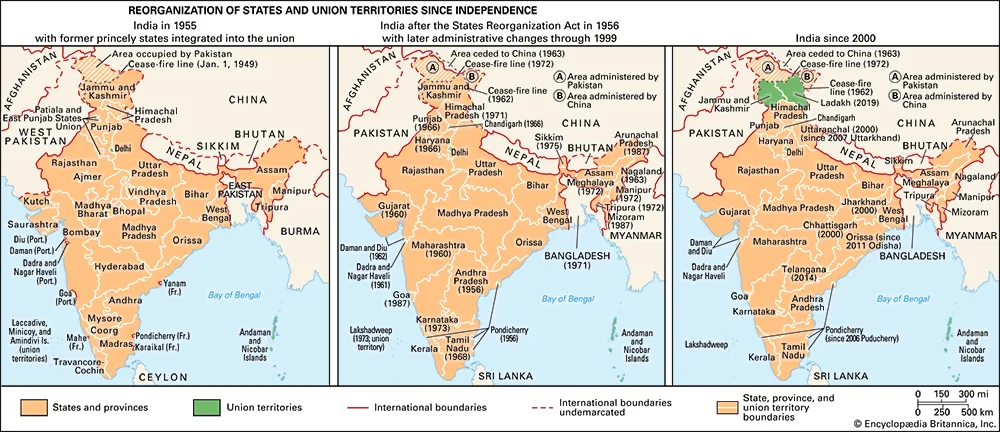
The Act abolished the earlier classification of Part A, B, C, and D states and replaced it with a simpler structure of States and Union Territories. It reorganised boundaries largely along linguistic lines while also considering administrative efficiency and national unity.
As a result, India was reorganised into 14 states and 6 Union Territories. States such as Andhra Pradesh, Kerala, Mysore (later Karnataka), and Madhya Pradesh were restructured. For instance, Kerala was formed by merging Travancore-Cochin with the Malabar district of Madras.
This reorganisation strengthened the federal structure and made governance more responsive to regional aspirations.
Rationale Behind State Reorganisation
The reorganisation of states in India was guided by a combination of multiple factors rather than a single criterion.
- Linguistic and cultural homogeneity played a crucial role in facilitating better communication between the government and the people, thereby improving administrative efficiency. It also strengthened democratic participation.
- Tribal and ethnic identities were another important factor. States like Nagaland (1963) were created to accommodate distinct tribal cultures and address their socio-political aspirations.
- Economic considerations also influenced reorganisation. Regions like Chhattisgarh, Jharkhand, and Uttarakhand (2000) demanded separate statehood due to perceived neglect and uneven development within larger states.
- Administrative viability was another key factor. Large states were often difficult to govern effectively, necessitating their division into smaller, more manageable units.
- Security concerns also played a role, as seen in the reorganisation of Jammu and Kashmir in 2019 into two Union Territories Jammu & Kashmir and Ladakh.
Post-1956 Reorganisation of States
The process of state reorganisation did not end in 1956 but continued in response to evolving political, social, and economic demands.
- In 1960, the Bombay Reorganisation Act led to the creation of Maharashtra and Gujarat, following linguistic movements like the Samyukta Maharashtra and Mahagujarat movements.
- In 1966, the Punjab Reorganisation Act resulted in the creation of Punjab and Haryana, while Himachal Pradesh emerged as a separate entity and later attained full statehood in 1971.
- The North-East witnessed significant reorganisation. Nagaland (1963), followed by Meghalaya, Manipur, and Tripura (1972), were granted statehood to address regional aspirations.
- Sikkim became a full-fledged state in 1975 after initially being an Indian protectorate.
- In 1987, Goa, Mizoram, and Arunachal Pradesh were granted statehood, reflecting the continued emphasis on regional identity and administrative needs.
- The year 2000 saw the creation of Chhattisgarh, Jharkhand, and Uttarakhand, marking a shift toward economic and administrative considerations rather than purely linguistic ones.
- In 2014, Telangana was carved out of Andhra Pradesh, highlighting regional disparities and political mobilization.
- Finally, in 2019, the former state of Jammu and Kashmir was reorganised into two Union Territories, reflecting strategic and security considerations.
Current Statehood Demands
The process of reorganisation remains ongoing, with several regions demanding separate statehood based on identity, development, or administrative concerns.
Demands such as Vidarbha (Maharashtra), Gorkhaland (West Bengal), Bodoland (Assam), and Bundelkhand (UP-MP region) highlight regional aspirations. Similarly, proposals to divide large states like Uttar Pradesh into smaller units indicate the continuing relevance of administrative efficiency in state reorganisation debates.
Significance of State Reorganisation
The reorganisation of states has played a crucial role in strengthening India’s unity by accommodating diversity within a federal structure. It has enhanced administrative efficiency, improved governance, and allowed regional identities to flourish within the national framework.
At the same time, it has prevented the rise of secessionist tendencies by providing constitutional means for addressing regional demands.
Conclusion
The reorganisation of states in India is a dynamic and evolving process that reflects the country’s commitment to democratic principles and federalism. While the State Reorganisation Act of 1956 laid the foundation, subsequent changes demonstrate the adaptability of the Indian polity in addressing emerging challenges.
FAQs
Q1. What is the Reorganisation of States in India?
The Reorganisation of States refers to the restructuring of state boundaries in India after independence, mainly on linguistic and administrative grounds.
Q2. Which Act played a key role in this process?
The States Reorganisation Act, 1956 was the most significant law that redrew state boundaries along linguistic lines.
Q3. What were the major committees and commissions involved?
Key bodies included the Dhar Commission (1948), JVP Committee (1949), and the States Reorganisation Commission.
Q4. Why was linguistic reorganisation demanded?
People demanded states based on language for administrative convenience, cultural identity, and democratic representation.
Q5. Which was the first state formed on a linguistic basis?
Andhra Pradesh was created in 1953 following the demand led by Potti Sriramulu.
Click on the question to see the Answers
Visit LevelUp IAS- Click Here
Related reads.
How to Read NCERTs for UPSC: Subject-Wise Strategy & Notes Making
22 Jun 2026 10 min
PSIR Topper's Answer Copies
22 Jun 2026 1 min
Sociology Optional PYQs (2009-2024)
22 Jun 2026 1 min
Philosophy Optional PYQs
22 Jun 2026 1 min
PSIR Optional PYQs
22 Jun 2026 1 min
History Optional PYQs (2009-2025) – Free PDF & Video
22 Jun 2026 1 min
Put it into practice
Reading is step one.
Turn what you've just read into exam-ready answers with mentor-led practice and our structured test series.