Unification of Germany (1871)
Content
- Background
- Ideological Foundations
- Factors Responsible
- Failure of the Frankfurt Parliament
- Rise of Prussia and Otto von Bismarck
- Wars of German Unification
- Proclamation of the German Empire (1871)
- Impacts
- Critical Evaluation
- Conclusion
- FAQs
The Unification of Germany was one of the most significant political developments of nineteenth-century Europe. It transformed a politically fragmented German-speaking region into a powerful nation-state under Prussian leadership in 1871. Before unification, the German territories consisted of numerous kingdoms, duchies, principalities, and free cities loosely organized under the German Confederation established by the Congress of Vienna in 1815. The process of unification was driven by the forces of nationalism, economic integration, military modernization, diplomatic maneuvering, and a series of carefully planned wars.
The creation of the German Empire not only reshaped the political map of Europe but also altered the balance of power on the continent. The rise of a unified Germany eventually made it one of the strongest industrial and military powers in the world.
Background of the Unification
The roots of German unification can be traced to the political fragmentation that existed in Central Europe for centuries. During the medieval period, the German-speaking regions formed part of the Holy Roman Empire. However, this empire was never a centralized nation-state and consisted of hundreds of semi-autonomous territories.
The Napoleonic Wars brought a major transformation. In 1806, Napoleon dissolved the Holy Roman Empire and established the Confederation of the Rhine. Although Napoleon’s rule was unpopular, it inadvertently promoted German nationalism by creating awareness of a common German identity.
After Napoleon’s defeat, the Congress of Vienna (1815) reorganized Europe and established the German Confederation consisting of 39 states. This arrangement was intended to preserve the existing political order and prevent nationalist revolutions. However, instead of eliminating nationalism, it encouraged demands for political unity among German-speaking people.
Within the Confederation, Austria and Prussia emerged as the two dominant powers. Their rivalry would ultimately determine the future course of German unification.
Ideological Foundations of Unification
Rise of Nationalism
Nationalism was the most powerful force behind German unification. The experience of French occupation under Napoleon generated a sense of common identity among German-speaking people. Intellectuals, writers, and philosophers emphasized the idea that people sharing a common language, culture, and historical heritage should belong to a single political nation.
Thinkers such as Johann Gottlieb Fichte played a significant role in promoting nationalist consciousness through their writings and speeches. Nationalism gradually evolved from a cultural movement into a political demand for unification.
Liberalism and Constitutional Aspirations
Alongside nationalism, liberalism also influenced the unification movement. The growing middle class demanded constitutional government, civil liberties, representative institutions, and economic freedom. Many Germans believed that national unity and political liberty were interconnected goals.
The Revolutions of 1848 reflected these aspirations. Liberal nationalists attempted to establish a united Germany through the Frankfurt Parliament. However, the experiment failed because it lacked military support and faced opposition from Austria and conservative rulers.
The failure of liberal nationalism demonstrated that German unification would ultimately be achieved not through parliamentary debates but through power politics.
Economic Factors Behind Unification
Zollverein and Economic Integration
One of the most important foundations of German unity was economic integration. In 1834, Prussia established the Zollverein or Customs Union.
The Zollverein abolished internal customs barriers among participating German states and created a common market. Austria was deliberately excluded from this arrangement, thereby increasing Prussia’s influence.
The economic benefits of the Zollverein were substantial. Trade expanded rapidly, industrial production increased, and transportation networks improved. The customs union created a sense of economic interdependence among German states and strengthened the idea that political unity was both desirable and beneficial.
By the middle of the nineteenth century, the Zollverein had effectively established economic unity long before political unification was achieved.
Failure of the Frankfurt Parliament (1848)
The Revolutions of 1848 represented the first major attempt to achieve German unification through constitutional means. Delegates from across the German states assembled in Frankfurt to draft a constitution for a united Germany.
The Frankfurt Parliament proposed a constitutional monarchy and offered the German crown to the Prussian King, Frederick William IV.
However, the king rejected the offer, famously refusing to accept a “crown from the gutter.” Austria also opposed the project, while the Parliament lacked military power to enforce its decisions.
The failure of the Frankfurt Parliament marked a turning point. It became clear that German unification would require military strength and political leadership rather than revolutionary idealism alone.
Rise of Prussia and Otto von Bismarck
The decisive phase of German unification began with the rise of Prussia under Otto von Bismarck.
In 1862, Bismarck became Prime Minister of Prussia. He rejected liberal methods and adopted a pragmatic political philosophy known as Realpolitik. According to Bismarck, national objectives should be achieved through practical measures rather than ideological commitments.
His famous “Blood and Iron” speech emphasized that the major issues of the age would be settled by military power rather than parliamentary debates.
Bismarck believed that German unification should occur under Prussian leadership and that Austria had to be excluded from German affairs. To achieve this objective, he strengthened the Prussian army, pursued strategic alliances, and carefully manipulated international politics.
Wars of German Unification
Danish War (1864)
The first step toward unification was the conflict over the duchies of Schleswig and Holstein.
Prussia and Austria jointly fought Denmark and secured victory. The duchies were placed under joint administration, with Prussia controlling Schleswig and Austria administering Holstein.
Although the war appeared to be a cooperative venture, Bismarck deliberately used the arrangement to create future tensions with Austria.
The Danish War enhanced Prussia’s prestige and provided an opportunity for the next phase of unification.
Austro-Prussian War (1866)
The dispute over Schleswig and Holstein eventually led to war between Prussia and Austria.
The Austro-Prussian War, also known as the Seven Weeks’ War, lasted only a short period but had far-reaching consequences. The superior organization and military efficiency of Prussia enabled it to secure a decisive victory at the Battle of Königgrätz.
The war ended Austrian dominance in German affairs. The German Confederation was dissolved, and Austria was excluded from the process of German unification.
Prussia annexed several territories and established the North German Confederation in 1867. This marked a major step toward national unity.
Formation of the North German Confederation
The North German Confederation brought together the northern German states under Prussian leadership. It introduced a federal structure with institutions such as the Reichstag and Bundesrat.
Although the southern German states remained formally independent, they entered into military alliances with Prussia. The confederation effectively created a framework for future unification.
This phase demonstrated Bismarck’s ability to combine military success with political institution-building.
Franco-Prussian War (1870-71)
The final stage of unification was achieved through the Franco-Prussian War.
Bismarck skillfully manipulated the Ems Dispatch to provoke France into declaring war against Prussia. By portraying France as the aggressor, he generated nationalist sentiment across Germany.
The southern German states rallied behind Prussia in the conflict. The war therefore transformed regional loyalties into a broader German national identity.
The decisive Battle of Sedan resulted in the defeat of France and the capture of Emperor Napoleon III. The victory generated immense nationalist enthusiasm and removed the final obstacle to German unity.
Proclamation of the German Empire (1871)
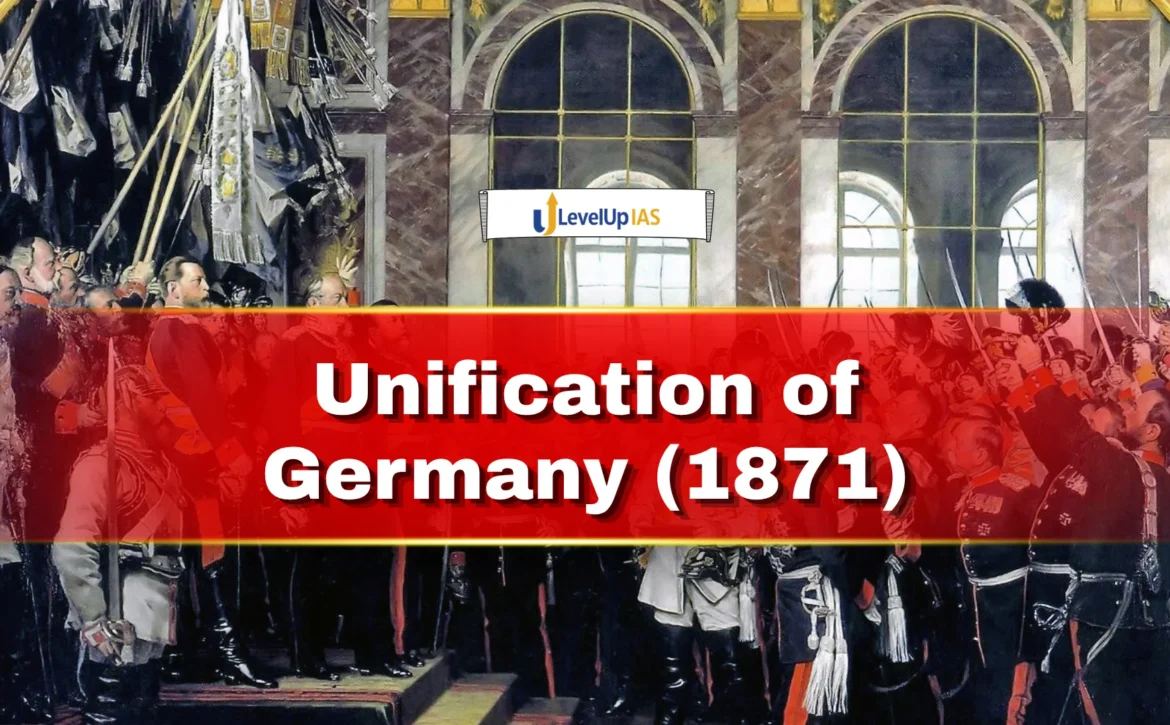
The culmination of the unification process occurred on 18 January 1871 in the Hall of Mirrors at Versailles.
King Wilhelm I of Prussia was proclaimed German Emperor (Kaiser), while Otto von Bismarck became Chancellor of the newly established German Empire.
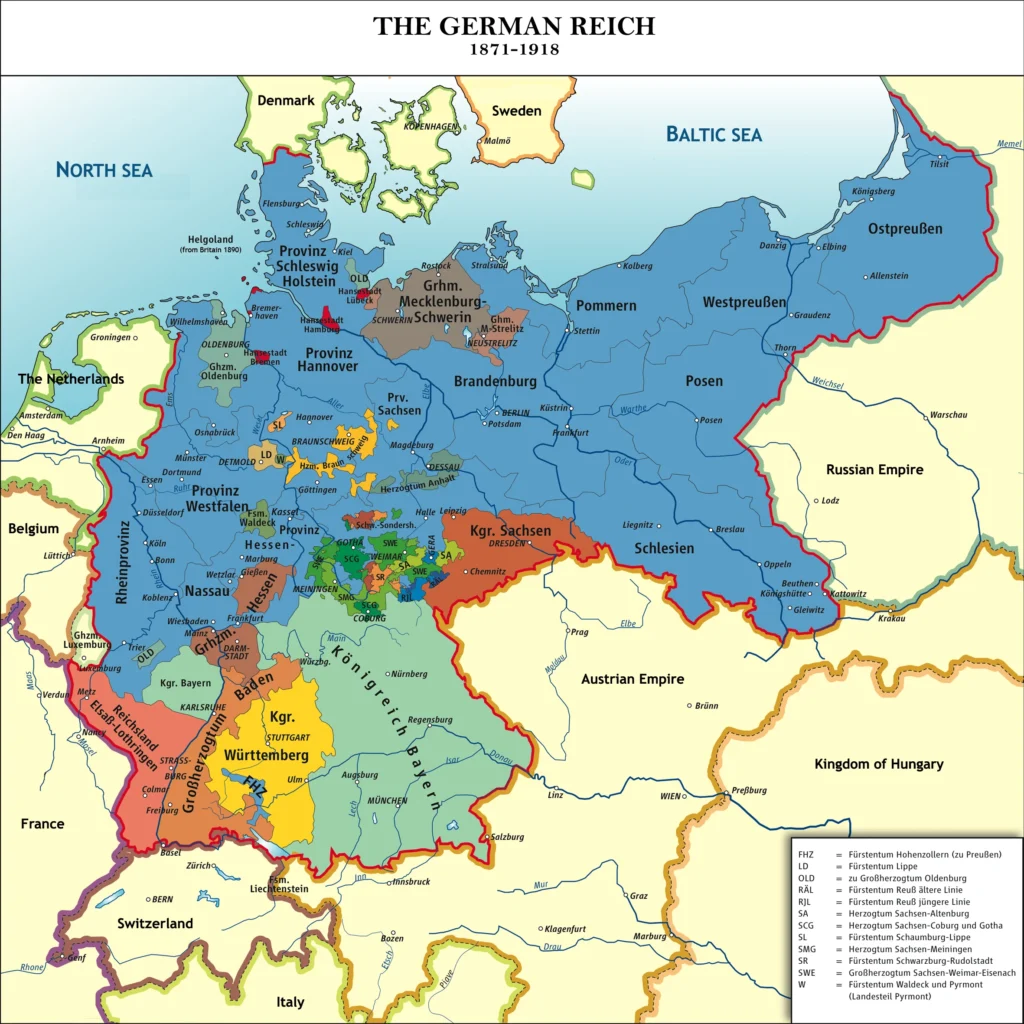
The new empire adopted a federal structure, but Prussia remained dominant. It controlled nearly two-thirds of the empire’s population and territory.
The proclamation symbolized the successful transformation of German nationalism into a unified nation-state.
Factors Responsible for the Success of German Unification
German unification succeeded because several factors worked together. Nationalism provided the ideological foundation by creating a sense of common identity among German-speaking people. Economic integration through the Zollverein strengthened cooperation and increased Prussian influence. Military modernization gave Prussia a decisive advantage over its rivals. The decline of Austrian power removed the principal obstacle to unification.
Most importantly, the leadership of Bismarck combined diplomacy, military strategy, and political realism in a highly effective manner. His ability to isolate opponents and exploit international circumstances was crucial in achieving unification.
Impacts
The unification of Germany had profound consequences both within Germany and across Europe.
Politically, it ended centuries of fragmentation and created a powerful nation-state in Central Europe. Germany emerged as a major continental power, replacing France as the dominant force on the mainland.
Economically, unification accelerated industrialization by creating a large national market. Germany rapidly became one of the world’s leading producers of coal, steel, chemicals, and manufactured goods.
The balance of power in Europe was fundamentally altered. The emergence of a strong Germany generated new rivalries among European powers and contributed to the alliance systems that eventually led to the First World War.
German unification also encouraged the growth of militarism. Since national unity had been achieved largely through warfare, military institutions acquired immense prestige within German society and politics.
Critical Evaluation
While German unification was a remarkable achievement, it was not a democratic process. Unlike the aspirations of the Frankfurt Parliament, unification occurred under conservative monarchical leadership rather than liberal constitutional ideals.
The new empire was dominated by Prussia, leading some historians to describe the process as the expansion of Prussian power rather than a genuinely popular national movement. Furthermore, the emphasis on military strength and authoritarian governance contributed to political tensions in later decades.
Nevertheless, German unification remains one of the most successful examples of nation-building in modern history and a landmark event in the development of modern Europe.
Conclusion
The Unification of Germany was the culmination of decades of nationalist aspirations, economic integration, diplomatic maneuvering, and military victories. Under the leadership of Otto von Bismarck, Prussia successfully united the German states and established the German Empire in 1871. The event transformed Germany into a major industrial and military power, reshaped European politics, and significantly influenced the course of modern world history. For UPSC, German unification is important not only as a nation-building process but also as a classic example of the role of nationalism, Realpolitik, and state power in shaping modern political history.
FAQs
Q1. What was the Unification of Germany?
The Unification of Germany was the process by which numerous German states were united into a single nation-state under the leadership of Prussia.
Q2. Why was Germany politically fragmented before unification?
Following the decline of the Holy Roman Empire, the German region consisted of many independent kingdoms, duchies, and principalities.
Q3. Who was the chief architect of German unification?
Otto von Bismarck played the central role in unifying Germany through diplomacy, military strength, and strategic alliances.
Q4. What was Bismarck’s ‘Blood and Iron’ policy?
The Blood and Iron Policy emphasized achieving national objectives through military power and practical politics rather than speeches and resolutions.
Q5. Which wars contributed to German unification?
Three major wars paved the way for unification:
Danish War (1864)
Austro-Prussian War (1866)
Franco-Prussian War (1870-71)
Click on the question to see the Answers
Visit LevelUp IAS: Click here