Why most candidates fail Prelims despite good preparation

Content
- Introduction
- Preparation vs Performance
- Behavioural Patterns
- Role of Negative Marking
- Static and Current Affairs Integration
- Revision Without Recall
- Psychological Pressure
- Structural Error in Preparation
Introduction
Every year, thousands of aspirants approach the Preliminary Examination conducted by the Union Public Service Commission with disciplined study plans and strong conceptual grounding. Yet, a large proportion of them fail to clear the cut-off. This paradox is not accidental. It reflects a structural mismatch between preparation methods and examination demands.
The Prelims is not a test of how much one has studied, it is a test of how effectively knowledge is applied under uncertainty. Many candidates prepare extensively but do not train themselves for this specific performance environment.
Preparation vs Performance: The Core Disconnect
Most aspirants invest heavily in reading standard books, compiling notes, and covering current affairs. However, the examination does not reward coverage alone. It rewards precision, elimination ability, and calibrated risk-taking. Questions are designed to test conceptual clarity in unfamiliar contexts. Candidates who prepare in an information-centric manner struggle to adapt when questions demand interpretation rather than recall.
Thus, the problem is not insufficient preparation but misdirected preparation.
Behavioural Patterns of Successful vs Unsuccessful Candidates
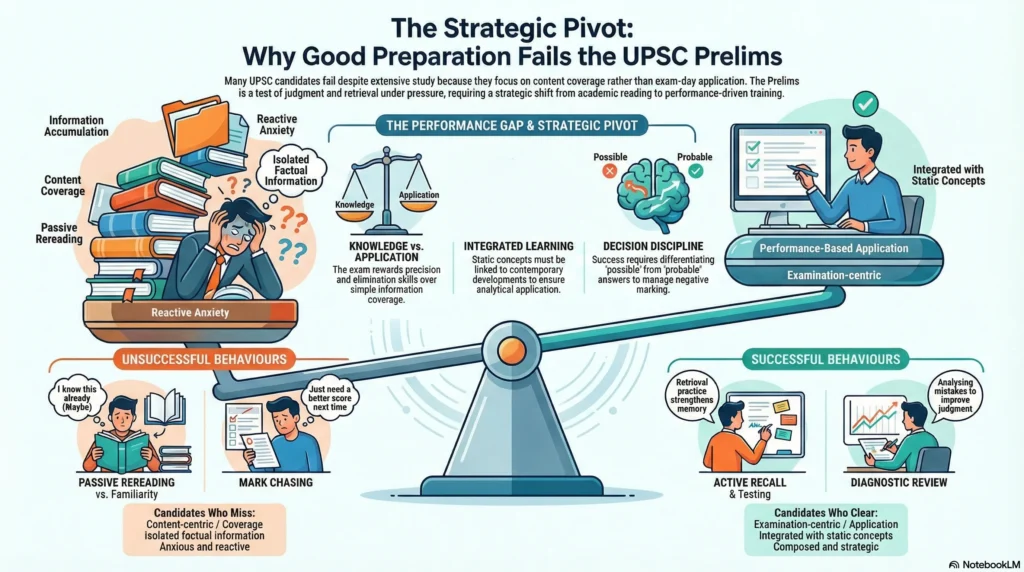
The difference between clearing and missing the cut-off often lies in behavioural choices during preparation and examination. This contrast can be understood systematically:
| Dimension of Preparation | Candidates Who Clear Prelims | Candidates Who Miss the Cut-off |
| Orientation | Examination-centric preparation focused on application | Content-centric preparation focused on coverage |
| Revision Style | Active recall and repeated testing | Passive rereading of notes and books |
| Mock Tests | Analytical review of errors and patterns | Marks-focused test-taking without diagnosis |
| Attempt Strategy | Balanced risk-taking based on elimination | Over-attempting or under-attempting due to uncertainty |
| Current Affairs | Integrated with static concepts | Studied as isolated factual information |
| Psychological Approach | Composed, strategic, and adaptive | Anxious, reactive, and inconsistent |
This comparison shows that success depends less on knowledge quantity and more on knowledge utilisation.
The Role of Negative Marking and Decision Discipline
Negative marking fundamentally alters the nature of the examination. It introduces a strategic dimension where judgment becomes as important as knowledge. Many aspirants fail because they treat every question as an opportunity to attempt rather than an opportunity to evaluate certainty.
The inability to differentiate between “possible” and “probable” answers leads to avoidable losses. Even strong candidates lose marks not due to ignorance but due to miscalculated risk.
Weak Integration Between Static and Current Affairs
- UPSC increasingly frames questions that combine foundational knowledge with contemporary developments. Candidates often prepare static subjects and current affairs separately. This fragmented approach prevents analytical application.
- For instance, environmental questions require understanding of ecology concepts, species characteristics, and conservation frameworks simultaneously. Without conceptual anchors, current affairs remain informational rather than analytical.
The Illusion of Revision Without Recall
Revision is widely practised but rarely optimised. Many aspirants equate familiarity with mastery. However, recognition during reading is not equivalent to recall during examination. Prelims demands retrieval under pressure.
Effective revision must simulate examination conditions. Without recall training, knowledge remains inaccessible at the moment of need.
Psychological Pressure and Performance Decline
Performance anxiety plays a critical role in failure despite preparation. Under stress, cognitive efficiency declines. Candidates misread questions, rush decisions, or abandon elimination logic. The fear of missing the cut-off often leads to emotional rather than strategic answering.
Prelims therefore tests temperament along with knowledge.
Structural Error in Preparation Philosophy
When viewed holistically, most failures stem from a preparation philosophy that prioritises accumulation over optimisation. Aspirants read extensively but simulate insufficiently. They measure effort but not effectiveness. Preparation becomes an academic exercise rather than performance training.
This insight is particularly important for serious aspirants like you who already possess conceptual depth. The challenge is not understanding content but converting understanding into marks.
Conclusion
Failure in Prelims despite good preparation is not a reflection of intellectual inadequacy. It is a consequence of strategic misalignment. The examination rewards integration, judgment, discipline, and composure. Candidates who transform preparation into performance training are far more likely to succeed.
Ultimately, success in Prelims depends not on studying more, but on studying in a way that mirrors the demands of the examination itself.
Want to know How to Analyse UPSC PYQs for Prelims Click Here
Want to Make a realistic UPSC Timetable Click Here