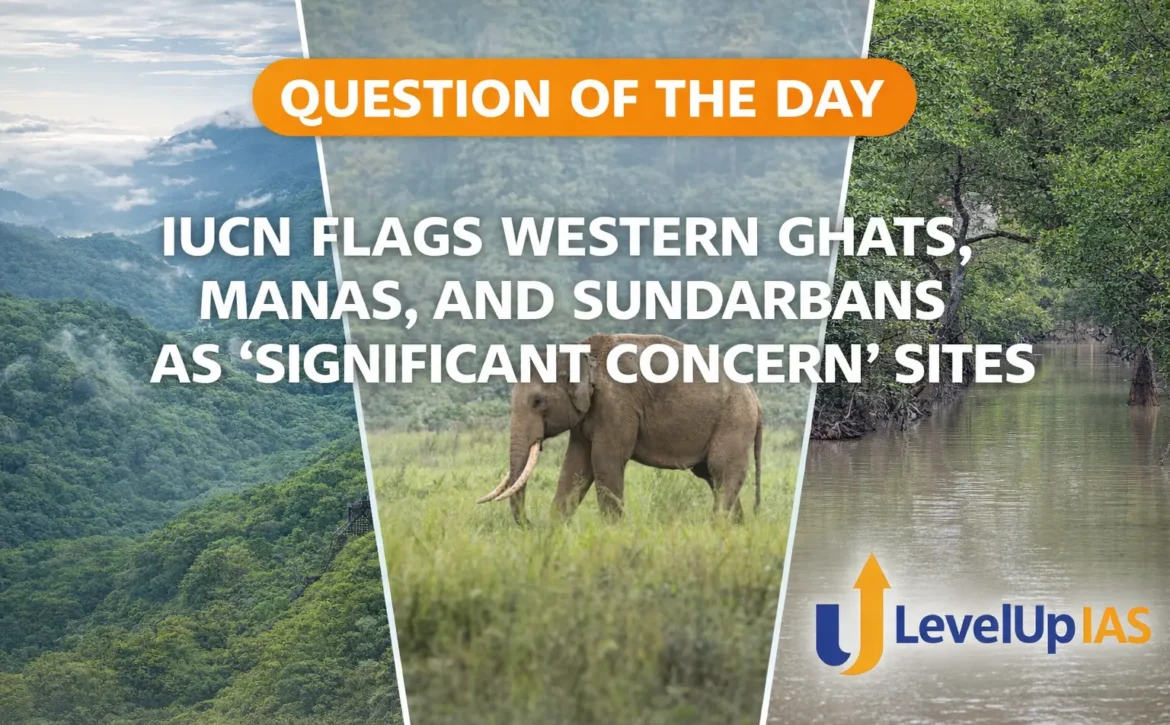
Question of the Day – IUCN FLAGS WESTERN GHATS, MANAS, AND SUNDARBANS AS ‘SIGNIFICANT CONCERN’ SITES
QOTD April 10,2026
With reference to the World Heritage Outlook by the IUCN, consider the following statements:
- It assesses the conservation status of natural World Heritage Sites.
- It is prepared by UNESCO every year.
- Sites marked as “significant concern” face high levels of threat to their ecological integrity.
which of the statements given above are correct?
(a) 1 and 2 only
(b) 1 and 3 only
(c) 2 and 3 only
(d) 1, 2 and 3
Answer: (a) 1 and 3 only
Explanation:
Statement 1 is correct
The IUCN World Heritage Outlook evaluates the conservation status of natural World Heritage Sites globally.
Statement 2 is incorrect
It is prepared by IUCN, not UNESCO, though UNESCO designates World Heritage Sites.
Statement 3 is correct
“Significant concern” indicates serious threats to the site’s values and conservation outlook.
Why in news–
The International Union for Conservation of Nature (IUCN) has recently flagged three major Indian natural heritage sites — Western Ghats, Manas National Park, and Sundarbans National Park — as areas of “significant concern” under its World Heritage Outlook assessment. This classification indicates that these ecologically sensitive regions are facing increasing threats such as climate change, biodiversity loss, human encroachment, and habitat degradation. The report highlights the urgent need for improved conservation measures and policy interventions to protect these globally important biodiversity hotspots.
There are more questions from this topic that you should practice to make your concepts stronger.
Practice Questions (PQ)
PQ1. Consider the following statements regarding the Western Ghats:
- They are older than the Himalayas.
- They are recognized as one of the world’s biodiversity hotspots.
- They run parallel to the eastern coast of India.
which of the statements given above are correct?
(a) 1 and 2 only
(b) 2 and 3 only
(c) 1 and 3 only
(d) 1, 2 and 3
Answer : (a) 1 and 2 only
Explanation:
Statement 1 is correct
The Western Ghats are geologically older than the Himalayas.
Statement 2 is correct
They are among the eight hottest biodiversity hotspots in the world.
Statement 3 is incorrect
They run parallel to the western coast, not the eastern coast.
PQ2. With reference to the Sundarbans, consider the following statements:
- It is the largest mangrove forest in the world.
- It is located entirely within India.
- It is home to the Royal Bengal Tiger.
which of the statements given above are correct?
(a) 1 and 3 only
(b) 1, 2 and 3
(c) 2 and 3 only
(d) 1 only
Answer: (a) 1 and 3 only
Explanation:
Statement 1 is correct
The Sundarbans is the largest mangrove forest globally.
Statement 2 is incorrect
It is shared between India and Bangladesh.
Statement 3 is correct
It is famous for the Royal Bengal Tiger population.
PQ3. With reference to Manas National Park, consider the following statements:
- It is located in Assam along the border with Bhutan.
- It is both a UNESCO World Heritage Site and a Biosphere Reserve.
- It is famous for the conservation of one-horned rhinoceros only.
which of the statements given above are correct?
(a) 1 and 2 only
(b) 1 and 3 only
(c) 2 and 3 only
(d) 1, 2 and 3
Answer: (a) 1 and 2 only
Explanation:
Statement 1 is correct
Manas National Park lies in Assam along the Bhutan border.
Statement 2 is correct
It is a UNESCO World Heritage Site, Project Tiger reserve, and Biosphere Reserve.
Statement 3 is incorrect
It conserves multiple species, not just one-horned rhinoceros.
Previous Year Question (UPSC Prelims)
With reference to the IUCN Red List of Threatened Species, consider the following statements:
- Critically Endangered status is given to species facing an extremely high risk of extinction in the wild.
- It is prepared under the aegis of UNESCO.
which of the statements given above is/are correct?
(a) 1 only
(b) 2 only
(c) both 1 and 2
(d) neither 1 nor 2
Answer: (a) 1 only
Explanation:
Statement 1 is correct
Critically Endangered is the highest risk category before extinction in the wild.
Statement 2 is incorrect
The IUCN Red List is prepared by IUCN, not UNESCO.