First World War (1914-1918)
Content
- Background
- Causes of War
- Immediate Cause
- Major International Crises
- Phases of the First World War
- Consequences
- Treaty of Versailles
- Conclusion
- FAQs
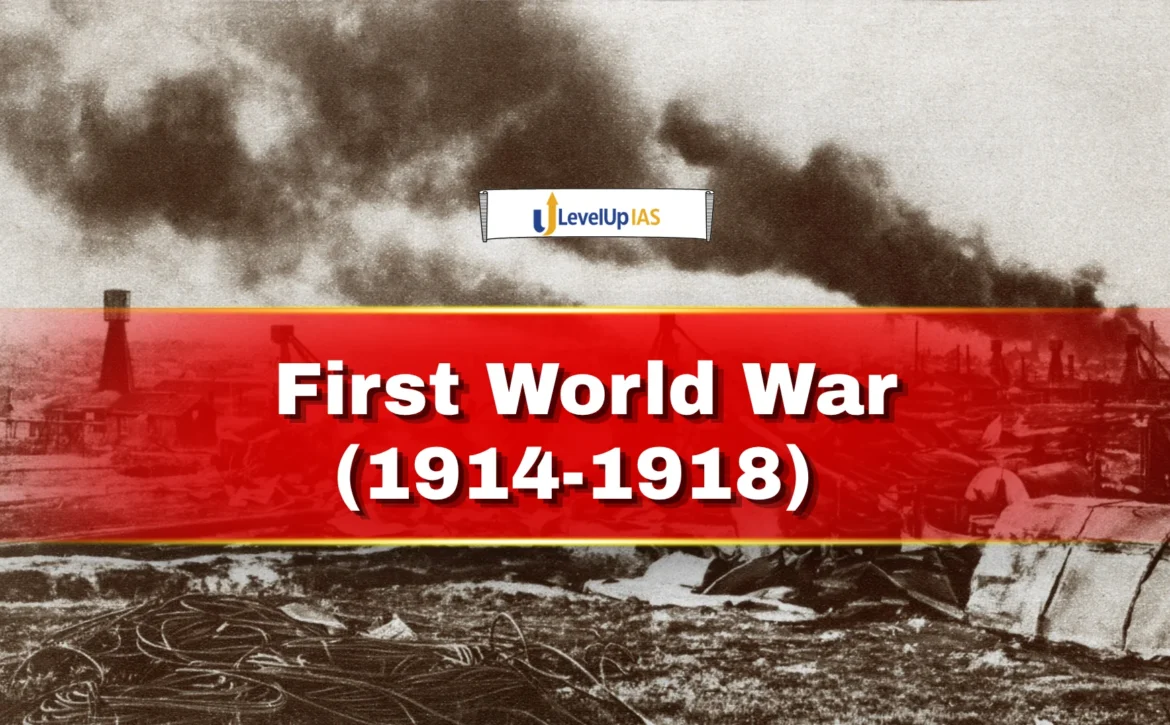
The First World War (1914-1918), often referred to as the Great War, was one of the most transformative events in modern world history. It marked the end of the nineteenth-century European order and ushered in a new era characterized by political instability, economic upheaval, ideological conflicts, and the emergence of new global powers. Unlike earlier wars, the First World War involved multiple continents, vast colonial resources, and unprecedented use of modern technology. The conflict claimed millions of lives and permanently altered the political map of the world.
The war began on 28 July 1914 and ended on 11 November 1918. Although the assassination of Archduke Franz Ferdinand acted as the immediate trigger, the roots of the conflict lay in deeper structural factors such as imperialism, nationalism, militarism, alliance politics, and economic rivalries. The war resulted in the collapse of major empires, the rise of new nation-states, the spread of revolutionary ideologies, and the creation of new international institutions.
Background of the Unification
The origins of the First World War can be traced to the developments that followed the Congress of Vienna (1815). The Vienna Settlement sought to maintain a balance of power in Europe and prevent the rise of revolutionary nationalism. For much of the nineteenth century, this arrangement maintained relative peace among the major European powers.
However, the unification of Germany in 1871 dramatically altered the balance of power. Germany emerged as a powerful industrial and military state, challenging Britain’s naval supremacy and France’s political influence. Simultaneously, the decline of the Ottoman Empire created instability in the Balkans, where several ethnic groups aspired to establish independent nation-states.
By the beginning of the twentieth century, Europe had become divided into rival power blocs. Industrial competition, colonial rivalries, and nationalist aspirations created an atmosphere of mutual suspicion. The continent was increasingly militarized, and a major conflict appeared inevitable.
Causes of the First World War
The outbreak of the First World War cannot be attributed to a single factor. Rather, it was the result of several interconnected political, economic, military, and ideological developments that accumulated over decades.
Imperialism and Colonial Rivalries
Imperialism was one of the most important long-term causes of the war. During the late nineteenth century, European nations competed intensely for colonies in Africa and Asia. Industrialization created a growing demand for raw materials, investment opportunities, and overseas markets. Consequently, colonial expansion became a symbol of national prestige and economic strength.
Britain and France possessed extensive colonial empires, while Germany, having achieved political unification only in 1871, sought to acquire colonies and expand its influence. This aggressive German expansion challenged the established colonial powers and generated widespread tensions.
The competition for colonial territories often brought European powers into direct confrontation. Crises in Morocco and other regions demonstrated how imperial rivalries could easily escalate into broader diplomatic disputes. Thus, colonial competition contributed significantly to the atmosphere of hostility that preceded the war.
Rise of Nationalism
Nationalism was another powerful force behind the conflict. Throughout Europe, people increasingly identified themselves with nations based on common language, culture, and history.
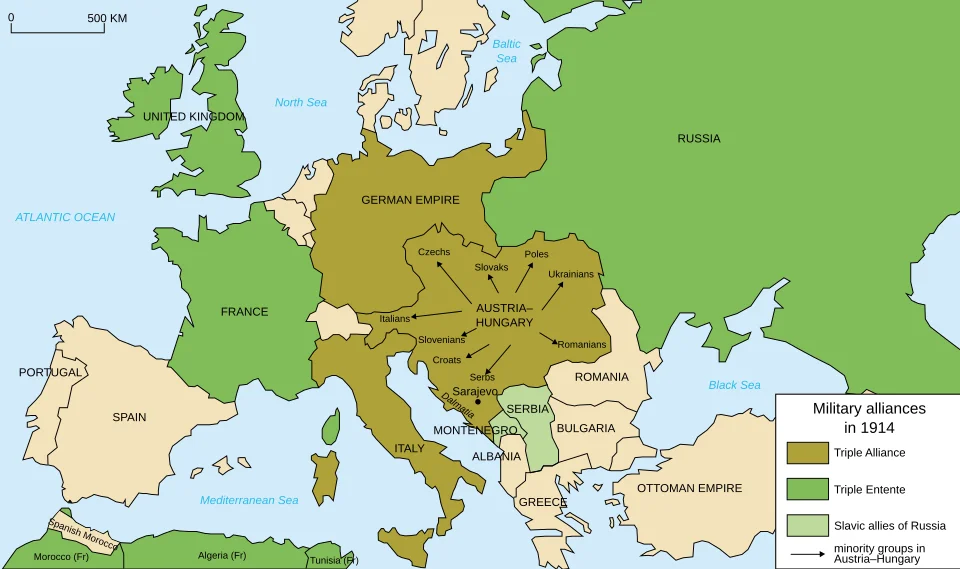
In Germany and Italy, nationalism had already succeeded in creating unified nation-states. These successes inspired nationalist movements elsewhere. Within the multinational Austro-Hungarian and Ottoman Empires, various ethnic groups demanded political autonomy and national self-determination.
The Balkan region became the centre of nationalist agitation. Serbia emerged as the champion of Pan-Slavism, a movement seeking the political unity of Slavic peoples. Russia supported this movement because of its cultural and religious links with the Slavic population.
Austria-Hungary regarded Serbian nationalism as a direct threat to its territorial integrity. Consequently, the Balkans became one of the most volatile regions in Europe and earned the title “Powder Keg of Europe.”
Militarism and Arms Race
The decades preceding the war witnessed an unprecedented expansion of military power across Europe. Governments increasingly viewed military strength as the primary instrument of national security and international influence.
Germany built a powerful army and rapidly expanded its navy under Kaiser Wilhelm II. This naval expansion challenged Britain’s long-standing dominance of the seas and triggered a costly naval arms race.
Military planning became highly sophisticated and rigid. Countries developed detailed war plans that required rapid mobilization. Once these mobilization processes began, political leaders found it difficult to reverse them. Consequently, diplomacy became subordinate to military considerations.
The glorification of military power and the belief that war was an acceptable means of achieving national objectives contributed significantly to the outbreak of conflict.
Alliance System
The alliance system transformed Europe into two opposing military camps.
Germany, Austria-Hungary, and Italy formed the Triple Alliance, while Britain, France, and Russia constituted the Triple Entente. These alliances were originally designed to preserve peace by deterring aggression. However, they ultimately made war more likely because they ensured that any regional conflict would involve multiple powers.
The alliance system created an atmosphere of suspicion and insecurity. Each country feared isolation and therefore strengthened its military commitments. As a result, Europe became increasingly polarized.
When the crisis of 1914 emerged, the alliance network rapidly converted a local dispute into a continental war.
Role of Germany
Historians continue to debate the extent of Germany’s responsibility for the war. While no single nation can be blamed exclusively, Germany played a significant role in escalating tensions.
Germany pursued an aggressive foreign policy aimed at expanding its global influence. It supported Austria-Hungary during the Balkan crisis and encouraged a firm response against Serbia after the Sarajevo assassination. German leaders believed that a quick and decisive war would strengthen their international position.
The German leadership underestimated both Russian determination and French resistance. These miscalculations contributed directly to the expansion of the conflict.
Immediate Cause: Assassination of Archduke Franz Ferdinand
The immediate trigger for the war was the assassination of Archduke Franz Ferdinand, heir to the Austro-Hungarian throne, on 28 June 1914 in Sarajevo. He was killed by Gavrilo Princip, a Bosnian Serb nationalist associated with groups advocating Slavic unity.
Austria-Hungary blamed Serbia for the assassination and issued a harsh ultimatum. Although Serbia accepted most of the demands, Austria-Hungary declared war on Serbia on 28 July 1914.
The alliance system then came into operation. Russia mobilized in support of Serbia. Germany declared war on Russia and France. Germany’s invasion of Belgium prompted Britain to enter the conflict. Within a few weeks, Europe was engulfed in war.
Major International Crises Before the War
The First World War did not emerge suddenly. Several international crises during the early twentieth century revealed the growing instability of the European system.
The Moroccan Crisis of 1905-06 emerged when Germany challenged French influence in Morocco. Germany expected diplomatic support but instead found itself isolated as Britain, Russia, and other powers backed France.
The Bosnia Crisis of 1908 erupted when Austria-Hungary annexed Bosnia-Herzegovina. Serbia strongly opposed the move, while Russia supported Serbian claims. The crisis intensified hostility between Austria-Hungary and Serbia.
The Agadir Crisis of 1911 occurred when Germany sent a gunboat to the Moroccan port of Agadir. Britain viewed the action as a threat and supported France, further strengthening the Entente.
The Balkan Wars of 1912-13 weakened Ottoman control in southeastern Europe and increased Serbian influence. The resulting territorial disputes heightened tensions and prepared the ground for the events of 1914.
Phases of the First World War
Phase I: Opening Campaigns (1914)
The war began with Germany’s implementation of the Schlieffen Plan. The strategy aimed to defeat France rapidly before turning eastward against Russia. Germany invaded Belgium to attack France from the north.
However, French and British forces successfully halted the German advance during the First Battle of the Marne. This failure prevented a quick German victory and transformed the conflict into a prolonged war.
On the Eastern Front, Germany achieved major victories against Russia, particularly at the Battle of Tannenberg. Nevertheless, neither side achieved a decisive breakthrough.
By the end of 1914, trench warfare had become the dominant feature of the Western Front.
Phase II: Stalemate and Attrition (1915-1917)
The second phase of the war was characterized by trench warfare and a strategy of attrition. Both sides attempted to exhaust the enemy through continuous military pressure.
The Battle of Verdun (1916) became one of the longest and bloodiest battles in history. Germany sought to “bleed France white” through sustained attacks. The battle resulted in enormous casualties without significant territorial gains.
Similarly, the Battle of the Somme (1916) demonstrated the horrific nature of industrial warfare. Millions of soldiers participated, and casualties exceeded one million.
The Gallipoli Campaign represented an unsuccessful Allied attempt to secure control of the Dardanelles and weaken the Ottoman Empire.
During this phase, new military technologies such as poison gas, tanks, aircraft, and submarines transformed the character of warfare.
Phase III: The Tide Turns (1917-1918)
The year 1917 marked a turning point in the war. The Russian Revolution led to the collapse of the Tsarist regime and eventually brought the Bolsheviks to power. The new government withdrew Russia from the conflict through the Treaty of Brest-Litovsk.
At the same time, the United States entered the war on the Allied side. German unrestricted submarine warfare and the Zimmermann Telegram played important roles in influencing American opinion.
American manpower, industrial strength, and financial resources provided a significant boost to the Allies. Combined with growing exhaustion among the Central Powers, this shifted the balance decisively.
In 1918, a series of Allied offensives forced Germany and its allies into retreat. Facing military collapse and internal unrest, Germany requested an armistice. The war officially ended on 11 November 1918.
Consequences of the First World War
The First World War had profound consequences that reshaped the modern world.
Politically, the war destroyed four major empires: the German Empire, the Austro-Hungarian Empire, the Ottoman Empire, and the Russian Empire. Their collapse led to the emergence of several new nation-states such as Poland, Czechoslovakia, Yugoslavia, Finland, Estonia, Latvia, and Lithuania.
Economically, the war imposed enormous financial burdens on participating countries. Governments financed military expenditures through taxation, borrowing, and currency expansion, resulting in inflation and economic instability. Many countries emerged heavily indebted and faced severe post-war economic challenges.
The social consequences were equally significant. Millions of people were killed, injured, or displaced. Traditional social structures weakened, and women entered the workforce in unprecedented numbers. Their contributions during the war strengthened movements for women’s rights and political participation.
Internationally, the war transformed the global balance of power. The United States emerged as a leading economic and political power, while the Russian Revolution gave birth to the Soviet Union. The ideological conflict between capitalism and communism would shape international relations throughout the twentieth century.
The war also encouraged the rise of extremist ideologies. Economic distress, political instability, and dissatisfaction with post-war settlements created conditions that facilitated the emergence of fascism and Nazism. Consequently, many historians view the First World War as the foundation of the Second World War.
Peace Settlement and the Treaty of Versailles
The peace settlement following the war sought to establish a stable international order but ultimately created new grievances.
The Treaty of Versailles, signed in 1919, imposed severe conditions on Germany. It required Germany to accept responsibility for the war, pay substantial reparations, surrender territories, reduce its military strength, and demilitarize the Rhineland.
Many Germans perceived the treaty as unjust and humiliating. The resentment generated by Versailles later became a major factor in the rise of Adolf Hitler and the outbreak of the Second World War.
Other treaties dismantled the Austro-Hungarian and Ottoman Empires and redrew the political map of Europe and the Middle East.
India and the First World War
India, as a colony of Britain, played a crucial role in the Allied war effort. More than one million Indian soldiers served in Europe, Africa, and the Middle East. Indian troops fought with distinction in campaigns such as Gallipoli, Mesopotamia, and Palestine.
India also contributed enormous financial resources, raw materials, and military supplies. However, these contributions imposed significant economic burdens on the Indian population. Inflation, shortages, and rising taxation caused widespread hardship.
The war had far-reaching political consequences for India. Indian leaders expected substantial constitutional reforms in return for their support. Although the British introduced the Montagu-Chelmsford Reforms in 1919, these reforms fell far short of nationalist expectations.
The war strengthened the Indian national movement and contributed to the rise of revolutionary organizations such as the Ghadar Movement. Exposure to ideas of nationalism and self-determination further intensified demands for independence.
Conclusion
The First World War was a watershed event in world history. It ended the old European order, destroyed powerful empires, transformed international politics, and accelerated social and economic change across the globe. The conflict gave rise to new nation-states, new ideologies, and new international institutions, while simultaneously sowing the seeds of future conflicts. The emergence of the United States and the Soviet Union, the growth of nationalism, the creation of the League of Nations, and the dissatisfaction generated by the post-war settlement ensured that the legacy of the First World War would continue to shape global affairs throughout the twentieth century.
FAQs
Q1. What was the First World War?
The First World War was a major international conflict fought between the Allied Powers and the Central Powers, involving countries across Europe, Asia, Africa, and beyond.
Q2. When did the First World War take place?
The war lasted from 1914 to 1918, making it one of the deadliest conflicts in human history up to that time.
Q3. What was the immediate cause of the First World War?
The immediate trigger was the assassination of Archduke Franz Ferdinand in Sarajevo on 28 June 1914.
Q4. What were the major causes of the First World War?
The main causes can be summarized as:
Nationalism
Militarism
Alliances
Imperialism
Q5. Which countries formed the major alliances during the war?
Triple Alliance: Germany, Austria-Hungary, and Italy (initially) Triple Entente: France, United Kingdom, and Russia
Click on the question to see the Answers
Visit LevelUp IAS: Click here