Second World War (1939-1945)
Content
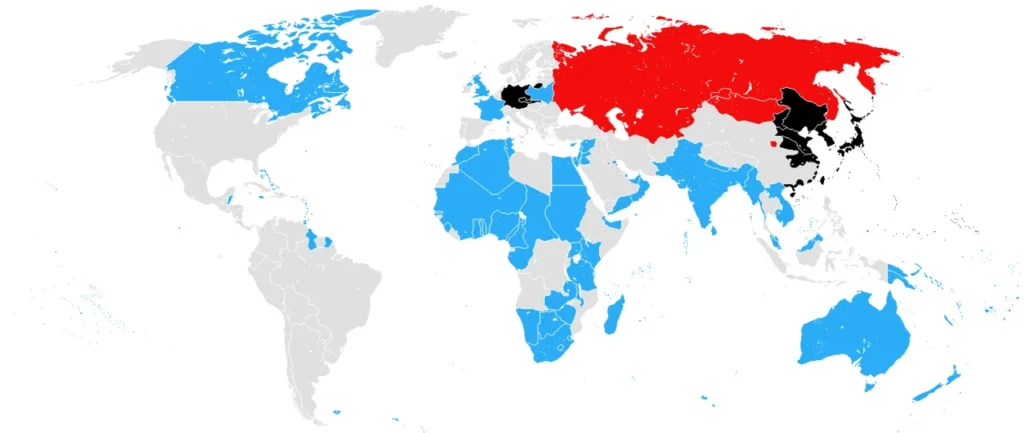
The Second World War (1939-1945) was the most destructive and widespread conflict in human history. It involved more than sixty countries, mobilized vast military and economic resources, and resulted in unprecedented destruction across Europe, Asia, Africa, and the Pacific. The war was fought primarily between the Axis Powers Germany, Italy, and Japan and the Allied Powers Britain, France, the Soviet Union, the United States, China, and several other nations.
The immediate cause of the war was Germany’s invasion of Poland on 1 September 1939, but the roots of the conflict lay in the unresolved tensions of the First World War, the rise of aggressive nationalism, the spread of fascist ideologies, economic instability, and the failure of collective security mechanisms. The war ended in 1945 with the defeat of Germany and Japan, fundamentally transforming the international political order and laying the foundation for the Cold War era.
Background of the Unification
The conclusion of the First World War did not establish a stable international order. Instead, the post-war settlement created widespread dissatisfaction among several countries. Germany considered the Treaty of Versailles a humiliating imposition. Italy felt deprived of promised territorial gains despite being on the victorious side. Japan was dissatisfied with the racial discrimination and unequal treatment it faced from Western powers.
At the same time, the global economic crisis of 1929 weakened democratic governments and facilitated the rise of authoritarian regimes. Fascist leaders such as Adolf Hitler in Germany, Benito Mussolini in Italy, and militarist groups in Japan pursued aggressive expansionist policies. The inability of the League of Nations to prevent acts of aggression further encouraged revisionist powers to challenge the existing international order.
Thus, by the late 1930s, Europe and Asia had become increasingly unstable, making another major conflict almost inevitable.
Causes of the Second World War
Treaty of Versailles and German Resentment
One of the most important long-term causes of the war was the Treaty of Versailles (1919). The treaty imposed severe penalties on Germany. It accepted responsibility for the war through the War Guilt Clause, lost significant territories, surrendered all overseas colonies, paid massive reparations, and faced strict military restrictions.
These conditions generated deep resentment among Germans and created fertile ground for the rise of Adolf Hitler. Hitler promised to restore German pride, rebuild military strength, overturn the treaty, and recover lost territories. His success transformed Germany into an aggressive revisionist power.
Rise of Fascism and Militarism
The interwar period witnessed the emergence of authoritarian governments that glorified military power and expansion.
In Germany, Adolf Hitler established a Nazi dictatorship based on extreme nationalism, racial superiority, and territorial expansion.
In Italy, Benito Mussolini promoted Fascism and sought to revive the glory of the Roman Empire through territorial conquest.
In Japan, military leaders pursued imperial expansion to secure resources and strategic dominance in East Asia and the Pacific.
These regimes rejected democratic values and increasingly relied upon military aggression to achieve national objectives.
Economic Depression of 1929
The Great Depression severely affected the world economy. Industrial production declined, unemployment increased dramatically, and international trade collapsed.
The economic crisis weakened democratic governments and strengthened extremist political movements. Many countries adopted protectionist policies and aggressive nationalism. Expansionist leaders argued that territorial conquest was necessary to obtain markets, raw materials, and economic security.
The depression thus contributed significantly to political instability and international tensions.
Failure of the League of Nations
The League of Nations was created after the First World War to maintain international peace and security. However, it suffered from several structural weaknesses.
The League lacked its own military force and depended on member states for enforcement. Major powers often ignored its decisions. The United States never joined the organization, reducing its effectiveness.
The League failed to stop Japanese aggression in Manchuria (1931), Italian aggression in Ethiopia (1935), and German violations of the Versailles Treaty. These failures undermined confidence in collective security and emboldened aggressor states.
Problem of National Minorities
The post-war settlements created several new states in Europe, but large ethnic minorities remained outside their national homelands.
Millions of Germans lived in Austria, Czechoslovakia, and Poland. Hitler exploited the issue by claiming to protect German minorities and demanding territorial revisions. Similar ethnic tensions existed throughout Central and Eastern Europe, contributing to political instability.
Aggressive Expansion of Axis Powers
Germany
Germany remilitarized the Rhineland in 1936, annexed Austria through the Anschluss in 1938, occupied the Sudetenland after the Munich Agreement, and eventually seized the whole of Czechoslovakia in 1939.
Italy
Italy invaded Ethiopia in 1935 and expanded its influence in the Mediterranean region.
Japan
Japan occupied Manchuria in 1931 and launched a full-scale invasion of China in 1937. Its expansion threatened Western colonial interests and regional stability.
Failure of the Policy of Appeasement
Britain and France adopted a policy of appeasement toward Hitler, hoping that reasonable concessions would preserve peace.
The most notable example was the Munich Conference (1938), where Britain and France allowed Germany to annex the Sudetenland without consulting Czechoslovakia.
Instead of preventing war, appeasement convinced Hitler that the Western powers lacked the determination to resist German expansion. Encouraged by these concessions, Germany adopted increasingly aggressive policies.
Immediate Cause: Invasion of Poland
In August 1939, Germany and the Soviet Union signed the Molotov-Ribbentrop Pact, a non-aggression agreement containing secret provisions for the partition of Poland.
On 1 September 1939, Germany invaded Poland using Blitzkrieg tactics. Britain and France responded by declaring war on Germany on 3 September 1939. This marked the formal beginning of the Second World War.
Phases of the Second World War
The Second World War did not unfold as a single continuous campaign. Instead, it progressed through several distinct phases, each marked by changing military strategies, shifting alliances, technological innovations, and major turning points. Historians generally divide the war into four broad phases: the period of Axis expansion (1939-1941), the globalization of the conflict (1941-1942), the Allied counteroffensive (1942-1944), and the final defeat of the Axis Powers (1944-1945).
Phase I: Axis Expansion and Early Victories (1939-1941)
The first phase of the war was characterized by the rapid military successes of Nazi Germany and its allies. Germany adopted a new style of warfare known as Blitzkrieg (Lightning War), which combined fast-moving tanks, mechanized infantry, and air support to overwhelm enemy defenses before they could organize resistance.
The war officially began on 1 September 1939, when Germany invaded Poland. Within weeks, Poland was defeated and partitioned between Germany and the Soviet Union under the secret provisions of the Molotov-Ribbentrop Pact. Britain and France declared war on Germany on 3 September 1939, but no major military action occurred immediately on the Western Front, leading to a period known as the “Phoney War.”
In April 1940, Germany invaded Denmark and Norway to secure strategic control over the Baltic Sea and iron ore supplies from Sweden. Soon after, German forces launched attacks against Belgium, the Netherlands, and Luxembourg. The swift German advance bypassed the heavily fortified Maginot Line and entered France through the Ardennes region.
France, considered one of Europe’s strongest military powers, collapsed within six weeks. Paris fell in June 1940, and France was divided into German-occupied territories and the collaborationist Vichy Government under Marshal Pétain.
With continental Europe largely under German control, Britain stood alone against Nazi Germany. Hitler launched the Battle of Britain (July-October 1940), relying heavily on air attacks by the Luftwaffe. The objective was to destroy the Royal Air Force and prepare for an invasion known as Operation Sea Lion. However, Britain’s successful air defense forced Germany to abandon invasion plans, marking Hitler’s first major setback.
Meanwhile, Italy under Benito Mussolini entered the war in June 1940, hoping to benefit from Germany’s victories. By the end of 1940, Axis powers controlled much of continental Europe and appeared nearly unstoppable.
Phase II: Globalization of the War and Axis High Point (1941-1942)
The second phase transformed the conflict from a predominantly European war into a truly global struggle involving multiple continents and oceans.
A decisive event occurred on 22 June 1941, when Hitler launched Operation Barbarossa, the invasion of the Soviet Union. Despite having signed a non-aggression pact with Stalin in 1939, Hitler believed that conquering the Soviet Union would provide Germany with resources, agricultural land, and “Lebensraum” (living space).
Initially, German forces achieved spectacular successes. Millions of Soviet soldiers were captured, and large territories including Ukraine and parts of western Russia fell under German occupation. The cities of Leningrad and Moscow came under severe threat. However, the vast geographical size of the Soviet Union, logistical difficulties, fierce Soviet resistance, and the harsh Russian winter slowed the German advance. By December 1941, German troops were halted at the gates of Moscow.
Simultaneously, tensions in the Pacific escalated. Japan sought to establish dominance in East Asia and secure access to raw materials. On 7 December 1941, Japan launched a surprise attack on the American naval base at Pearl Harbor in Hawaii. The attack severely damaged the U.S. Pacific Fleet and drew the United States directly into the war.
Following Pearl Harbor, Germany and Italy declared war on the United States. The conflict now expanded into a worldwide war involving Europe, Africa, Asia, and the Pacific.
During this phase, Axis powers reached the height of their territorial expansion. Germany dominated most of Europe, Japan controlled vast regions of East and Southeast Asia, and Italy maintained influence in parts of the Mediterranean and North Africa.
However, beneath these successes, the Axis powers had overstretched themselves militarily and economically, laying the foundations for future defeats.
Phase III: The Allied Counteroffensive and Turning Points (1942–1944)
The years between 1942 and 1944 marked the turning point of the war. During this period, the strategic initiative gradually shifted from the Axis powers to the Allied forces.
The most significant turning point in Europe was the Battle of Stalingrad (1942-43). Hitler sought control over Soviet industrial centers and the oil fields of the Caucasus. Fierce urban warfare devastated the city. Eventually, Soviet forces encircled the German Sixth Army, forcing its surrender in February 1943. This was the first major German defeat and destroyed the myth of Nazi invincibility.
On the Eastern Front, Soviet forces gradually pushed westward, reclaiming occupied territories and weakening German military power.
In North Africa, Allied forces under General Montgomery defeated German and Italian troops led by Field Marshal Erwin Rommel at the Battle of El Alamein (1942). Soon afterward, Allied landings in North Africa further weakened Axis positions, leading to the complete expulsion of Axis forces from the region by 1943.
The Allies then invaded Sicily and mainland Italy. Mussolini’s Fascist regime collapsed, and Italy surrendered in September 1943. However, German troops continued fighting in Italy, turning the peninsula into another major battlefield.
In the Pacific theatre, the United States adopted an “Island-Hopping Strategy.” Instead of attacking every Japanese-held island, American forces selectively captured strategically important islands while bypassing others. Major battles such as Midway (1942) and Guadalcanal (1942-43) significantly weakened Japanese naval and military power.
Technological superiority, industrial production, and coordinated Allied planning increasingly tilted the balance of war in favor of the Allies.
By 1944, it had become clear that the Axis powers were losing the ability to sustain prolonged warfare.
Phase IV: Final Allied Victory and Collapse of the Axis Powers (1944-1945)
The final phase witnessed the systematic destruction of Axis military power and the eventual end of the war.
The most important event was Operation Overlord, popularly known as D-Day, launched on 6 June 1944. Allied forces landed on the beaches of Normandy in northern France, opening a second front against Germany in Western Europe. This operation remains one of the largest amphibious invasions in history.
Following the liberation of Paris in August 1944, Allied armies advanced rapidly into Germany from the west. At the same time, Soviet forces launched massive offensives from the east, liberating Eastern Europe and pushing toward Berlin.
As Germany faced attacks from both directions, its military situation became hopeless. Soviet troops entered Berlin in April 1945. On 30 April 1945, Adolf Hitler committed suicide in his bunker. Germany formally surrendered on 7 May 1945, and 8 May 1945 was celebrated as Victory in Europe (VE) Day.
Despite Germany’s defeat, Japan continued fighting in the Pacific. American forces captured strategic islands such as Iwo Jima and Okinawa, bringing them closer to the Japanese mainland.
In July 1945, the Allied leaders met at the Potsdam Conference and demanded Japan’s unconditional surrender. Japan refused.
The United States then used atomic weapons for the first time in history. On 6 August 1945, an atomic bomb was dropped on Hiroshima, and on 9 August 1945, another bomb was dropped on Nagasaki. Simultaneously, the Soviet Union declared war on Japan and launched attacks in Manchuria.
Facing overwhelming destruction and military defeat, Japan accepted surrender terms. The formal surrender was signed aboard the USS Missouri on 2 September 1945, bringing the Second World War to an end.
Consequences of the Second World War
Human and Material Losses
The war caused approximately 70-85 million deaths, making it the deadliest conflict in history. Entire cities were destroyed, and millions were displaced.
The Holocaust led to the systematic murder of nearly six million Jews by Nazi Germany, alongside millions of other victims.
Decline of European Dominance
The war weakened traditional European powers such as Britain, France, Germany, and Italy. Their economic and military capacities were severely reduced.
This decline accelerated the process of decolonization across Asia and Africa.
Emergence of Superpowers
The United States and the Soviet Union emerged as the two dominant global powers.
The United States possessed immense economic strength and military influence, while the Soviet Union controlled Eastern Europe and commanded one of the world’s largest armies.
Beginning of the Cold War
Ideological rivalry between the capitalist United States and the communist Soviet Union led to the Cold War.
The world became divided into competing political, military, and economic blocs, shaping international relations for nearly five decades.
Formation of the United Nations
The failure of the League of Nations encouraged the creation of a stronger international organization.
The United Nations (UN) was established in 1945 with the objective of maintaining international peace, promoting cooperation, and preventing future global conflicts.
Nuclear Age
The atomic bombings of Hiroshima and Nagasaki introduced nuclear weapons into international politics.
The post-war period witnessed an arms race between major powers, making nuclear deterrence a central feature of global security.
Decolonization
The war weakened European colonial powers and strengthened anti-colonial movements.
Many Asian and African nations gained independence in the decades following the war, including India in 1947.
India and the Second World War
India played a crucial role in the Allied war effort despite remaining under British colonial rule.
The British Indian Army expanded to approximately 2.5 million soldiers, becoming the largest volunteer army in history. Indian troops fought in North Africa, Italy, the Middle East, and Southeast Asia.
India also served as an important industrial and logistical base, supplying troops, food, textiles, and military equipment.
However, the war imposed severe economic burdens on India. Inflation, taxation, shortages, and the devastating Bengal Famine of 1943 caused immense suffering.
Politically, the war intensified the freedom struggle. The Quit India Movement of 1942 reflected growing dissatisfaction with British rule. Simultaneously, Subhas Chandra Bose organized the Indian National Army (INA) with Japanese support.
After the war, the INA trials generated widespread nationalist sentiment, while Britain’s weakened position made continued colonial rule increasingly unsustainable.
Conclusion
The Second World War was a watershed event in modern history. It destroyed fascist regimes, transformed international power structures, accelerated decolonization, and led to the emergence of a bipolar world dominated by the United States and the Soviet Union. The war also gave birth to institutions such as the United Nations and ushered in the nuclear age. For India, the conflict strengthened the demand for independence and significantly influenced the final phase of the national movement. From a UPSC perspective, the Second World War remains crucial for understanding the transition from imperialism to decolonization and the origins of the contemporary world order.
FAQs
Q1. What was the Second World War?
The Second World War was a worldwide military conflict fought between the Allied Powers and the Axis Powers, involving countries across Europe, Asia, Africa, and the Pacific.
Q2. When did the Second World War begin and end?
The war began on 1 September 1939 with Germany’s invasion of Poland and ended on 2 September 1945 following Japan’s surrender.
Q3. What were the major causes of the Second World War?
Key causes included:
Policy of appeasement by Western powers
Harsh provisions of the Treaty of Versailles
Rise of fascism and militarism
Expansionist policies of Germany, Italy, and Japan
Failure of the League of Nations
Q4. Who were the Axis Powers?
The principal Axis Powers were:
Japan
Germany
Italy
Q5. Who were the Allied Powers?
The major Allied Powers included:
China
United Kingdom
Soviet Union
United States
France
Click on the question to see the Answers
Visit LevelUp IAS: Click here