
Current Affairs
West Nile Fever
Why in News?
Recently, health authorities issued a caution following suspected cases of West Nile fever (WNF) in Ernakulam district of Kerala, prompting vigilance and preventive measures to control mosquito-borne transmission.
What Is West Nile Virus?
West Nile virus is a single-stranded, positive-sense RNA virus belonging to the genus Flavivirus and family Flaviviridae. It is related to other mosquito-borne viruses, including those responsible for Japanese encephalitis, yellow fever and dengue, although these diseases are caused by distinct viruses.
The virus was first isolated from a woman in the West Nile district of Uganda in 1937. It was subsequently identified in birds in Egypt's Nile Delta region in 1953.
WNV is commonly reported in Africa, Europe, the Middle East, West Asia and North America. Its transmission is influenced by mosquito activity, environmental conditions and the presence of infected birds.
Transmission Cycle
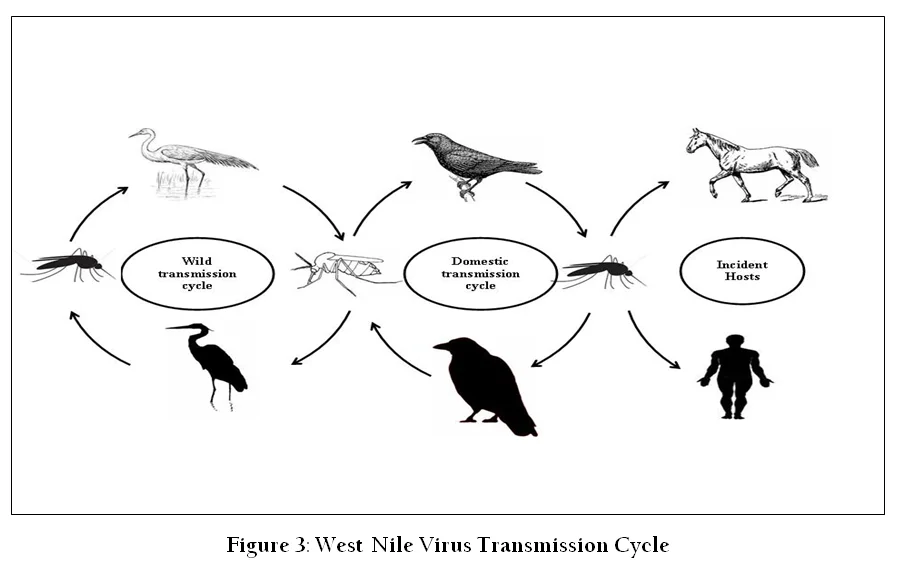
West Nile virus is maintained primarily through a cycle involving birds and mosquitoes.
- Reservoir and amplifying hosts: Birds serve as the natural hosts in which the virus circulates and multiplies.
- Principal vectors: Mosquitoes belonging to the genus Culex are the primary vectors.
- Transmission to humans: Mosquitoes become infected after feeding on infected birds and may subsequently transmit the virus to humans and other animals through bites.
- Dead-end hosts: Humans and horses generally do not develop sufficiently high levels of the virus in their blood to sustain the usual transmission cycle.
Rare transmission can also occur through blood transfusions, organ transplantation and from mother to child during pregnancy, delivery or breastfeeding. However, casual person-to-person transmission has not been documented.
West Nile Fever in India
West Nile virus activity has been reported in several parts of India. Antibodies against the virus were detected in humans in Mumbai in 1952, and subsequent reports have indicated its presence in different regions.
Important developments include:
- Kerala: The virus was reported in Alappuzha in 2006 and subsequently in Ernakulam in 2011. A fatal infection in Thrissur in 2022 also raised public health concerns.
- May 2024: Detection of cases in three Kerala districts prompted health alerts and preventive action.
- Other regions: Evidence of WNV activity has been reported in states including Tamil Nadu, Karnataka, Andhra Pradesh, Maharashtra and West Bengal.
The National Centre for Disease Control's 2025 manual on zoonotic diseases describes the virus's transmission cycle in India and notes the role of migratory birds in its dispersal. Surveillance of mosquitoes, birds and human cases is therefore important for early detection.
Symptoms and Health Effects
Most people infected with West Nile virus do not develop noticeable symptoms. According to the World Health Organization, approximately 80% of infected people remain asymptomatic, while around 20% develop West Nile fever.
Common symptoms include:
- Fever and headache
- Fatigue and body aches
- Nausea and vomiting
- Skin rash
- Swollen lymph glands
In a small proportion of infections, the virus affects the central nervous system, causing neuroinvasive disease. This may lead to:
- Encephalitis: Inflammation of the brain.
- Meningitis: Inflammation of the membranes surrounding the brain and spinal cord.
- Acute flaccid paralysis: Sudden weakness or loss of muscle function.
Severe disease can be life-threatening. Older adults and people with weakened immune systems are at greater risk of serious complications. Some patients may experience prolonged recovery or lasting neurological effects.
Treatment and Prevention
There is currently no licensed human vaccine or specific antiviral treatment for West Nile virus disease. Treatment focuses on relieving symptoms and providing supportive care. Severe cases may require hospitalisation, intravenous fluids, respiratory support and management of neurological complications.
Preventive measures include:
- Personal protection: Use mosquito repellents, wear protective clothing and install screens on doors and windows.
- Mosquito control: Eliminate stagnant water where mosquitoes can breed and implement appropriate larval and adult mosquito control.
- Disease surveillance: Monitor human infections and mosquito populations to identify possible outbreaks early.
- Animal surveillance: Monitor relevant bird and animal populations, since infections in birds can provide early warning of virus circulation.
- Public awareness: Inform communities about mosquito-bite prevention and the symptoms that require medical attention.
Integrated vector management and coordination between human and animal health authorities can strengthen outbreak prevention.
Conclusion
West Nile fever is a zoonotic, mosquito-borne disease maintained mainly through a transmission cycle involving birds and Culex mosquitoes. Although most infections are asymptomatic or mild, severe cases can affect the nervous system and may be fatal.
In India, reported virus activity highlights the need for effective surveillance, mosquito control and public awareness. Since no licensed human vaccine is available, prevention of mosquito bites and early recognition of severe symptoms remain essential public health measures.
Related reads.

Satkosia Tiger Reserve
23 Sep 2026 2 min

EU’s Carbon Border Adjustment Mechanism (CBAM)
22 Sep 2026 4 min

ASEAN: Association of Southeast Asian Nations
16 Sep 2026 6 min
National Food Security Act (NFSA), 2013
16 Sep 2026 6 min

Borophene
15 Sep 2026 3 min

WTO Agreement on Fisheries Subsidies
14 Sep 2026 3 min
Put it into practice
Reading is step one.
Turn what you've just read into exam-ready answers with mentor-led practice and our structured test series.