
Mains Articles
Charter Act 1853

Content
- Introduction
- Background and Causes
- Key Provisions
- Significance of the Act
- Limitations of the Act
- Conclusion
- FAQs
Introduction
The Charter Act of 1853 was the last in the series of Charter Acts passed by the British Parliament to regulate the affairs of the East India Company. It marked a decisive stage in the constitutional development of British India by introducing significant administrative, legislative, and civil service reforms.
Unlike earlier Charter Acts, it did not merely renew the Company’s charter but initiated structural changes that indicated the gradual transition from Company rule to direct Crown control.
Background
- The Charter Act of 1853 emerged in response to growing dissatisfaction in Britain regarding the functioning of the East India Company. By the mid-nineteenth century, the Company had transformed from a commercial enterprise into a vast territorial power, controlling large parts of the Indian subcontinent. This transformation created serious administrative challenges.
- The earlier Charter Act of 1833 had centralized administration, but over time, this centralization led to inefficiencies, delays, and increased administrative costs. The dual system involving the Board of Control and the Court of Directors resulted in bureaucratic complications and lack of accountability.
- Further, territorial expansion particularly the annexation of regions such as Sind and Punjab under expansionist policies made governance more complex and demanded institutional reforms. Concerns were also raised regarding the dual role of the Governor-General, who simultaneously functioned as the Governor of Bengal, leading to possible regional bias.
- Simultaneously, there was a growing demand for administrative decentralization and greater Indian participation in governance. These pressures compelled the British Parliament to renew the Company’s charter in 1853, but with significant modifications.
Key Provisions of the Act
- The Charter Act of 1853 introduced several important constitutional and administrative changes that fundamentally altered the governance structure in India.
- A defining feature of the Act of 1853 was the indefinite renewal of the East India Company’s charter. Unlike previous acts, which renewed the Company’s rule for a fixed period of twenty years, this Act did not specify any duration. This implied that the Company’s rule could be terminated at any time by the British Parliament, thereby asserting parliamentary supremacy over Indian administration.
- A landmark reform introduced by the Act was the separation of legislative and executive functions of the Governor-General’s Council. This separation marked the beginning of a distinct legislative process in India and laid the foundation for modern governance structures.
- The Act of 1853 also provided for the creation of a separate legislative wing, leading to the establishment of the Indian (Central) Legislative Council. This council functioned as a quasi-parliamentary body and followed procedures similar to those of the British Parliament. For the first time, legislation was treated as a specialized function requiring dedicated procedures and institutional mechanisms.
- The composition of the Legislative Council was expanded to include the Governor-General, the Commander-in-Chief, members of the executive council, the Chief Justice and a judge of the Calcutta Supreme Court, along with representatives from provincial governments. This expansion introduced an element of deliberation and broadened participation in legislative discussions.
- Another significant feature was the introduction of local representation. Representatives from provinces such as Madras, Bombay, Bengal, and Agra were included in the Legislative Council. Although limited in scope, this was the first step toward associating local elements with central governance.
- The Act also brought about important reforms in the civil services by introducing a system of open competitive examination for recruitment. This marked the beginning of a merit-based bureaucracy. Following this, the Macaulay Committee (1854) was established to design the framework for civil service recruitment. Although theoretically open to Indians, practical barriers limited their participation.
- Institutionally, the Act reduced the strength of the Court of Directors from 24 to 18 members, of whom six were to be nominated by the Crown. This change increased the influence of the British government over the Company’s administration.
- The Act also laid the groundwork for administrative decentralization by providing for the appointment of a Lieutenant-Governor for provinces such as Punjab. Additionally, it created a separate Governor for Bengal, thereby relieving the Governor-General from regional administrative responsibilities and enabling him to focus on all-India governance.
- Another provision empowered the Governor-General to nominate a Vice-President of the Council and required his assent for all legislative measures, thereby maintaining central control over legislative processes.
Significance of the Act
The Charter Act of 1853 holds immense importance in the constitutional history of India as it marked a transition from purely administrative control to a more structured governance system.
One of its most significant contributions was laying the foundation of a modern legislative system in India. By separating legislative and executive functions and establishing a dedicated legislative council, the Act initiated a process that would eventually evolve into parliamentary democracy.
The introduction of merit-based civil services was another crucial development. It led to the creation of a professional administrative class, which became the backbone of British governance in India.
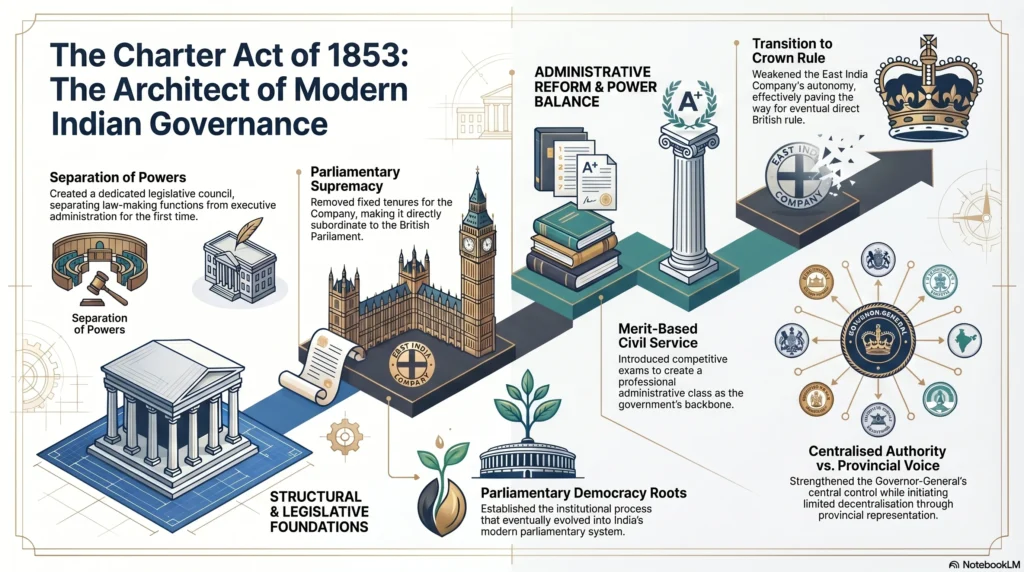
The Act of 1853 also strengthened parliamentary control over Indian affairs. By not specifying a fixed tenure for the Company’s rule, it made the Company subordinate to the will of the British Parliament, thereby paving the way for eventual Crown rule.
Additionally, the Act facilitated the centralization of authority under the Governor-General, enabling more uniform governance across British India while also initiating limited decentralization through provincial representation.
Limitations of the Charter Act
- Despite its progressive features, the Charter Act of 1853 faced significant criticism.
- One of the major criticisms was the absence of Indian representation in meaningful terms. Although local representation was introduced, Indians were largely excluded from legislative and executive decision-making processes.
- The legislative powers of the council remained limited, as the Governor-General retained overriding authority. This restricted the autonomy and effectiveness of the legislative body.
- Furthermore, although the Act introduced open competition for civil services, the examination was conducted in Britain, making it practically inaccessible to most Indians due to financial and logistical constraints.
- Another important criticism was that the Act indirectly facilitated the transfer of power to the British Crown. By not renewing the Company’s charter for a fixed period, it left room for direct intervention, which eventually materialized after the Revolt of 1857.
Conclusion
The Charter Act of 1853 represents a crucial milestone in the evolution of British India’s administrative and constitutional framework. It marked the beginning of institutional reforms that introduced legislative specialization, merit-based bureaucracy, and greater parliamentary oversight.
At the same time, it exposed the limitations of colonial governance, particularly in excluding Indian participation. The Act ultimately set the stage for the Government of India Act of 1858, which ended Company rule and established direct Crown administration in India.
FAQs
Q1. What is the Charter Act of 1853?
The Charter Act, 1853 was the final Charter Act passed by the British Parliament to regulate the administration of the East India Company.
Q2. Why is the Charter Act of 1853 significant?
It marked the beginning of a transition towards a more modern administrative system and reduced the Company’s autonomy.
Q3. What were the key provisions of the Act?
Separation of legislative and executive functions of the Governor-General’s Council
Introduction of open competition for civil services
Expansion of the Legislative Council
No fixed tenure for the Company’s rule (unlike previous Acts)
Q4. How did the Act affect civil services?
It introduced a system of competitive examinations, paving the way for the modern Indian Civil Services.
Q5. What was the importance of legislative changes under this Act?
It laid the foundation for a separate legislative machinery, marking a step towards parliamentary-style governance.
Click on the question to see the Answers
Visit LevelUp IAS- Click Here
Related reads.

How to Read NCERTs for UPSC: Subject-Wise Strategy & Notes Making
22 Jun 2026 10 min
PSIR Topper's Answer Copies
22 Jun 2026 1 min
Sociology Optional PYQs (2009-2024)
22 Jun 2026 1 min
Philosophy Optional PYQs
22 Jun 2026 1 min
PSIR Optional PYQs
22 Jun 2026 1 min
History Optional PYQs (2009-2025) – Free PDF & Video
22 Jun 2026 1 min
Put it into practice
Reading is step one.
Turn what you've just read into exam-ready answers with mentor-led practice and our structured test series.