
GS-I (History, Geography, Society)
Charter Act 1833

Content
- Introduction
- Background and Causes
- Objectives
- Key Provisions
- Significance of the Act
- Limitations of the Act
- Conclusion
- FAQs
Introduction
The Charter Act of 1833, often referred to as the Saint Helena Act, occupies a central place in the constitutional development of British India. It represented a decisive shift in British policy, where the East India Company was finally transformed from a commercial body into a purely administrative agency of the British Crown. The Act is widely regarded as a watershed because it completed the long process beginning with the Regulating Act of 1773 of bringing Indian administration under tighter parliamentary control while simultaneously restructuring governance along more centralised and uniform lines.
Background
- By the early nineteenth century, the East India Company had ceased to be merely a trading organisation and had evolved into a territorial power controlling vast regions in India. However, its functioning was increasingly criticised in Britain for corruption, inefficiency, and lack of accountability. Earlier legislative interventions such as the Regulating Act of 1773 and Pitt’s India Act of 1784 had attempted to impose checks, but they did not fundamentally alter the dual nature of the Company as both a commercial and governing entity.
- Economic changes in Britain also played a crucial role. The rise of industrial capitalism created strong pressure from British merchants and manufacturers to open Indian markets fully to free trade. The earlier Charter Act of 1813 had already ended the Company’s monopoly over Indian trade (except tea and China trade), but by 1833, even these remaining monopolies were seen as obsolete.
- Simultaneously, utilitarian thinkers like Jeremy Bentham and reformers such as Thomas Macaulay advocated for a rational and uniform system of governance and law in India. There was also a growing belief that governance should be centralised and standardised to ensure administrative efficiency.
- Thus, the Charter Act of 1833 emerged as a response to economic liberalism, administrative reform demands, and the need to consolidate British authority in India.
Objectives of the Act
The Charter Act of 1833 aimed to achieve multiple objectives simultaneously. It sought to end the Company’s commercial character, centralise administration, streamline legislative authority, and introduce elements of legal and administrative reform.
At its core, the Act intended to establish a unitary system of governance for British India, replacing the earlier fragmented and semi-autonomous presidency system. It also aimed to bring about uniformity in laws and administration, reflecting the growing influence of utilitarian ideas.
Key Provisions of the Act
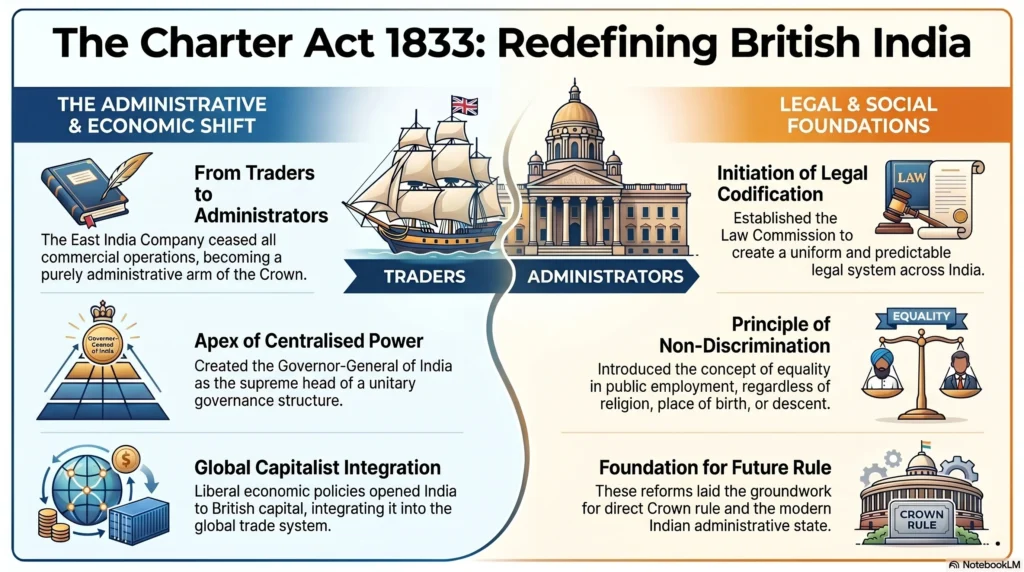
- One of the most significant changes introduced by the Act was the complete abolition of the East India Company’s trade monopoly, including its monopoly over tea and trade with China. This marked the end of the Company as a commercial enterprise. From this point onward, it functioned purely as an administrative body on behalf of the British Crown. In essence, the Company became a trustee managing Indian territories for Britain.
- Another major transformation was the centralisation of administrative authority. The Governor-General of Bengal was redesignated as the Governor-General of India, thereby making him the supreme authority over all British territories in India. This effectively subordinated the presidencies of Madras and Bombay, which lost their legislative powers and became largely administrative units. Lord William Bentinck became the first Governor-General of India under this system.
- The Act also introduced a centralised legislative framework. The Governor-General in Council was vested with exclusive legislative powers for the entire British India. Laws passed under this authority were called “Acts,” marking a shift toward a more formal legislative process. This ended the earlier system where different presidencies could make their own laws, leading to inconsistencies.
- A notable institutional innovation was the inclusion of a law member in the Governor-General’s Council for legislative purposes. This led to the appointment of Thomas Babington Macaulay as the first Law Member. His presence marked the beginning of systematic legal codification in India.
- In line with this, the Act provided for the establishment of the First Law Commission, which was tasked with codifying Indian laws. The outcome of this initiative was the eventual development of important legal codes, including the Indian Penal Code (drafted later).
- The Act also contained a progressive provision stating that no Indian shall be disqualified from holding any office under the Company on the basis of religion, race, caste, or place of birth. Although this principle was rarely implemented in practice, it became an important foundation for later demands of equality and representation by Indians.
- Another important administrative change was the centralisation of financial powers. The Governor-General of India was given authority over all revenues and expenditures of British India, further strengthening the centralised structure. Additionally, the Act of 1833 permitted free entry of Europeans into India, allowing them to settle, acquire property, and engage in economic activities. While this facilitated economic integration with Britain, it also accelerated colonial penetration into Indian society.
Significance of the Act
- The significance of the Act lies in the fact that it fundamentally reshaped the structure and nature of British governance in India.
- First, it marked the end of the East India Company as a commercial entity, completing its transformation into an administrative arm of the British state. This was a crucial step toward the eventual establishment of direct Crown rule in 1858.
- Second, the Act established a highly centralised administrative system, with the Governor-General of India at its apex. This laid the foundation for a unitary form of governance, which continued to influence Indian administration even after independence.
- Third, the Act initiated the process of legal codification, which brought a degree of uniformity and predictability to the legal system. The work of the Law Commission contributed significantly to the development of modern Indian law.
- Fourth, the provision regarding non-discrimination in public employment introduced the idea of equality in administration, even though it remained largely theoretical during colonial rule.
- Finally, the Act reflected the growing dominance of liberal economic policies, as it opened India completely to British trade and capital, integrating it more closely into the global capitalist system under British control.
Limitations of the Charter Act
- Despite its progressive features, the Charter Act of 1833 had several limitations that restricted its effectiveness and exposed the contradictions of colonial governance.
- One of the major drawbacks was the over-centralisation of power. Concentrating authority in the hands of the Governor-General created administrative bottlenecks and made governance less responsive to local conditions, especially in distant regions like Madras and Bombay.
- The Act also failed to provide adequate representation to Indians in governance. Although it proclaimed equality in public employment, the higher administrative services continued to be dominated by British officials.
- Another issue was the practical exclusion of Indians from decision-making processes, as the legislative and executive bodies remained overwhelmingly European in composition.
- The provision allowing free entry of Europeans, while economically beneficial for Britain, led to the exploitation of Indian resources and markets, contributing to the decline of indigenous industries.
- Additionally, although the Act aimed at legal uniformity, it did not clearly resolve judicial ambiguities, leading to conflicts between different authorities in practice.
Conclusion
The Charter Act of 1833 stands as a landmark in the constitutional history of India. It completed the transition of the East India Company from a trading organisation to a governing body and established a highly centralised administrative structure. At the same time, it introduced important reforms in legislation, law-making, and the idea of administrative equality.
However, the Act also highlighted the inherent contradictions of colonial rule. While it promoted administrative efficiency and legal reform, it continued to prioritise British interests over Indian welfare. Despite its limitations, it laid the groundwork for subsequent constitutional developments and played a crucial role in shaping the evolution of governance in colonial India.
FAQs
Q1. What is the Charter Act of 1833?
The Charter Act, 1833 was a landmark act passed by the British Parliament that transformed the role of the East India Company into a purely administrative body.
Q2. Why is the Charter Act of 1833 significant?
It marked the end of the Company’s commercial activities, making it solely responsible for governance in India.
Q3. What were the key provisions of the Act?
Governor-General of Bengal became Governor-General of India Centralisation of legislative powers End of Company’s trade monopoly completely Establishment of a Law Commission
Q4. Who was the first Governor-General of India?
Lord William Bentinck became the first Governor-General of India under this Act.
Q5. What was the role of the Law Commission?
The Law Commission, led by Thomas Babington Macaulay, worked on codification of laws, leading to the development of the Indian Penal Code.
Click on the question to see the Answers
Visit LevelUp IAS- Click Here
Related reads.

Coastal Landforms
28 Sep 2026 8 min

Medieval Indian Literature
28 Sep 2026 8 min

Ocean Currents
26 Sep 2026 7 min

Ancient Indian Literature
26 Sep 2026 6 min

Salinity Distribution in Oceans
25 Sep 2026 6 min

Folk Theatre of India
25 Sep 2026 5 min
Put it into practice
Reading is step one.
Turn what you've just read into exam-ready answers with mentor-led practice and our structured test series.