
Mains Articles
Cripps Mission, Cabinet Mission and Mountbatten Plan
Content
- Introduction
- Cripps Mission (1942)
- Cabinet Mission (1946)
- Mountbatten Plan (1947)
- Comparative Overview
- Conclusion
- FAQs
Introduction
The final phase of India’s freedom struggle was dominated by constitutional negotiations between Indian leaders and the British Government. The Cripps Mission, Cabinet Mission, and Mountbatten Plan were three major constitutional developments that ultimately led to the transfer of power and the partition of India. These events are extremely important in Modern History because they explain how the British gradually moved from limited constitutional concessions to complete withdrawal from India.
Cripps Mission (1942)
The Cripps Mission was sent to India in March 1942 under the leadership of Sir Stafford Cripps during the Second World War. At that time, the British Empire was under severe pressure because Japan had rapidly captured large parts of Southeast Asia, including Singapore and Burma, and the threat to India appeared real. Britain urgently required Indian political and military support for the war effort.
International pressure also played an important role. Countries such as the United States, Soviet Union, and China wanted Britain to adopt a more liberal policy toward India. Moreover, the failure of the August Offer and growing dissatisfaction among Indian nationalists forced the British government to attempt another constitutional compromise.
The mission proposed that after the end of the war, India would be granted Dominion Status and would have the right to frame its own Constitution through a Constituent Assembly. Provinces unwilling to join the Indian Union would have the option to remain outside it or frame separate constitutions. The British, however, decided to retain control over defence during the war period.
The proposals failed to satisfy Indian political groups. Congress opposed the plan because it did not promise immediate transfer of power and allowed provinces to secede, which threatened Indian unity. Mahatma Gandhi famously described the offer as:
“A post-dated cheque drawn on a failing bank.”
The Muslim League was also dissatisfied because the plan did not clearly accept the demand for Pakistan. Hindu Mahasabha, Sikhs, and several minority groups also rejected the proposals for different reasons.
Although unsuccessful, the Cripps Mission was historically significant because it was the first British proposal that accepted the idea of Indians framing their own Constitution. It also indirectly recognised the possibility of partition. Its failure further intensified nationalist anger and became one of the immediate reasons behind the launch of the Quit India Movement in 1942.
Cabinet Mission (1946)
By 1946, British rule in India had become extremely weak. The impact of the Quit India Movement, growing unrest within the armed forces, especially after the Royal Indian Navy Revolt, and Britain’s economic exhaustion after World War II convinced the British government that power transfer could no longer be delayed.
In this background, the Cabinet Mission was sent to India in March 1946. The mission consisted of Lord Pethick-Lawrence, Stafford Cripps, and A.V. Alexander. Its primary objective was to create a constitutional framework for independent India while preserving the unity of the country.
The mission rejected the Muslim League’s demand for a completely sovereign Pakistan because it believed partition would create serious administrative, economic, and military problems. Instead, it proposed a three-tier federal structure consisting of the Union Government, provincial groups, and provinces. The Union would control only defence, foreign affairs, and communications, while provinces would enjoy maximum autonomy.
To accommodate communal concerns, provinces were divided into three groups. Group A consisted mainly of Hindu-majority provinces, Group B included Muslim-majority provinces of northwest India, and Group C contained Bengal and Assam. This grouping arrangement later became the most controversial part of the plan.
The mission also proposed the formation of a Constituent Assembly consisting of representatives from provinces and princely states for drafting the Constitution of India. Alongside this, an Interim Government was to be formed before complete independence.
Congress accepted the idea of a Constituent Assembly but opposed compulsory grouping of provinces because it feared excessive provincial autonomy could weaken national unity. The Muslim League initially accepted the plan because grouping strengthened Muslim-majority regions, but later rejected it after Congress objections.
The breakdown of agreement between Congress and the League led the Muslim League to announce, Direct Action Day on 16 August 1946, which resulted in severe communal violence across the country.
Ultimately, the Cabinet Mission failed because Congress and the Muslim League interpreted the grouping provisions differently and neither side was willing to compromise. Its failure convinced the British that partition had become unavoidable.
Mountbatten Plan (1947)
As communal violence intensified and constitutional negotiations collapsed, the British government decided to transfer power at the earliest possible date. British Prime Minister Clement Attlee announced Britain’s intention to leave India.
Lord Louis Mountbatten was appointed as the final Viceroy to oversee the transfer of power.
On 3 June 1947, Mountbatten announced the famous Mountbatten Plan, also known as the 3 June Plan. Unlike earlier constitutional proposals, this plan accepted the partition of India as the only practical solution to the political deadlock between Congress and the Muslim League.
The plan proposed the creation of two independent dominions India and Pakistan. Punjab and Bengal were to be partitioned after separate voting in their legislative assemblies. Referendums were also to be held in the North-West Frontier Province and Sylhet district of Assam to determine their future.
Boundary Commissions under:
Cyril Radcliffe were established to demarcate the borders between India and Pakistan. Princely states were given the option to join either dominion based on geographical and practical considerations.
The British Parliament subsequently passed the:
Indian Independence Act which formally ended British rule in India and created the two independent dominions of India and Pakistan on 15 August 1947.
Although the Mountbatten Plan succeeded in transferring power quickly, its aftermath was tragic. Partition led to unprecedented communal violence, mass migration, and large-scale human suffering. Millions of people crossed borders, and hundreds of thousands lost their lives.
Comparative Overview
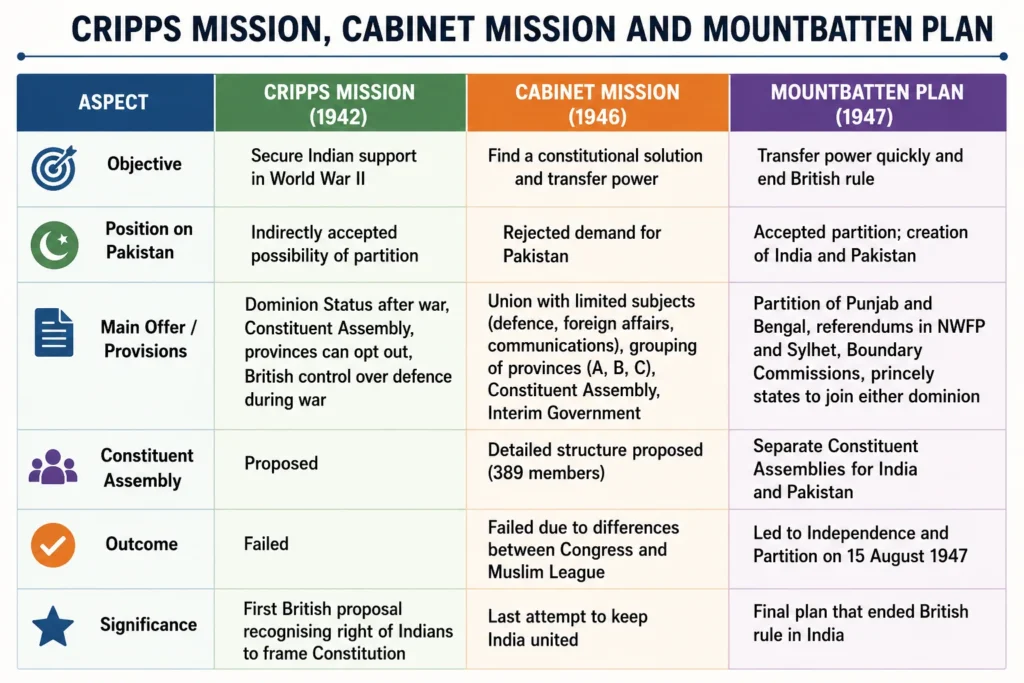
| Aspect | Cripps Mission (1942) | Cabinet Mission (1946) | Mountbatten Plan (1947) |
| Main Objective | Secure Indian support during WWII | Constitutional settlement | Transfer of power |
| Position on Pakistan | Indirect possibility accepted | Rejected Pakistan | Accepted partition |
| Nature of Proposal | Dominion Status after war | Federal structure with grouping | Partition and independence |
| Constituent Assembly | Proposed | Detailed structure provided | Separate assemblies for two dominions |
| Outcome | Failed | Failed | Led to Independence and Partition |
Conclusion
The Cripps Mission, Cabinet Mission, and Mountbatten Plan represent the final constitutional stages of India’s freedom struggle. Together, they reveal the decline of British imperialism, the growing communal divide, and the increasing inability of Congress and the Muslim League to reach a common constitutional settlement. While the Cripps Mission and Cabinet Mission failed to resolve political differences, the Mountbatten Plan ultimately led to independence though at the heavy cost of partition and communal tragedy.
FAQs
Q1. What was the Cripps Mission?
The Cripps Mission was sent by the British government in 1942 under Stafford Cripps to secure Indian cooperation during the Second World War by offering post-war constitutional reforms.
Q2. Why did the Cripps Mission fail?
It failed because:
British proposals were considered vague and unsatisfactory
Congress demanded immediate self-government
The Muslim League insisted on Pakistan
Q3. What was the Cabinet Mission?
The Cabinet Mission was sent in 1946 to propose a constitutional framework for India and avoid partition.
Q4. What were the main proposals of the Cabinet Mission Plan?
Key proposals included:
Interim government at the centre
Formation of a Union of India with limited powers
Grouping of provinces into sections
Formation of a Constituent Assembly
Impact of the Second World War
Q5. Why did the Cabinet Mission Plan fail?
Differences between the Indian National Congress and the All-India Muslim League over grouping and powers led to its collapse.
Click on the question to see the Answers
Visit LevelUp IAS- Click Here
Related reads.
How to Read NCERTs for UPSC: Subject-Wise Strategy & Notes Making
22 Jun 2026 10 min
PSIR Topper's Answer Copies
22 Jun 2026 1 min
Sociology Optional PYQs (2009-2024)
22 Jun 2026 1 min
Philosophy Optional PYQs
22 Jun 2026 1 min
PSIR Optional PYQs
22 Jun 2026 1 min
History Optional PYQs (2009-2025) – Free PDF & Video
22 Jun 2026 1 min
Put it into practice
Reading is step one.
Turn what you've just read into exam-ready answers with mentor-led practice and our structured test series.