
Mains Articles
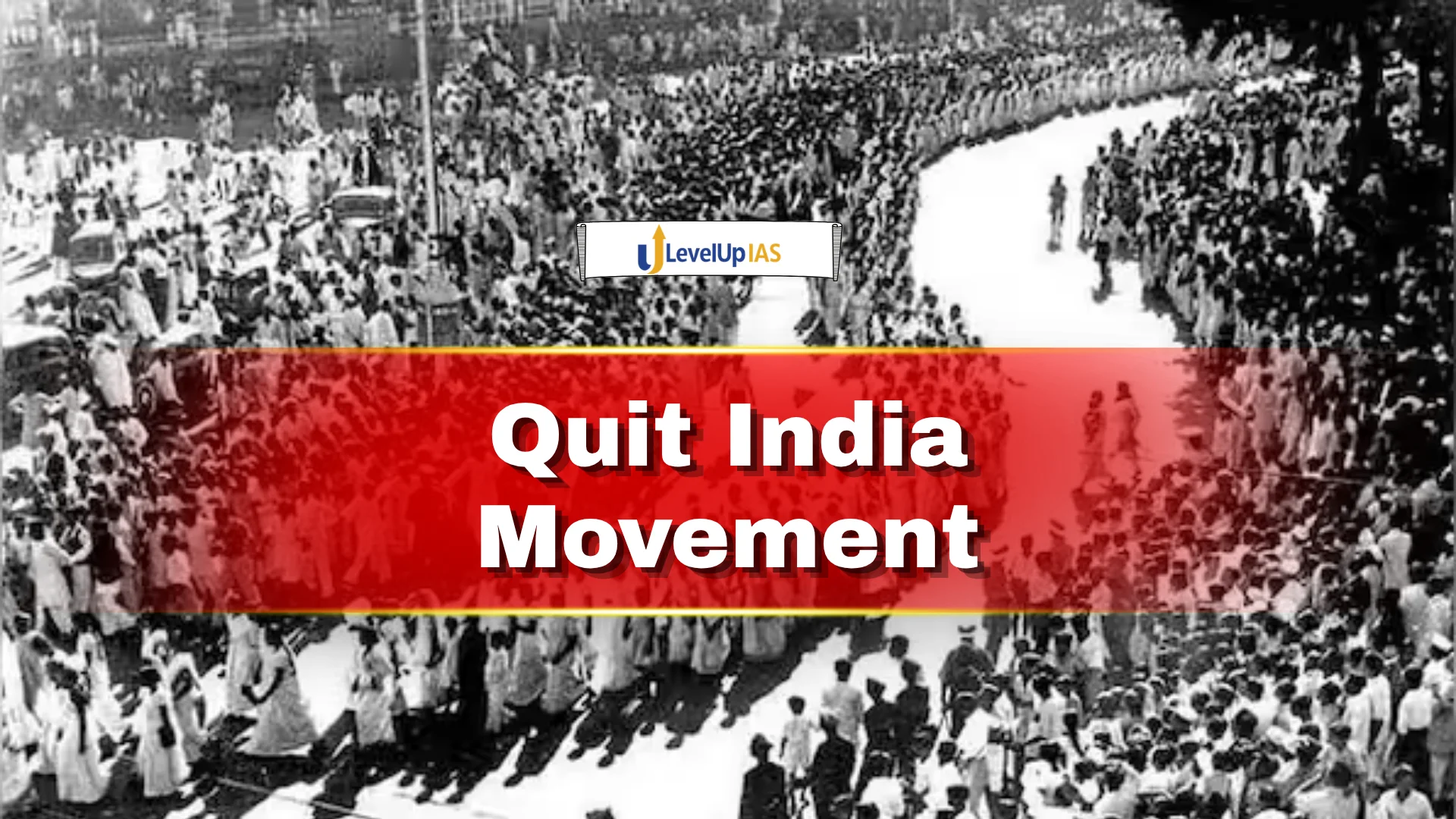
Quit India Movement
Content
- Introduction
- Background
- Causes
- Nature and Methods
- Spread of the Movement
- Parallel Governments
- Participation of Different Social Groups
- Government Response
- Limitations
- Significance of the Formation of INC
- Conclusion
- FAQs
Introduction
The Quit India Movement was the final great mass movement launched by the Indian National Congress under the leadership of Mahatma Gandhi against British colonial rule. Initiated on 8 August 1942, the movement marked the most intense and widespread anti-colonial uprising since the Revolt of 1857. Gandhi gave the historic slogan “Do or Die”, urging Indians to fight relentlessly for independence.
The movement is also known as the August Kranti Movement because it represented a decisive rejection of British authority. Unlike earlier Gandhian movements that focused mainly on disciplined satyagraha, the Quit India Movement quickly developed into a nationwide revolt involving strikes, sabotage, underground activities, and the establishment of parallel governments in several regions.
Although the movement was suppressed by the British within a short period, it permanently weakened colonial authority and demonstrated that British rule in India could no longer continue without massive coercion.
Background
The Quit India Movement emerged during the difficult years of the Second World War. By the early 1940s, political dissatisfaction, economic hardship, and nationalist sentiment had reached unprecedented levels.
The immediate background of the movement was the failure of the Cripps Mission. The British government had sent Sir Stafford Cripps to India in March 1942 with proposals for constitutional reforms in return for Indian support during the war. However, the proposals did not promise immediate self-government and allowed provinces the option to separate from India in the future. Congress rejected these proposals because they fell far short of nationalist expectations.
The British government’s attitude further deepened Indian resentment. Although India was deeply involved in the war effort, Indians had no effective role in decision-making. Simultaneously, the British government continued repressive policies while also indirectly encouraging communal divisions through support to the Muslim League’s demand for Pakistan.
Economic conditions also worsened sharply during the war. Rising prices, shortages of essential commodities, increased taxation, and forced procurement policies created severe hardships for ordinary Indians. The wartime economy led to inflation and food scarcity, especially in eastern India, eventually contributing to the Bengal Famine.
International developments further encouraged Indian nationalism. British defeats in Southeast Asia and the rapid Japanese advance towards India shattered the myth of British invincibility. The fall of Burma created fear that India itself could become vulnerable to invasion. Many Indians believed that only a free national government could effectively defend the country.
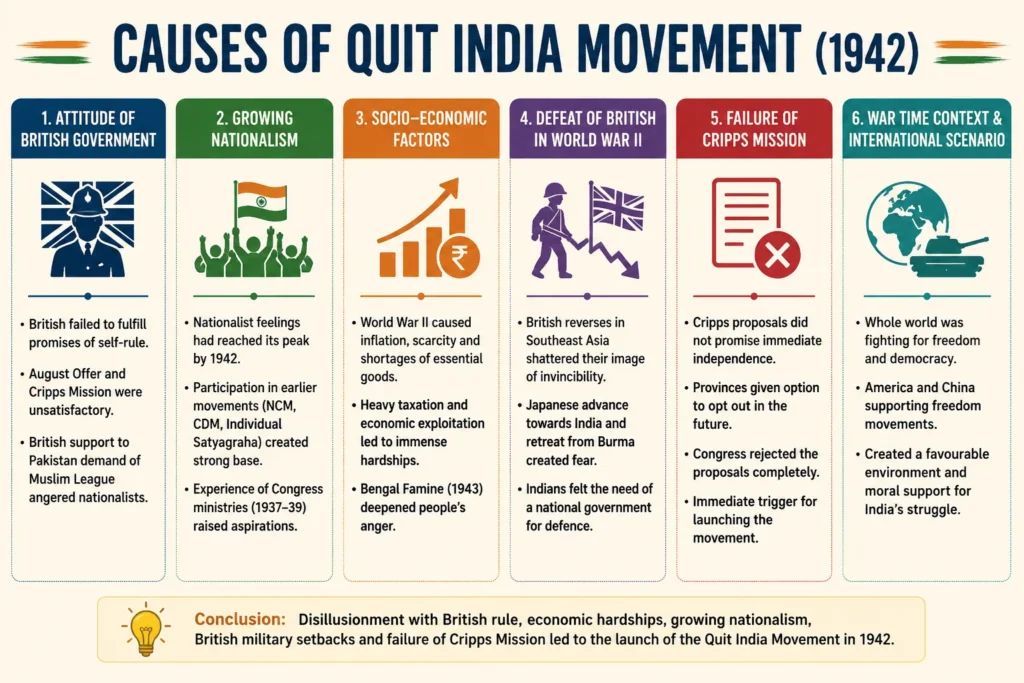
Causes of the Quit India Movement
Failure of Constitutional Negotiations:
The failure of the August Offer, Cripps Mission, and earlier constitutional reforms convinced Congress that the British government had no genuine intention of granting freedom.
Growth of Nationalism:
By 1942, Indian nationalism had become deeply rooted among the masses. Earlier movements such as the Non-Cooperation Movement and Civil Disobedience Movement had already politicised millions of Indians.
The period of Congress provincial ministries between 1937 and 1939 had also given Indians a limited experience of self-government, increasing aspirations for complete independence.
Economic Hardships During World War II:
The war caused inflation, unemployment, food shortages, and economic distress. Common people suffered greatly due to rising prices and scarcity of goods.
British Military Failures:
British defeats in Southeast Asia and their retreat from Burma weakened confidence in imperial power. Many Indians believed that British rule was collapsing and that the time for independence had arrived.
Immediate Trigger: Failure of the Cripps Mission:
The rejection of Congress demands during the Cripps negotiations became the immediate trigger for launching the movement.
Launch of the Movement
The decision to launch the movement was taken at the meeting of the Congress Working Committee at Wardha in July 1942.
The historic resolution was finally passed by the All India Congress Committee Session at Gowalia Tank on 8 August 1942.
In his famous speech, Gandhi called upon Indians to “Do or Die.” He appealed to every Indian to consider themselves free and to resist British authority through mass struggle.
The main demands of the movement included:
- Immediate end of British rule in India,
- Formation of a provisional national government,
- Recognition of India’s right to freedom.
Nature and Methods of the Movement
The Quit India Movement differed significantly from earlier Gandhian movements.
Unlike the Non-Cooperation and Civil Disobedience Movements, which were carefully organised and centrally directed, the Quit India Movement became largely decentralised after the arrest of Congress leaders.
The movement was more militant and radical in character. Gandhi himself recognised the intense anger among the masses and accepted that resistance could become violent under conditions of severe repression.
Another important feature was its grassroots nature. Local activists, students, peasants, workers, and underground revolutionaries took leadership in different regions.
The movement also witnessed:
- Emergence of parallel governments.
- Sabotage of railways and telegraph lines,
- Attacks on police stations and government offices,
- Formation of underground networks,
Spread of the Movement Across India
The Quit India Movement spread rapidly across India, especially in Bihar, eastern Uttar Pradesh, Maharashtra, Bengal, and Odisha.
Students played a major role in organising protests, strikes, and demonstrations. Educational institutions became centres of nationalist activity.
Peasants participated actively in many rural areas, particularly in Bihar and eastern Uttar Pradesh, where resentment against colonial administration was strong.
In Bengal and Odisha, tribal communities joined anti-British protests.
Women also played a remarkable role by organising demonstrations, carrying secret messages, and sheltering underground activists.
The movement witnessed widespread destruction of symbols of colonial authority such as:
- Government buildings.
- Railway tracks,
- Telegraph lines,
- Post offices,
- Police stations,
Parallel Governments
One of the unique features of the Quit India Movement was the emergence of parallel governments in several regions.
| Region and Year | Leaders | Major Activities |
| Ballia (1942) | Chittu Pandey | Released imprisoned Congress leaders and temporarily took over local administration |
| Tamluk, Bengal (1942-44) | Satish Chandra Samanta | Formation of Jatiya Sarkar, relief work, schools, local administration, Vidyut Vahinis |
| Satara, Maharashtra (1943-45) | Nana Patil and Yashwantrao Chavan | Establishment of Prati Sarkar, people’s courts, village reforms, prohibition campaigns |
These parallel governments demonstrated the weakening of British administrative authority in certain regions.
Participation of Different Social Groups
Students and Youth:
Students emerged as the most active force in the movement. In Bihar and eastern Uttar Pradesh, student activists organised strikes, demonstrations, and underground activities.
Peasants:
Peasant participation was strong in several regions where economic hardships and resentment against colonial policies already existed.
Women:
Women participated actively in protests, underground networks, and relief work. Leaders such as Aruna Asaf Ali became symbols of courage and resistance.
Government Employees:
Some lower-level officials and policemen secretly helped the movement by passing information to activists.
Tribals:
Tribal communities participated in parts of Bengal and Odisha, especially in areas affected by colonial forest policies.
Government Response
The British government suppressed the movement with massive force.
Thousands of people were arrested, public meetings were banned, and police firing became common. Official figures reported over one thousand deaths, though actual numbers were probably much higher.
The British also used:
- Air attacks in some areas,
- Collective fines,
- Mass detentions,
- Torture and raids,
- Strict censorship.
Despite repression, the movement continued in underground form until 1944.
Significance
The Quit India Movement was a turning point in India’s freedom struggle.
First, it represented the most widespread and radical anti-colonial uprising after 1857. It demonstrated that British rule survived only through military repression.
Second, the movement had a strong grassroots character. Unlike earlier movements, ordinary people took leadership at the local level, making it a true people’s movement.
Third, the movement weakened British moral authority and administrative confidence. The scale of unrest convinced many British officials that governing India without Indian cooperation was impossible.
Fourth, the movement gave rise to a new generation of leaders such as Jayaprakash Narayan, Ram Manohar Lohia, and Aruna Asaf Ali.
Finally, although independence was not achieved immediately, the Quit India Movement created the psychological and political conditions that made British withdrawal inevitable after the war.
Limitations and Decline of the Movement
The movement had several limitations despite its massive scale.
First, it lacked central leadership after the arrest of Congress leaders, which reduced coordination.
Second, several political groups opposed the movement, including:
- All-India Muslim League,
- Communist Party of India,
- Hindu Mahasabha.
Third, Muslim participation remained limited, and communal tensions increased during this period.
Finally, the movement did not immediately force the British to leave India.
Conclusion
The Quit India Movement was the final great mass struggle of the Indian freedom movement. It reflected the determination of Indians to achieve complete independence at any cost. Despite brutal repression and organisational difficulties, the movement shook the foundations of British rule in India.
Its greatest achievement was not immediate independence but the clear demonstration that the British Empire could no longer govern India against the will of its people. The movement prepared the ground for the final transfer of power in 1947 and remains one of the most powerful symbols of India’s anti-colonial struggle.
FAQs
Q1. What was the Quit India Movement?
The Quit India Movement was a nationwide mass movement launched by Mahatma Gandhi demanding the immediate withdrawal of British rule from India.
Q2. When was the Quit India Movement launched?
It was launched on 8 August 1942 during the Bombay session of the Indian National Congress.
Q3. What was the famous slogan associated with the movement?
Gandhi gave the famous slogan “Do or Die”, urging Indians to fight for freedom through mass struggle.
Q4. Why was the Quit India Movement launched?
Major reasons included:
Demand for complete independence
Failure of the Cripps Mission
Growing dissatisfaction with British rule
Impact of the Second World War
Q5. What was the British response to the movement?
The British government responded with severe repression, arresting Gandhi and other Congress leaders immediately after the movement began.
Click on the question to see the Answers
Visit LevelUp IAS- Click Here
Related reads.

How to Read NCERTs for UPSC: Subject-Wise Strategy & Notes Making
22 Jun 2026 10 min
PSIR Topper's Answer Copies
22 Jun 2026 1 min
Sociology Optional PYQs (2009-2024)
22 Jun 2026 1 min
Philosophy Optional PYQs
22 Jun 2026 1 min
PSIR Optional PYQs
22 Jun 2026 1 min
History Optional PYQs (2009-2025) – Free PDF & Video
22 Jun 2026 1 min
Put it into practice
Reading is step one.
Turn what you've just read into exam-ready answers with mentor-led practice and our structured test series.