
Mains Articles
Doctrine of Checks and Balances, Indian Polity
Content
- Concept and Meaning
- Relationship with Separation of Powers
- Instruments of Checks and Balances
- Limitations and Challenges
- Conclusion
- FAQs
Concept and Meaning
The doctrine of checks and balances is a fundamental principle of constitutional governance which ensures that each organ of the government, legislature, executive, and judiciary, acts as a restraint on the others to prevent concentration of power. The core idea is that no single authority should become absolute or arbitrary, thereby safeguarding democratic values and preventing authoritarianism.
This doctrine operates through institutional mechanisms that allow each branch to monitor, limit, and influence the functioning of the others. It reduces the scope for misuse of power, ensures accountability, and promotes adherence to constitutional obligations. Thus, it acts as a safeguard against errors, improper functioning, and centralisation of authority within the state.
Relationship with Separation of Powers
The doctrine of separation of powers provides for the division of governmental functions among three organs, legislature, executive, and judiciary. However, in the Indian context, this separation is not rigid. Instead, the system is characterised by functional overlap supported by checks and balances.
Checks and balances complement the separation of powers by ensuring that each organ operates within its constitutional limits while maintaining a system of mutual control. This combination prevents encroachment by one organ upon another and avoids the emergence of unchecked authority. Therefore, while separation ensures division, checks and balances ensure regulation and equilibrium.
Constitutional Basis in India:
The doctrine is not explicitly mentioned in the Constitution but is deeply embedded in its structure and provisions. Various Articles of the Constitution of India establish a system of interdependence and accountability among the three organs of government.
Instruments of Checks and Balances
The doctrine of checks and balances in India operates through a carefully designed network of constitutional provisions that create mutual accountability among the legislature, executive, and judiciary. These instruments are not merely procedural but substantive in ensuring that power remains distributed and controlled.
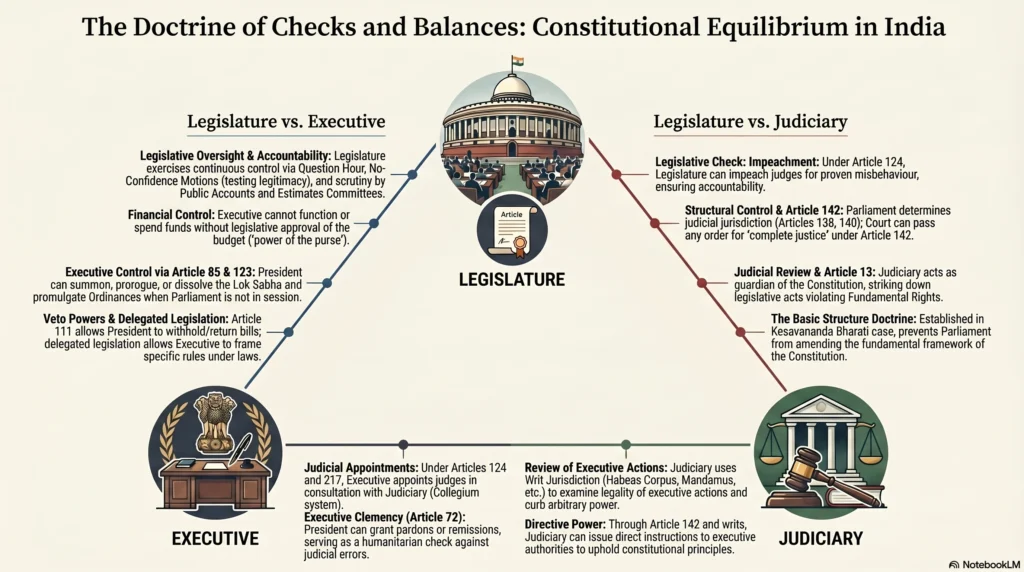
1. Checks and Balances between Legislature and Executive
In the Indian parliamentary system, the executive derives its authority from the legislature, making accountability the cornerstone of their relationship. The legislature exercises continuous control over the executive through several parliamentary devices.
- The most prominent among them is the Question Hour, during which ministers are required to respond to queries raised by Members of Parliament, thereby ensuring transparency and responsiveness.
- Similarly, motions such as the No-Confidence Motion directly test the legitimacy of the Council of Ministers, as the government must resign if it loses the confidence of the Lok Sabha.
Financial control is another critical instrument.
- The executive cannot function without legislative approval of the budget, and Parliament scrutinises government expenditure through discussions and committees.
- Parliamentary committees, such as the Public Accounts Committee and Estimates Committee, play a crucial role in the detailed examination of policies, expenditures, and administrative functioning, thereby acting as effective watchdogs over the executive.
On the other hand, the executive also exercises influence over the legislature through constitutional powers vested in the President.
- Under Article 85, the President can summon, prorogue, and dissolve the Lok Sabha, which directly affects the functioning of the legislature.
- The ordinance-making power under Article 123 enables the executive to legislate during the recess of Parliament, although such ordinances must later be approved by the legislature.
- The veto power under Article 111 allows the President to withhold assent, return a bill for reconsideration, or delay it (pocket veto), thus acting as a check on legislative actions.
- Additionally, delegated legislation empowers the executive to frame rules and regulations for implementing laws passed by Parliament. While this enhances administrative efficiency, it also gives the executive significant influence over law-making, thereby creating a balance of power.
2. Checks and Balances between Legislature and Judiciary
The relationship between the legislature and judiciary reflects a balance between law-making authority and constitutional supremacy.
- The legislature exercises certain controls over the judiciary, particularly through the power of impeachment of judges under Article 124. This ensures accountability of the higher judiciary, although the process is deliberately stringent to preserve judicial independence.
The legislature also determines the structure and jurisdiction of the judiciary.
- It can regulate the number of judges in the Supreme Court and High Courts and extend the jurisdiction of the Supreme Court under Articles 138 and 140. Moreover, when courts declare a law unconstitutional, the legislature has the power to amend the law or even the Constitution to overcome the judicial ruling, provided it does not violate the basic structure.
Conversely, the judiciary serves as the guardian of the Constitution and exercises powerful checks on legislative authority.
- Under Article 13, it can strike down laws that violate Fundamental Rights. This power of judicial review ensures that legislative actions remain within constitutional limits. The landmark doctrine of Basic Structure, evolved in Kesavananda Bharati v. State of Kerala, further restricts Parliament’s power by holding that it cannot alter the fundamental framework of the Constitution.
The judiciary also exercises writ jurisdiction under Articles 32 and 226 to protect citizens’ rights and can pass orders under Article 142 to ensure complete justice. These powers make the judiciary a crucial check against potential legislative excesses.
3. Checks and Balances between Executive and Judiciary
The executive and judiciary also maintain a delicate balance through mutual controls.
- The executive has an important role in the appointment of judges under Articles 124 and 217, although this power is now exercised in consultation with the judiciary through the collegium system. This ensures a degree of executive involvement without compromising judicial independence.
- The executive also has the power to grant pardons, reprieves, respites, or remissions under Article 72. This clemency power acts as a humanitarian check on judicial decisions, allowing correction of possible judicial errors or excessive punishments.
At the same time, the judiciary exercises significant control over the executive through judicial review.
- It can examine the legality and constitutionality of executive actions and strike them down if found arbitrary or violative of Fundamental Rights.
- The judiciary can also issue writs such as habeas corpus, mandamus, prohibition, certiorari, and quo warranto to ensure that the executive acts within its legal boundaries.
- Furthermore, under Article 142, the Supreme Court can pass any order necessary to do complete justice, which sometimes extends to directing executive authorities to take specific actions. This ensures that governance remains aligned with constitutional principles.
Limitations and Challenges
Despite its importance, the doctrine faces several challenges in practice. The lack of a clear demarcation of powers often leads to overlaps and institutional conflicts. Increasing centralisation of power in the executive, particularly in the Prime Minister’s Office, can weaken legislative oversight.
Judicial overreach is another concern, where the judiciary is perceived to intervene excessively in policy matters. Additionally, declining parliamentary effectiveness, reduced deliberation, and one-party dominance can weaken the legislature’s role in checking the executive.
Conclusion
The doctrine of checks and balances forms the backbone of India’s constitutional democracy. It ensures that power is distributed, regulated, and exercised responsibly. While challenges exist, strengthening institutional integrity and adherence to constitutional principles can enhance its effectiveness, thereby preserving democratic governance and the rule of law.
FAQs
Q1. What is the Doctrine of Checks and Balances?
The Doctrine of Checks and Balances refers to a constitutional principle where the legislature, executive, and judiciary restrain each other to prevent concentration of power.
Q2. What is the objective of this doctrine?
Its primary objective is to prevent abuse of power, ensure accountability, and maintain balance among the three organs of government.
Q3. How does the legislature check the executive?
The legislature exercises control through no-confidence motions, parliamentary questions, budget approval, and impeachment powers.
Q4. How does the executive check the legislature?
The executive can veto bills, promulgate ordinances, and influence legislative agenda, thereby checking the legislature.
Q5. How does the judiciary check the other organs?
The judiciary exercises judicial review, ensuring that laws and executive actions conform to the Constitution.
Click on the question to see the Answers
Visit LevelUp IAS- Click Here
Related reads.
How to Read NCERTs for UPSC: Subject-Wise Strategy & Notes Making
22 Jun 2026 10 min
PSIR Topper's Answer Copies
22 Jun 2026 1 min
Sociology Optional PYQs (2009-2024)
22 Jun 2026 1 min
Philosophy Optional PYQs
22 Jun 2026 1 min
PSIR Optional PYQs
22 Jun 2026 1 min
History Optional PYQs (2009-2025) – Free PDF & Video
22 Jun 2026 1 min
Put it into practice
Reading is step one.
Turn what you've just read into exam-ready answers with mentor-led practice and our structured test series.