UNSC, United Nations Security Council
Content
- Why in News?
- About UNSC
- Structure and Membership
- India and the UNSC
- Key Issues and Challenges with UNSC
- Way Forward
- Conclusion
Why in News?
The United Nations Security Council has once again come under scrutiny due to the use of veto power by permanent members. Recently, Russia and China vetoed a Council resolution aimed at reopening the Strait of Hormuz, despite the draft being significantly diluted to accommodate their concerns. This incident highlights the persistent issue of great power politics and the limitations of the UNSC in addressing critical global security challenges.
Additionally, in the ongoing Intergovernmental Negotiations (IGN) on UNSC reforms, Kuwait’s Permanent Representative to the UN has stated that India is “surely” a strong contender if the Council is expanded, further intensifying discussions on UNSC restructuring.
About UNSC: Origin and Mandate
The United Nations Security Council is one of the six principal organs established under the United Nations Charter in 1945. Its primary responsibility is the maintenance of international peace and security, making it the most powerful organ within the UN system. Unlike other UN bodies, decisions of the UNSC are legally binding on all member states, which significantly enhances its authority.
The Council performs multiple functions such as identifying threats to international peace, recommending peaceful settlement mechanisms, imposing sanctions, and authorising the use of force. Thus, it operates at the intersection of diplomacy, international law, and global security governance.
Structure and Membership
The UNSC consists of 15 members, each having one vote. It includes five permanent members (P5), the United States, Russia, China, the United Kingdom, and France—who possess veto power. The remaining ten members are non-permanent members elected by the UN General Assembly for a two-year term, based on equitable geographical representation.
The regional distribution ensures representation from different parts of the world: five seats for Africa and Asia, one for Eastern Europe, two for Latin America, and two for Western Europe and others. The presidency of the Council rotates monthly among its members, ensuring procedural balance.
Voting and Decision-Making Process
Each member of the UNSC has one vote, but decision-making follows a unique structure. Substantive decisions require at least nine affirmative votes, including the concurring votes of all five permanent members. This effectively gives the P5 veto power, as even a single negative vote from any permanent member can block a resolution.
Procedural matters, however, require only nine votes without the veto constraint. Additionally, non-members of the Council may participate in discussions without voting rights if their interests are directly affected.
India and the UNSC
- India has been an active participant in the UN system since its inception and has played a significant role in shaping global norms. It contributed to the drafting of the Universal Declaration of Human Rights and consistently opposed racial discrimination, particularly in South Africa.
- India has served multiple terms as a non-permanent member of the UNSC, most recently in 2021-22. Its contributions to UN peacekeeping are substantial, with over 160,000 troops deployed in 43 missions, making it one of the largest contributors globally.
- India’s claim for permanent membership is based on several factors, including its large population, growing economic strength, democratic credentials, civilisational heritage, and consistent commitment to multilateralism. It is also part of the G4 grouping (India, Germany, Japan, Brazil), which advocates for UNSC reforms.
Key Issues and Challenges with UNSC
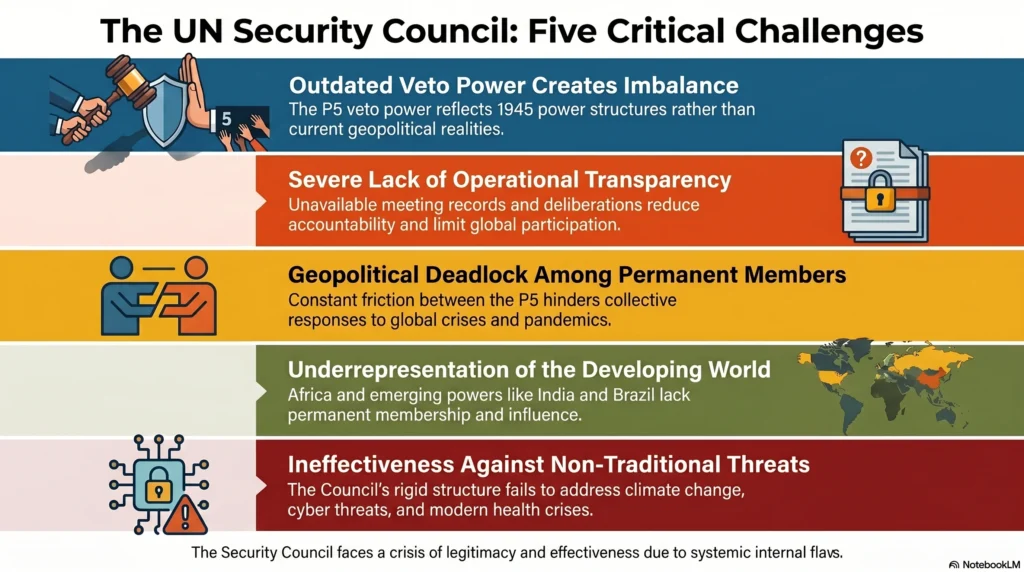
1. Veto Power and Power Imbalance
The veto power enjoyed by the P5 is often criticised as outdated and undemocratic. It reflects the power structure of 1945 rather than present-day geopolitical realities, leading to an imbalance in decision-making.
2. Lack of Transparency
UNSC deliberations lack transparency, as official records and detailed meeting texts are often unavailable. This reduces accountability and limits broader participation in global decision-making.
3. Geopolitical Divisions among P5
Frequent disagreements among permanent members often result in deadlock. For instance, divisions have hindered effective responses to global crises such as conflicts and pandemics, undermining the Council’s credibility.
4. Underrepresentation of Developing World
Regions like Africa and emerging powers such as India, Brazil, and Germany remain underrepresented in permanent membership. This raises concerns about legitimacy and inclusiveness.
5. Ineffectiveness in Modern Threats
The UNSC struggles to address non-traditional security threats such as climate change, cyber threats, and pandemics due to its rigid structure and political constraints.
Way Forward: Reforming the UNSC
- Reforming the UNSC has become imperative to make it more representative, accountable, and effective. Expansion in both permanent and non-permanent categories is widely suggested to reflect current geopolitical realities.
- India can play a proactive role by building consensus through diplomatic engagement, particularly with like-minded countries such as the G4 nations. It can also push for text-based negotiations within the IGN framework to accelerate reform.
- A reformed UNSC must aim to balance power with representation, ensuring that it remains relevant in addressing evolving global challenges while maintaining its core mandate of international peace and security.
Conclusion
The UNSC remains central to global governance, but its legitimacy is increasingly questioned due to structural and functional limitations. As global power dynamics shift, reforming the Council is not merely desirable but essential. India’s growing global stature and contributions position it as a strong candidate for permanent membership, aligning with the broader goal of making the UNSC more democratic and effective.
Visit LevelUp IAS- Click Here