
GS-I (History, Geography, Society)
Government of India Act, 1858
Content
- Introduction
- Background and Causes
- Key Provisions
- Queen Victoria’s Proclamation (1858)
- Significance of the Act
- Limitations of the Act
- Conclusion
- FAQs
Introduction
The Government of India Act, 1858, also known as the “Act for the Better Government of India,” marked a decisive turning point in the constitutional and administrative history of colonial India. It formally ended the rule of the British East India Company and transferred the governance of India directly to the British Crown. This transition inaugurated the period of the British Raj, which continued until India’s independence in 1947.
The Act was enacted in the aftermath of the Revolt of 1857, which exposed serious administrative, military, and political shortcomings in the Company’s rule and necessitated a fundamental restructuring of governance in India.
Background
- The roots of the Government of India Act, 1858, lie in the widespread discontent that culminated in the Revolt of 1857, often described as the First War of Indian Independence.
- The revolt was not merely a military uprising but a reflection of deeper political, economic, and social grievances against the policies of the British East India Company.
- Excessive revenue extraction, annexation policies such as the Doctrine of Lapse, disregard for traditional institutions, and interference in socio-religious practices contributed to the growing unrest.
- The failure of the Company to effectively manage such a large and diverse territory became evident during the revolt. It highlighted the need for a more centralized and accountable system of governance.
- In response, the British Parliament decided to abolish Company rule and assume direct control over Indian territories. The initial proposal for this change was introduced by British Prime Minister Lord Palmerston. After political changes in Britain, Edward Stanley reintroduced the bill, which was eventually passed as the Government of India Act, 1858.
Nature and Purpose of the Act:
The Act aimed to establish a more centralized and efficient administrative system under direct Crown control. It sought to ensure better coordination between British authorities in India and the government in Britain while addressing the administrative weaknesses that had led to the Revolt of 1857. The Act did not introduce democratic governance or Indian participation but rather strengthened imperial control through institutional reorganization.
Key Provisions of the Government of India Act, 1858
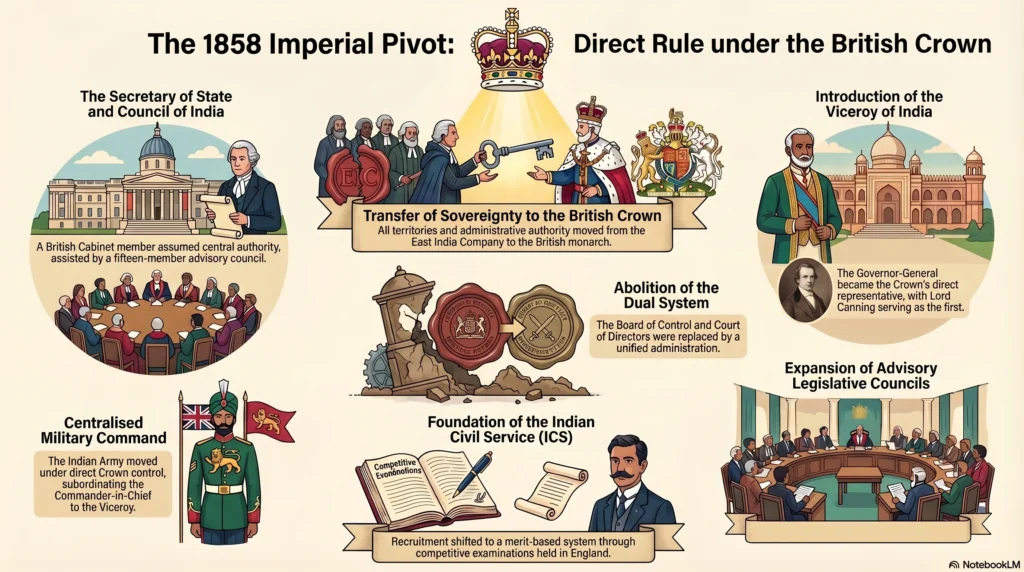
- One of the most significant features of the Act was the complete transfer of power from the East India Company to the British Crown. All territories, revenues, and administrative authority previously held by the Company were vested in the British monarch. This marked the formal end of Company rule and the beginning of direct imperial governance.
- To facilitate this new arrangement, the Act created the office of the Secretary of State for India, a powerful member of the British Cabinet. This office became the central authority responsible for Indian affairs. The Secretary of State was assisted by a Council of India consisting of fifteen members. While the council had an advisory role, the real decision-making authority rested with the Secretary of State, who could even send secret communications to India without consulting the council.
- The Governor-General of India was designated as the Viceroy, representing the British Crown in India. This change was symbolic as well as functional, reflecting the direct authority of the Crown. Lord Canning became the first Viceroy under this new system. The Viceroy exercised executive authority in India but remained subordinate to the Secretary of State.
- Another important provision was the abolition of the dual system of governance established under Pitt’s India Act of 1784. The Board of Control and the Court of Directors were abolished, thereby eliminating the system of double government and creating a unified administrative structure.
- The Act also brought the Indian Army under the direct control of the Crown. The Commander-in-Chief became subordinate to the Governor-General, ensuring centralized military command. This was considered essential in the wake of the 1857 revolt, where the loyalty and organization of the army had become critical concerns.
- In terms of administration, the Act reorganized the civil services. It laid the foundation for the Indian Civil Services (ICS), which was to be based on merit through competitive examinations. Although theoretically open to Indians, in practice, entry barriers such as examinations held in England limited Indian participation.
- The Act also provided for the expansion of legislative councils at the central and provincial levels. However, these councils remained largely advisory and dominated by British officials. Indian representation was minimal and did not reflect the diversity or aspirations of Indian society.
Queen Victoria’s Proclamation (1858)
A significant political and symbolic development associated with the Act was the proclamation issued by the British monarch on November 1, 1858. Queen Victoria formally announced the transfer of power and laid down the principles of governance under the Crown.
The proclamation assured Indian princes that their territories and rights would be respected, thereby abandoning aggressive annexation policies like the Doctrine of Lapse. It also promised non-interference in religious matters, which was intended to address fears of cultural and religious imposition. Additionally, it declared that Indian subjects would be treated equally under the law, although in practice, racial discrimination continued.
The proclamation played a crucial role in stabilizing British rule after the upheaval of 1857 by attempting to gain the loyalty of Indian rulers and elites.
Significance of the Act
- The Government of India Act, 1858, holds immense significance in the constitutional development of India. It marked the Beginning of the British Raj, a period characterized by direct imperial control and centralized administration. By ending Company rule, the Act brought India under the direct supervision of the British Parliament, making governance more accountable, at least in theory.
- The Act also laid the foundation for a centralized bureaucratic structure that became the hallmark of colonial administration. Institutions such as the office of the Secretary of State and the Indian Civil Services played a pivotal role in shaping governance in India for decades.
- Another important aspect was the shift in British policy towards Indian princely states. Instead of annexation, the British adopted a policy of indirect rule, allowing princes to retain their territories in exchange for loyalty to the Crown. This ensured political stability and reduced the likelihood of widespread rebellions.
- Furthermore, the Act served as a precursor to subsequent constitutional developments. It paved the way for later reforms, including the Indian Councils Acts and ultimately the Government of India Act, 1935, which introduced greater Indian participation in governance.
Limitations of the Act
- Despite its importance, the Government of India Act, 1858, had several limitations that restricted its effectiveness in addressing Indian aspirations. One of the most significant shortcomings was the absence of meaningful Indian representation. The administrative structure remained dominated by British officials, and Indians had little or no role in decision-making processes.
- The Act also led to excessive centralization of power. Authority was concentrated in the hands of the Secretary of State and the Viceroy, leaving little autonomy for provincial governments. This centralized system often failed to address local needs and complexities.
- Another major limitation was the continuation of colonial exploitation. While the administrative framework was reorganized, the underlying objective of British rule remained economic exploitation and political control. Issues such as land revenue policies, economic drain, and social inequalities were not addressed.
- The Act also failed to establish a comprehensive constitutional framework. It focused primarily on administrative restructuring rather than creating institutions for representative governance. As a result, it did not provide any roadmap for political participation or self-governance.
- Moreover, although the civil services were theoretically open to Indians, practical barriers ensured that higher administrative positions remained largely inaccessible to them. This reinforced the dominance of British officials and limited opportunities for Indian advancement.
Conclusion
The Government of India Act, 1858, was a landmark legislation that transformed the governance of India by transferring power from the East India Company to the British Crown. It established a centralized administrative structure, introduced new institutions, and marked the beginning of the British Raj. While it brought administrative stability after the Revolt of 1857, it failed to address the aspirations of the Indian people and continued the colonial framework of governance.
FAQs
Q1. What is the Government of India Act, 1858?
The Government of India Act, 1858 was a landmark law passed by the British Parliament that ended the rule of the East India Company and transferred control of India to the British Crown.
Q2. Why was the Act of 1858 enacted?
It was enacted in response to the Revolt of 1857, which exposed administrative weaknesses and led to major political changes.
Q3. What were the key provisions of the Act?
Abolition of East India Company rule
Introduction of the office of the Secretary of State for India
Establishment of the Council of India to assist him
Governor-General designated as Viceroy, representing the Crown
Q4. Who became the first Viceroy of India?
Lord Canning became the first Viceroy under this Act.
Q5. What was Queen Victoria’s Proclamation (1858)?
It was a declaration by Queen Victoria assuring Indians of religious tolerance, equal treatment under law, and non-interference in traditional practices.
Click on the question to see the Answers
Visit LevelUp IAS- Click Here
Related reads.

Coastal Landforms
28 Sep 2026 8 min

Medieval Indian Literature
28 Sep 2026 8 min

Ocean Currents
26 Sep 2026 7 min

Ancient Indian Literature
26 Sep 2026 6 min

Salinity Distribution in Oceans
25 Sep 2026 6 min

Folk Theatre of India
25 Sep 2026 5 min
Put it into practice
Reading is step one.
Turn what you've just read into exam-ready answers with mentor-led practice and our structured test series.