How to Read the Newspaper in 40 Minutes for UPSC
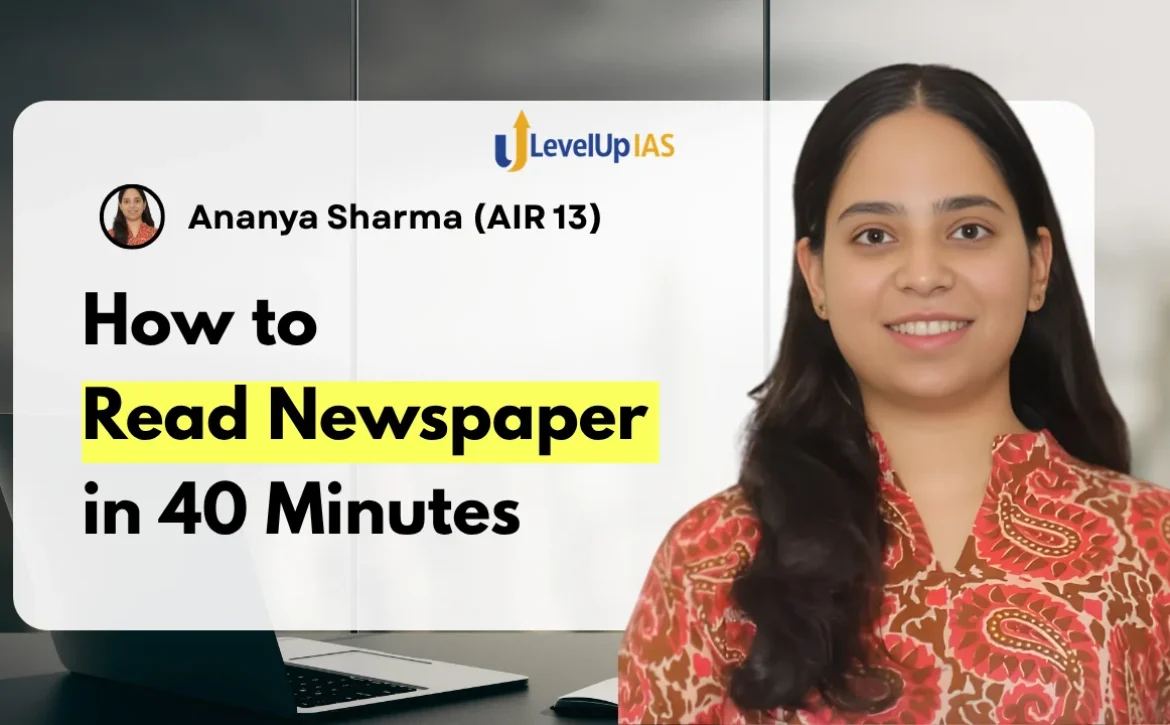
Intro – Ananya Sharma
- UPSC Rank: Secured All India Rank (AIR) 13 in the UPSC Civil Services Examination 2025
- Optional Subject: Sociology
- Place of Study: Completed schooling at Daly College, Indore, Madhya Pradesh.
- Graduation: B.A. (Hons.) in Economics.
- University/College: Graduated from Hindu College, Delhi.
- Background: Economics graduate who transitioned into full-time UPSC preparation. Her success has been attributed to disciplined self-study, structured mentorship, consistent answer-writing practice, and conceptual clarity across all stages of the examination.
How to Read the Newspaper in 40 Minutes for UPSC
For many UPSC aspirants, the newspaper is the biggest hurdle in their daily schedule, often consuming hours of valuable time. However, Ananya Sharma (AIR 13) reveals that with the right strategy, you can filter the news effectively and complete your reading in under 1 hour.
Here is a comprehensive guide on how to master newspaper reading for the UPSC Civil Services Examination.
1. Build Your Foundation First
The newspaper will only start making sense once you have covered the basics of your syllabus, such as Geography, Economy, and Polity. Without this foundation, you will struggle to understand technical terms, especially in the Economy section, where knowing the difference between depreciation, fiscal deficit, and current account is vital to making linkages. Additionally, being thorough with Previous Year Questions (PYQs) and the official syllabus helps you identify which topics deserve 60% of your attention versus those that only need 30%.
2. The Art of “Linkage” Across GS Papers
The secret to efficient newspaper reading is identifying how a news item connects to the General Studies (GS) papers:
- GS2 (Polity & Governance): Look for keywords like Citizenship, the Judiciary, or constitutional/non-constitutional bodies like the ED and CBI. Even political news can be relevant if it impacts Federalism or center-state relations.
- GS3 (Economy, Security, Environment): News about cyber security or “digital arrests” links directly to internal security. Use reports on new coal mines in conservation zones as examples of the “nature vs. development” debate.
- GS4 (Ethics): Local news about slum relocation or data privacy gaps at visa centers can be transformed into excellent fodder for ethics case studies.
- Sociology/Social Issues: Use data on the increasing number of female IAS officers as an example of women empowerment, or use news of communal disputes to discuss social disharmony.
3. What to Read vs. What to Skip
To stay under the one-hour limit, you must be ruthless with your filtering:
- Skip Political Rallies: Avoid general political news unless it highlights a constitutional keyword.
- Local/City News: Generally skip these during Prelims and Mains. They only become important during the Interview phase to show awareness of your own locality.
- Sports: This section offers a low Return on Investment (ROI) and can usually be avoided unless there is a major governance issue involved.
- High-Value Sections: Prioritize the “Explained” section (Indian Express) or the “FAQ” page (The Hindu). These cover topics extensively in a question-answer format that is easy to replicate in exam answers.
4. Smart Note-Making Strategy
Ananya Sharma advises against making notes for Prelims because the sheer volume of daily information is impossible to revise. Instead:
- Notes for Mains Only: Only write down points that provide value addition, such as specific data, committee suggestions, or unique anecdotes.
- Use Monthly Magazines: Supplement your reading with a monthly current affairs magazine, which systematically categorizes news for Prelims and Mains, saving you the effort of manual compilation.
- Check Author Credibility: When reading the OPED (Opinion-Editorial) page, look for authors with high credibility, such as former Election Commissioners or UN dignitaries, as their suggestions can be directly used as solutions in your answers.
5. Leveraging Global News
The World/Global page is essential for both Prelims mapping and GS2 International Relations (IR). Focus on regions that have been in the news for 6-8 months, as UPSC tends to ask about these. For example, if a conflict is mentioned, identify the surrounding countries and key water bodies, such as the Strait of Hormuz.
By focusing on smart linkages and staying disciplined with the 1-hour rule, you can turn the newspaper from a time-consuming chore into your most powerful tool for value addition
To know her strategy in detail, watch the video – https://youtu.be/7T4D9NNhA1U?si=npnfP8YIF0yjawxK
Visit LevelUp IAS- Click Here