
General
Regulating Act, 1773
Content
- Introduction
- Background and Causes
- Objectives
- Key Provisions
- Significance of the Act
- Limitations of the Act
- Amending Act of 1781
- Conclusion
- FAQs
Introduction
The Regulating Act of 1773 marked a decisive turning point in the constitutional and administrative history of British India. It was the first major attempt by the British Parliament to regulate the affairs of the East India Company, thereby initiating formal governmental control over Indian territories. Though limited in scope, the Act laid the foundation of centralised administration and parliamentary oversight, which later evolved into full-fledged colonial governance.
Background
- The enactment of the Regulating Act was driven by a combination of financial crisis, administrative failure, and moral concerns surrounding the functioning of the East India Company.
- By the early 1770s, the Company was facing severe financial distress due to corruption, mismanagement, and excessive territorial expansion. The situation worsened after the Bengal Famine of 1770, which led to massive loss of life, decline in agricultural productivity, and reduced revenue collection.
- At the same time, the Dual Government system introduced by Robert Clive where the Company exercised revenue powers (Diwani) while the Nawab retained administrative authority (Nizamat) created confusion and inefficiency. In reality, the Company controlled both, but neglected governance and welfare in favour of revenue extraction.
- The Company also accumulated heavy debts and sought financial assistance from the British government. This compelled Parliament to intervene, leading to the passage of the Regulating Act in 1773.
Objectives of the Regulating Act, 1773
The Regulating Act was essentially an attempt by the British Parliament to bring order to the chaotic administration of the East India Company. The primary concern was not just financial recovery, but also restoring credibility and control over a company that had gradually transformed into a political power in India.
One of the central objectives was to introduce greater accountability in governance. The British government realised that unchecked authority in distant territories had led to corruption and inefficiency. Therefore, the Act aimed to ensure that the Company’s officials operated under stricter supervision.
Another important objective was the centralisation of administrative authority, so that decision-making could be more coordinated rather than fragmented across presidencies. At the same time, Parliament sought to establish its own indirect control over Indian affairs, marking the beginning of a new phase where the Company was no longer entirely autonomous.
In essence, the Act tried to balance two goals: retaining the Company as an administrative instrument while ensuring that its actions aligned with British state interests.
Key Provisions of the Act
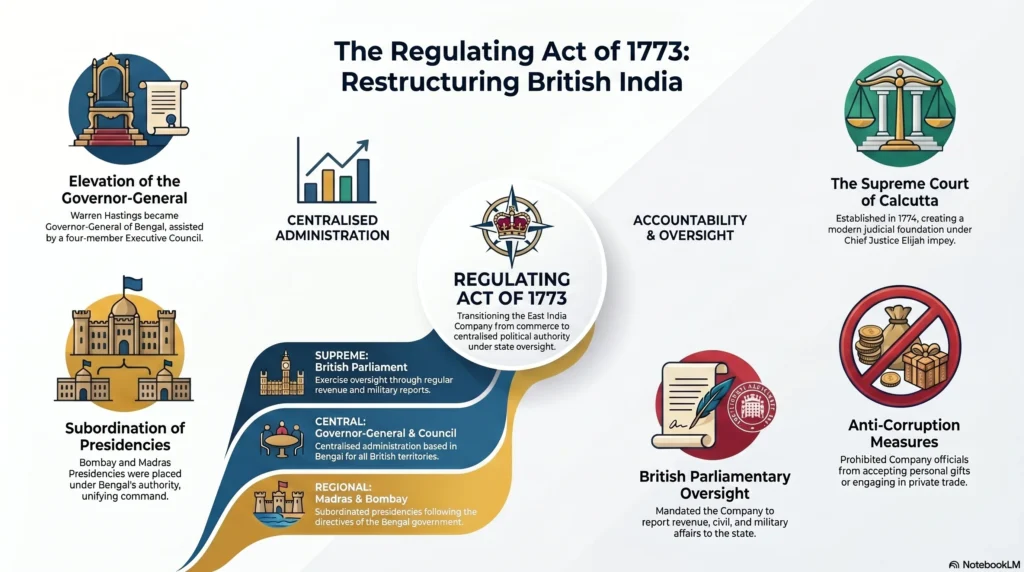
- The Act brought about a significant restructuring of the Company’s governance in India. One of the most notable changes was the elevation of the Governor of Bengal, Warren Hastings, to the position of Governor-General of Bengal. This marked the beginning of a more centralised administrative system, with Bengal becoming the focal point of British authority in India.
- To assist him, an Executive Council of four members was created. However, decisions were to be taken by majority, which meant that the Governor-General did not enjoy absolute authority. This provision, though intended to ensure collective decision-making, often resulted in internal conflicts and administrative delays.
- Another major step was the subordination of the Bombay and Madras Presidencies to Bengal. This effectively ended the earlier system where presidencies functioned independently and introduced a more unified chain of command. It was a crucial step toward administrative consolidation in British India.
- The Act also laid the foundation of a modern judicial system by establishing a Supreme Court at Calcutta in 1774, with Sir Elijah Impey as its first Chief Justice. While this was a landmark reform, the lack of clarity regarding its jurisdiction later led to friction between the judiciary and the executive.
- In an effort to curb corruption, Company officials were prohibited from engaging in private trade or accepting gifts. This provision reflected growing concerns in Britain about unethical practices in India. At the same time, the Act strengthened parliamentary oversight by requiring the Company’s governing body to regularly report on its revenue, civil, and military affairs.
- Financial discipline was also introduced by limiting the Company’s dividend payments and regulating the functioning of the Court of Directors. These measures were aimed at stabilising the Company’s finances and preventing reckless expansion.
- Overall, the provisions of the Regulating Act were not just administrative reforms; they represented the first structured attempt to align the Company’s governance with the broader interests of the British state.
Significance of the Act
- The Regulating Act of 1773 holds immense importance in India’s constitutional development.
- Firstly, it marked the beginning of British Parliamentary control over Indian administration, transforming the Company from a purely commercial body into a political authority under state supervision.
- Secondly, it introduced the concept of centralised governance, with Bengal emerging as the administrative centre. This laid the groundwork for later administrative consolidation.
- Thirdly, the establishment of the Supreme Court at Calcutta initiated the development of a modern judicial system in India, although with several limitations.
- The Act also recognised the political and administrative functions of the East India Company, which had previously operated primarily as a trading entity.
- Finally, it served as a precursor to later constitutional reforms, including the Pitt’s India Act of 1784, which further strengthened British control.
Limitations of the Act
- Despite its significance, the Regulating Act suffered from several structural and functional weaknesses.
- One major drawback was the lack of clear demarcation of powers between the Governor-General and his Council. Since decisions were based on majority voting, the Governor-General could often be overruled, leading to administrative deadlock.
- The jurisdiction of the Supreme Court was ambiguous, particularly regarding its authority over Indians and Company officials. This resulted in conflicts between the judiciary and the executive.
- The Act also failed to ensure adequate representation of Indians in governance. The entire administrative structure remained dominated by British officials, ignoring local interests.
- Additionally, although the Act aimed to curb corruption, enforcement remained weak, and many malpractices continued.
- The centralisation of power in Bengal also weakened the autonomy of Bombay and Madras, leading to administrative inefficiencies in distant regions.
Amending Act of 1781 (Act of Settlement)
- To address the shortcomings of the Regulating Act, the British Parliament passed the Amending Act of 1781.
- This Act clarified the jurisdiction of the Supreme Court, limiting its authority over revenue matters and exempting the Governor-General and Council from judicial interference in official functions.
- It also ensured that Indian personal laws (Hindu and Muslim laws) would be applied in relevant cases, thereby recognising indigenous legal traditions.
- Furthermore, it strengthened the authority of the Governor-General-in-Council in administrative matters.
Conclusion
The Regulating Act of 1773 was a landmark constitutional development that marked the beginning of British parliamentary intervention in Indian governance. Although it had several limitations, it laid the foundation for centralised administration, judicial institutions, and state control over the East India Company.
In the broader historical context, the Act represents the transition from Company rule to Crown supervision, eventually culminating in the establishment of the British Raj.
FAQs
Q1. What is the Regulating Act, 1773?
The Regulating Act, 1773 was the first major step taken by the British Parliament to regulate the affairs of the East India Company in India.
Q2. Why was the Regulating Act enacted?
It was introduced due to administrative corruption, financial crisis of the Company, and mismanagement in India, which demanded government intervention.
Q3. What were the key provisions of the Act?
Governor of Bengal became Governor-General of Bengal
Establishment of a Supreme Court at Calcutta (1774)
Formation of an Executive Council of four members
Restrictions on Company officials engaging in private trade
Q4. Who was the first Governor-General under this Act?
Warren Hastings became the first Governor-General of Bengal.
Q5. What were the limitations of the Act?
It had ambiguities in authority, conflicts between the Governor-General and Council, and issues between the Supreme Court and executive.
Click on the question to see the Answers
Visit LevelUp IAS- Click Here
Related reads.

Mastering Anthropology: The 292-Mark Roadmap By AIR 521
21 Aug 2026 6 min

Mastering UPSC Answer Writing by AIR 255
17 Aug 2026 5 min

GS & Optional Balancing Strategy By AIR 48
13 Aug 2026 5 min

AIR 49’s Brutally Honest UPSC Strategy Session
10 Aug 2026 4 min

Full 12 Months UPSC Roadmap By AIR 13
07 Aug 2026 5 min

Scientific Revision System By AIR 341 Vishal Pattanayak
05 Aug 2026 5 min
Put it into practice
Reading is step one.
Turn what you've just read into exam-ready answers with mentor-led practice and our structured test series.