Self Help Groups (SHGs), GS 2
Content
- Objectives
- Features
- Evolution
- Role of SHGs
- Advantages
- Challenges
- Government Initiatives
- Way Forward
- FAQs
Self Help Groups (SHGs) are small voluntary associations of people belonging to similar socio-economic backgrounds who come together to achieve common economic and social objectives through collective savings, mutual support, and self-reliance. These groups generally consist of poor and marginalized sections of society, especially women, who pool their resources and use the common fund to meet credit requirements and undertake income-generating activities. Over time, SHGs have evolved into an important instrument of rural development, financial inclusion, poverty alleviation, and women empowerment in India.
The concept of SHGs is based on the principles of collective responsibility, participatory decision-making, and mutual trust. Members regularly save small amounts, which are accumulated into a common corpus and later used for internal lending at affordable interest rates. This system reduces dependence on informal moneylenders and encourages financial discipline among members. SHGs also serve as a platform for improving awareness, leadership, entrepreneurship, and community participation
Objectives of Self Help Groups
The primary objective of SHGs is to provide easy access to credit and promote entrepreneurship among economically weaker sections. These groups also aim to strengthen the confidence and decision-making abilities of marginalized communities, especially women, by encouraging collective participation in economic and social activities.
SHGs further seek to connect unbanked populations with formal financial institutions, improve financial literacy, enhance livelihood opportunities, and promote sustainable income generation. In addition to economic objectives, SHGs contribute towards social empowerment by spreading awareness regarding health, education, sanitation, legal rights, and gender equality.
Features of Self Help Groups
Self Help Groups generally consist of 10-20 members, which allows effective coordination and stronger group cohesion. Members usually belong to similar socio-economic backgrounds, creating an environment of trust and mutual understanding.
A defining feature of Self Help Groups is the practice of regular savings and internal lending. The pooled savings form a common fund from which members can borrow money for emergencies, consumption needs, or small business activities at low interest rates. Decisions regarding loans, repayment, and group activities are taken collectively through democratic functioning.
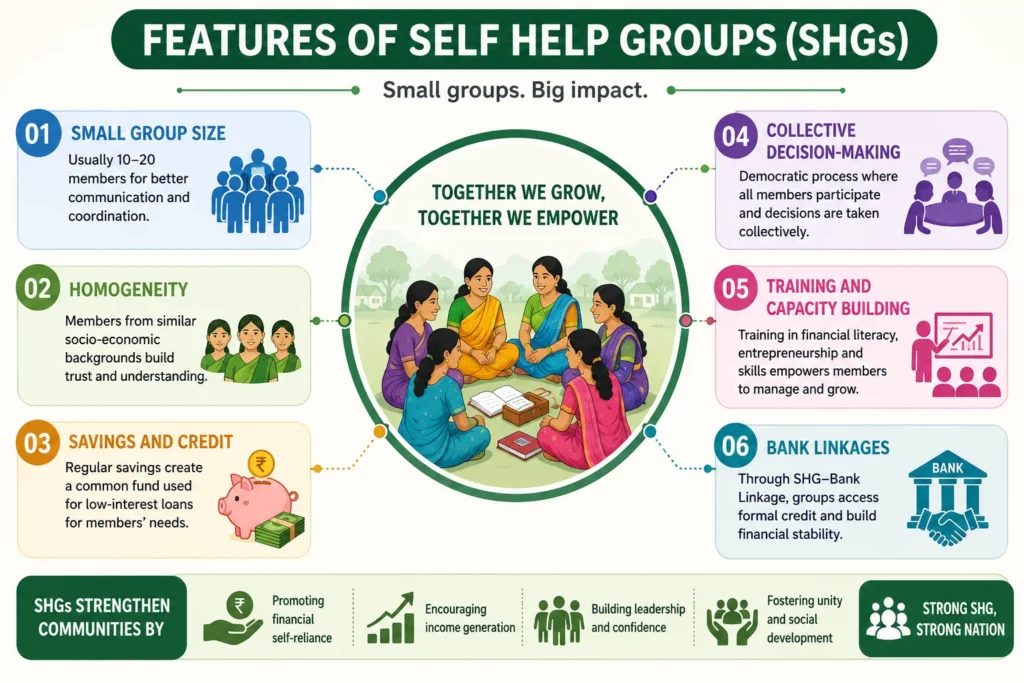
Self Help Groupsalso emphasize training and capacity building in areas such as bookkeeping, financial literacy, skill development, and entrepreneurship. Through programmes like the NABARD-led SHG-Bank Linkage Programme, SHGs are connected with formal banking institutions, enabling access to larger credit facilities and improving financial inclusion.
Evolution of SHGs in India
The SHG movement in India emerged as a grassroots response to rural poverty, lack of institutional credit, and economic exclusion of women. Early efforts can be traced back to the 1950s when the Textile Labour Association in Ahmedabad initiated welfare and skill-development programmes for women from labour families.
A major turning point came in 1972 with the establishment of the Self-Employed Women’s Association (SEWA) by Ela Bhatt, which organized women workers in the informal sector such as artisans, hawkers, and weavers. During the 1980s, several NGOs promoted savings and credit groups to reduce rural indebtedness and exploitation by moneylenders.
The movement gained institutional support in 1992 when National Bank for Agriculture and Rural Development launched the SHG-Bank Linkage Programme (SBLP), integrating informal SHGs with the formal banking system. In 1993, the Reserve Bank of India permitted SHGs to open bank accounts, giving them formal recognition within the financial sector.
Government initiatives such as the Swarn Jayanti Gram Swarozgar Yojana (1999) and the National Rural Livelihoods Mission (NRLM) further expanded the SHG movement across rural India. State-level models like Kudumbashree became successful examples of women-led community development and poverty alleviation.
Role of SHGs in Socio-Economic Development
SHGs have emerged as important agents of socio-economic transformation in India. One of their most significant contributions has been women empowerment. By promoting savings habits, access to credit, and participation in economic activities, Self Help Groups enhance women’s financial independence, confidence, and leadership capabilities. Participation in group decision-making also increases awareness regarding rights, governance, and social issues.
SHGs contribute significantly to poverty alleviation by supporting income-generating activities such as dairy farming, tailoring, handicrafts, food processing, and agriculture-related enterprises. Access to microcredit helps poor households reduce dependence on exploitative informal credit systems and improves household income stability.
Another important contribution of SHGs is financial inclusion. They bridge the gap between marginalized communities and formal banking institutions, especially in rural areas where banking penetration remains limited. Through savings and credit activities, SHGs encourage financial literacy, repayment discipline, and banking awareness.
SHGs also strengthen social cohesion by creating collective platforms to address issues such as alcoholism, child marriage, domestic violence, illiteracy, and poor sanitation. During natural disasters and emergencies, SHGs have played an important role in community mobilization, relief distribution, and resilience building.
Advantages of SHGs
- SHGs promote financial inclusion by providing collateral-free loans to poor households that generally lack access to formal banking institutions, thereby reducing dependence on moneylenders charging high rates of interest.
- They encourage regular savings habits and create a common financial corpus that can be utilized for productive purposes, emergency needs, and income-generating activities at the local level.
- SHGs significantly contribute to women empowerment by improving economic independence, leadership qualities, social awareness, and participation in household and community decision-making.
- Through skill development, entrepreneurship training, and better access to government welfare schemes, SHGs help improve livelihood opportunities and strengthen rural economic development.
- SHGs also act as instruments of social change by spreading awareness regarding health, education, sanitation, legal rights, and social evils such as dowry, alcoholism, and child marriage.
Challenges Faced by SHGs
Despite their achievements, SHGs face several structural and operational challenges. Many SHGs fail to effectively include the poorest and most vulnerable households, limiting their impact on poverty reduction. Patriarchal social structures and gender discrimination often restrict women’s active participation and leadership.
Weak financial management, irregular meetings, poor record-keeping, and lack of transparency affect the sustainability of many SHGs. Inadequate rural banking infrastructure also creates difficulties in accessing timely institutional credit.
Many SHGs suffer from insufficient training, lack of market linkages, and poor branding of products, which limits profitability and competitiveness. Regional imbalance is another concern, as the SHG movement is stronger in southern states compared to several central and northeastern regions of India.
Government Initiatives Related to SHGs
The Government of India has introduced several programmes to strengthen SHGs and promote livelihood generation. The National Rural Livelihoods Mission (NRLM), launched in 2011, aims to mobilize rural poor households into SHGs and improve their access to institutional credit and sustainable livelihoods.
The SHG-Bank Linkage Programme initiated by National Bank for Agriculture and Rural Development remains the world’s largest microfinance initiative, connecting SHGs with formal banking institutions and enhancing rural financial inclusion.
Several state-level initiatives such as Kudumbashree have demonstrated the potential of SHGs in women empowerment, poverty alleviation, and decentralized community development.
Way Forward
The effectiveness of SHGs can be improved through greater focus on capacity building, digital literacy, financial management, and entrepreneurship development. Strengthening rural banking infrastructure and expanding SHGs into underserved regions can improve balanced regional development and financial inclusion.
There is also a need to develop better market linkages, branding strategies, and e-commerce platforms for SHG products so that members can access larger and more profitable markets. Improved monitoring mechanisms, transparency, and institutional support can further enhance the sustainability and effectiveness of the SHG movement.
SHGs have evolved beyond mere savings groups and now function as important instruments of grassroots democracy, women empowerment, and inclusive development. Their continued strengthening is essential for achieving sustainable rural transformation and socio-economic justice in India.
FAQs
Q1. What are Self Help Groups (SHGs)?
Self Help Groups are voluntary groups, usually consisting of 10-20 members from similar socio-economic backgrounds, who come together to save regularly and access small loans.
Q2. What are the main objectives of SHGs?
The objectives include:
Social and community development
Financial inclusion
Poverty alleviation
Women’s empowerment
Livelihood generation
Q3. How do SHGs function?
Members contribute regular savings to a common fund, which is used to provide loans to members. Over time, SHGs may establish linkages with banks and government schemes.
Q4. What is the SHG-Bank Linkage Programme?
The SHG-Bank Linkage Programme, launched by National Bank for Agriculture and Rural Development, connects SHGs with formal banking institutions to improve access to credit.
Q5. What is the role of SHGs in governance?
SHGs promote participatory governance by encouraging community participation in local decision-making, social audits, implementation of welfare schemes, and grassroots development initiatives.
Click on the question to see the Answers
Visit LevelUp IAS: Click here