
Mains Articles
Temperature and Heat Budget UPSC
Content
- Introduction
- Concept
- Factors Affecting Temperature Distribution
- Horizontal Distribution
- Vertical Distribution
- Heat Budget of the Earth
- Components of Earth’s Heat Budget
- Mechanism of Heat Budget
- Conclusion
- FAQs
Introduction
Temperature is one of the most fundamental elements of climate and plays a decisive role in shaping weather patterns, atmospheric circulation, rainfall distribution, vegetation, and human activities. It refers to the degree of hotness or coldness of the atmosphere and is primarily controlled by the amount of solar energy received and retained by the Earth. However, the atmosphere is not heated directly by the Sun alone. Instead, the Earth’s surface absorbs solar radiation and then re-radiates heat in the form of terrestrial radiation, which warms the lower atmosphere.
Closely linked with temperature is the concept of the Heat Budget of the Earth, also known as the Earth’s Energy Budget or Radiation Budget. It represents the balance between incoming solar radiation and outgoing terrestrial radiation. This balance is essential for maintaining Earth’s average temperature at nearly 15°C and sustaining life on the planet. If the Earth continuously absorbed more energy than it emitted, temperatures would rise uncontrollably, whereas excessive heat loss would result in global cooling. Thus, thermal equilibrium is the basis of climatic stability.
In recent decades, the study of the Earth’s heat budget has become increasingly important due to climate change and global warming. Even a slight imbalance in the energy system can alter atmospheric circulation, intensify extreme weather events, and disturb ecological systems.
Concept
Temperature refers to the intensity of heat present in the atmosphere or on the Earth’s surface. It is generally measured in degrees Celsius, Fahrenheit, or Kelvin using thermometers. The distribution of temperature over the Earth is not uniform because different regions receive varying amounts of solar radiation depending upon latitude, altitude, cloud cover, ocean currents, and several other geographical factors.
The Sun is the ultimate source of heat and energy for the Earth. Solar radiation reaching the Earth is known as insolation. However, only a portion of this incoming solar energy is absorbed by the Earth, while the rest is reflected or scattered back into space. The absorbed energy heats the Earth’s surface, which in turn heats the atmosphere through conduction, convection, and terrestrial radiation.
Factors Affecting Temperature Distribution
Latitude:
Latitude is the most significant factor influencing temperature distribution. Regions near the equator receive vertical rays of the Sun throughout the year, leading to greater concentration of solar energy and higher temperatures. On the other hand, polar regions receive slanting rays, causing the same amount of solar energy to spread over a larger area, resulting in lower temperatures.
Therefore, temperatures generally decrease from the equator towards the poles. This latitudinal variation forms the basis of major climatic zones of the Earth.
Altitude:
Temperature decreases with increasing altitude because the atmosphere is mainly heated from below by terrestrial radiation. As altitude increases, the density of air decreases and the atmosphere becomes thinner, reducing its heat-retaining capacity.
The average rate of decrease in temperature with altitude is known as the normal lapse rate, which is approximately:
6.5∘C per 1000 m
Mountain regions are therefore cooler than nearby plains despite being located at similar latitudes.
Distance from Sea (Continentality)
Land and water heat and cool at different rates. Water bodies absorb heat slowly and release it gradually, whereas land surfaces heat and cool rapidly. As a result, coastal regions experience moderate temperatures with lower annual range, while continental interiors witness extreme climatic conditions.
This phenomenon is known as continentality and explains why places like Mumbai have a moderate climate, whereas Delhi experiences both extremely hot summers and cold winters.
Ocean Currents
Ocean currents significantly influence the temperature of coastal regions. Warm currents raise temperatures of adjacent coastal areas, while cold currents lower them.
For example:
- The Gulf Stream keeps Western Europe relatively warm.
- The Labrador Current lowers temperatures along the eastern coast of Canada.
Ocean currents also influence fog formation, rainfall patterns, and marine ecosystems.
Prevailing Winds
Winds transport heat from one region to another and thus modify local temperatures. Maritime winds originating over oceans bring moderate temperatures and moisture, while continental winds originating over land are generally dry and extreme.
Monsoon winds in India are an excellent example of how seasonal winds influence temperature and rainfall patterns.
Cloud Cover
Clouds influence temperature by controlling both incoming and outgoing radiation. During the day, clouds reflect solar radiation and reduce heating of the Earth’s surface. During the night, clouds act like a blanket by trapping outgoing terrestrial radiation and preventing rapid cooling.
Thus, cloudy nights are generally warmer than clear nights.
Horizontal Distribution of Temperature
The horizontal distribution of temperature refers to the variation of temperature across latitudes and regions at the same altitude. Isotherms are imaginary lines joining places with equal temperature.
The general trend shows a decrease in temperature from the equator towards the poles. However, this pattern is modified by:
- Ocean currents,
- Land-water distribution,
- Prevailing winds,
- Altitude.
The Northern Hemisphere exhibits greater temperature contrasts because of extensive landmasses, whereas the Southern Hemisphere shows relatively uniform temperatures due to oceanic dominance.
Vertical Distribution of Temperature
Temperature also changes vertically in different layers of the atmosphere.
In the troposphere, temperature decreases with height because the atmosphere is heated by terrestrial radiation from the Earth’s surface.
In the stratosphere, temperature increases with altitude due to absorption of ultraviolet radiation by ozone.
In the mesosphere, temperature again decreases, while in the thermosphere, temperatures rise sharply because of absorption of high-energy solar radiation.
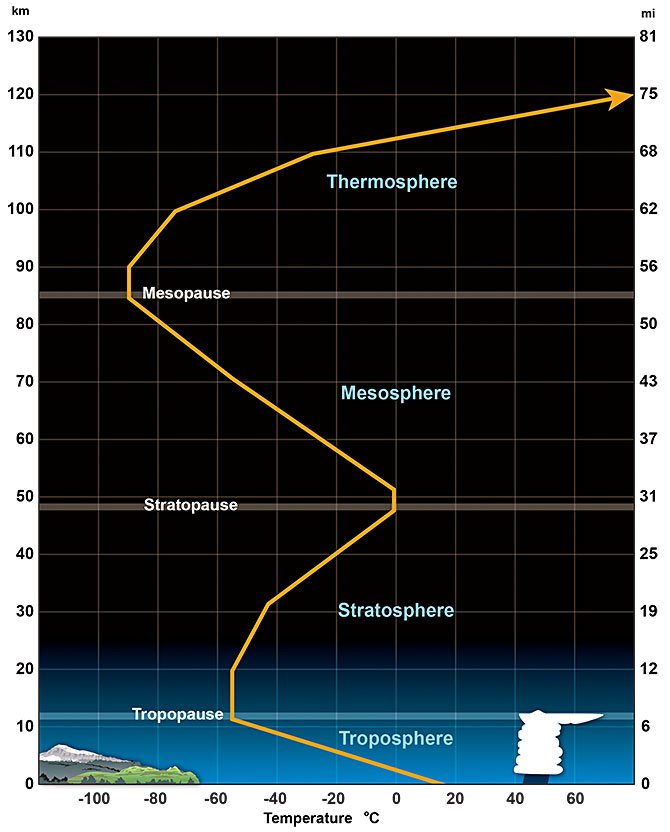
This vertical variation is crucial in understanding atmospheric stability, weather systems, and aviation.
Heat Budget of the Earth
The Heat Budget of the Earth refers to the balance between incoming solar radiation and outgoing terrestrial radiation. It is governed by the First Law of Thermodynamics, according to which energy can neither be created nor destroyed but only transformed from one form to another.
The Sun continuously supplies energy to Earth in the form of shortwave radiation. Simultaneously, the Earth loses energy in the form of longwave infrared radiation. For climatic equilibrium to exist over long periods, the amount of incoming energy must equal the amount of outgoing energy.
If this balance is disturbed, the Earth either warms or cools. Presently, due to greenhouse gas accumulation, Earth is retaining more heat than it emits, leading to global warming.
Components of Earth’s Heat Budget
Insolation
Insolation refers to incoming solar radiation received by Earth. It is the primary source of atmospheric heating and powers climatic processes such as evaporation, winds, and ocean circulation.
The amount of insolation received varies with:
- Latitude,
- Season,
- Duration of day,
- Atmospheric transparency.
Reflection and Albedo
A portion of incoming solar radiation is reflected back into space by clouds, ice, snow, deserts, and water surfaces. This reflectivity is called albedo.
Highly reflective surfaces such as snow and ice possess high albedo, while oceans have low albedo and absorb more heat.
Globally:
- Polar ice caps reflect most radiation,
- Oceans act as major heat absorbers and storage zones.
Absorption
The remaining solar energy is absorbed by:
- The atmosphere,
- Oceans,
- Land surfaces.
This absorbed energy is converted into heat and later re-radiated as terrestrial radiation.
Scattering
Atmospheric particles, dust, and gas molecules scatter sunlight in different directions. Scattering reduces the intensity of direct solar radiation and contributes to phenomena such as the blue colour of the sky and red sunsets.
Terrestrial Radiation
The Earth’s surface, after absorbing solar energy, emits longwave infrared radiation known as terrestrial radiation. This outgoing heat maintains Earth’s energy balance.
However, greenhouse gases absorb part of this outgoing radiation and re-radiate it back towards the Earth, producing the greenhouse effect.
Mechanism of Heat Budget
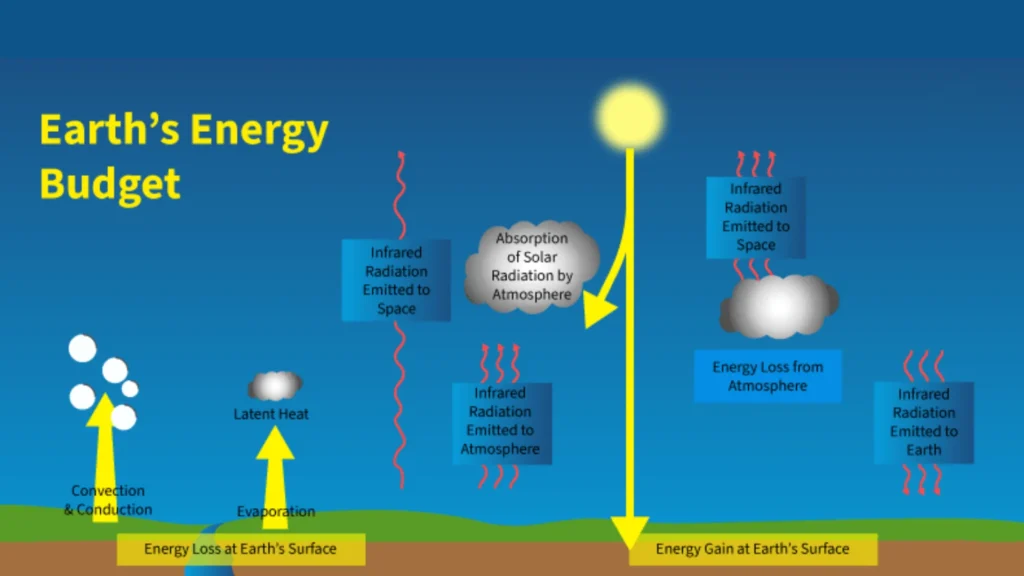
The Earth’s heat budget is commonly explained using 100 units of incoming solar radiation.
Out of these 100 units:
- Nearly 35 units are reflected and scattered back into space.
- About 65 units are absorbed by the Earth-atmosphere system.
Of the absorbed energy:
- Approximately 14 units are absorbed directly by atmospheric gases and clouds.
- Around 51 units are absorbed by land and oceans.
The Earth’s surface then emits heat in the form of terrestrial radiation.
A part of this heat escapes directly into space, while the remaining heat is transferred to the atmosphere through:
- Conduction,
- Convection,
- Latent heat transfer,
- Longwave radiation absorption.
Finally, the atmosphere emits heat back into outer space, maintaining equilibrium between incoming and outgoing radiation.
Thus, over long periods: Incoming Solar Radiation=Outgoing Terrestrial Radiation
Conclusion
Temperature and the Earth’s heat budget together form the foundation of climatology and atmospheric science. The balance between incoming solar radiation and outgoing terrestrial radiation sustains Earth’s thermal equilibrium and enables the existence of life. Unequal heating drives atmospheric and oceanic circulation, shaping weather systems and climatic patterns across the globe.
However, anthropogenic activities have increasingly disturbed this delicate energy balance, intensifying global warming and climatic instability. Understanding the processes of heat transfer, radiation balance, and temperature distribution is therefore essential not only for geographical studies but also for addressing climate change, environmental sustainability, and disaster management in the modern world.
FAQs
Q1. What is temperature in climatology?
Temperature refers to the degree of hotness or coldness of the atmosphere, primarily influenced by solar radiation received by the Earth.
Q2. What is the Heat Budget of the Earth?
Heat Budget of the Earth is the balance between incoming solar radiation (insolation) and outgoing terrestrial radiation, maintaining Earth’s average temperature.
Q3. What is insolation?
Insolation is the solar energy received by the Earth in the form of shortwave radiation.
Q4. What factors affect temperature distribution on Earth?
Major factors include:
Slope and aspect
Latitude
Altitude
Distance from the sea
Ocean currents
Winds and cloud cover
Q5. What is albedo in the heat budget process?
Albedo refers to the percentage of solar radiation reflected back into space by the Earth’s surface and atmosphere.
Click on the question to see the Answers
Visit LevelUp IAS- Click Here
Related reads.

How to Read NCERTs for UPSC: Subject-Wise Strategy & Notes Making
22 Jun 2026 10 min
PSIR Topper's Answer Copies
22 Jun 2026 1 min
Sociology Optional PYQs (2009-2024)
22 Jun 2026 1 min
Philosophy Optional PYQs
22 Jun 2026 1 min
PSIR Optional PYQs
22 Jun 2026 1 min
History Optional PYQs (2009-2025) – Free PDF & Video
22 Jun 2026 1 min
Put it into practice
Reading is step one.
Turn what you've just read into exam-ready answers with mentor-led practice and our structured test series.