
Mains Articles
Anglo-Sikh Wars, Modern History
Content
- Introduction
- Background of the Sikh Empire
- Causes of the Anglo-Sikh Wars
- First Anglo-Sikh War
- Second Anglo-Sikh War
- Annexation of Punjab
- Impact of the Anglo-Sikh Wars
- Reasons for Sikh Defeat
- Conclusion
- FAQs
Introduction
The Anglo-Sikh Wars were two important military conflicts fought between the Sikh Empire and the British East India Company during the mid-nineteenth century. These wars resulted in the annexation of Punjab by the British and marked the completion of British territorial expansion in India before the Revolt of 1857. The conflicts were fought in two phases, the First Anglo-Sikh War (1845-46) and the Second Anglo-Sikh War (1848-49).
The Sikh Empire under Maharaja Ranjit Singh had emerged as one of the most powerful Indian states of the nineteenth century. Ranjit Singh created a strong and modern kingdom in Punjab which acted as a buffer between British India and Afghanistan. However, after his death in 1839, the empire rapidly declined because of succession disputes, court conspiracies, factional rivalries, and military interference in politics. The British took advantage of this instability and gradually increased their influence in Punjab, eventually leading to open conflict.
The Anglo-Sikh Wars are extremely important in modern Indian history because they demonstrate how internal political instability and colonial expansionism combined to destroy one of the last major independent Indian kingdoms.
Background of the Sikh Empire
The Sikh Empire was consolidated by Maharaja Ranjit Singh in the early nineteenth century after unifying the Sikh misls. He established an efficient administration and maintained religious tolerance by appointing Hindus, Muslims, and Sikhs to important positions. His military reforms transformed the Khalsa army into a disciplined and modern force.
Ranjit Singh modernised the army with the help of European officers such as Ventura and Allard. The Sikh army was trained in European military techniques and possessed strong artillery, making it one of the strongest indigenous military powers in Asia.
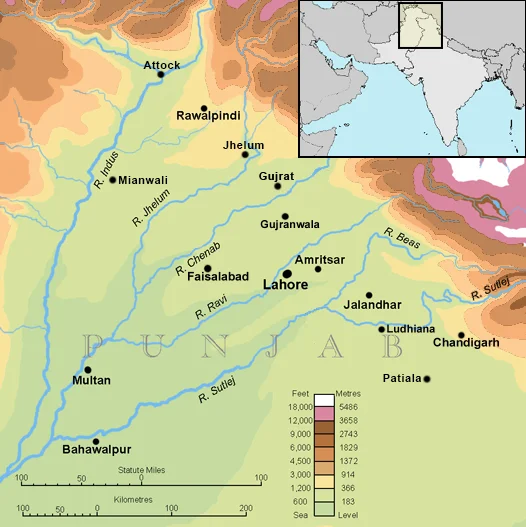
Relations between the Sikh Empire and the British East India Company remained peaceful during Ranjit Singh’s lifetime because both sides recognised each other’s strength. Through the Treaty of Amritsar (1809), the Sutlej River became the boundary between British territories and the Sikh kingdom. However, mutual suspicion always existed because the British considered Punjab strategically important for securing north-western India.
Causes of the Anglo-Sikh Wars
Political Instability after Ranjit Singh’s Death
The death of Ranjit Singh in 1839 created a major political vacuum in Punjab. Within a short period, several rulers came to power and many were assassinated due to palace conspiracies. The absence of strong leadership weakened the administrative and military structure of the Sikh Empire.
The Lahore court became dominated by factional politics involving Sikh chiefs, Dogra nobles, and military leaders. This instability provided the British with an opportunity to interfere in Punjab’s affairs.
Rise of the Khalsa Army
After Ranjit Singh’s death, the Khalsa army became politically powerful and began interfering in administration. The soldiers considered themselves protectors of Sikh sovereignty and increasingly distrusted British intentions. The growing influence of the army created instability within the Sikh state.
At the same time, British officials viewed the powerful Sikh military as a threat to their expanding empire.
British Expansionist Policy
The British East India Company was steadily expanding its control in India. After conquering Sindh in 1843, British territories reached the borders of Punjab. The British increased troop deployment near the Sutlej frontier and adopted an aggressive diplomatic attitude towards the Sikh kingdom.
The annexationist policies of the British, combined with the unstable political situation in Punjab, increased tensions between the two sides.
Treachery of Sikh Commanders
An important factor behind the Sikh defeat was the betrayal by senior Sikh commanders such as Lal Singh and Teja Singh. Historians believe that these leaders secretly maintained contacts with the British during the wars and deliberately weakened Sikh military operations.
Their lack of commitment severely damaged Sikh resistance despite the bravery shown by ordinary Sikh soldiers.
First Anglo-Sikh War (1845-1846)
Beginning of the War
The immediate cause of the First Anglo-Sikh War was the crossing of the Sutlej River by the Sikh army in December 1845. The British considered this an act of aggression and declared war. However, the deeper causes were British imperial ambitions and the political instability within Punjab.
At the beginning of the conflict, the Sikh army possessed numerical strength and superior artillery, while the British had better organisation and leadership.
Major Battles of the First Anglo-Sikh War
Battle of Mudki:
The Battle of Mudki was the first major engagement between the Sikhs and the British. The Sikh forces fought with great courage and inflicted heavy casualties on the British army. Although the British eventually won the battle, it became clear that defeating the Sikh army would not be easy.
Battle of Ferozeshah:
The Battle of Ferozeshah was one of the fiercest battles fought by the British in India. Sikh troops strongly resisted British attacks and nearly defeated them. British officers later admitted that the battle could easily have ended in disaster for them. However, confusion among Sikh commanders and lack of coordination weakened Sikh efforts, allowing the British to secure victory.
Battle of Baddowal:
At Baddowal, Sikh commander Ranjodh Singh Majithia successfully attacked British supply lines and damaged parts of the British cantonment. The battle boosted Sikh morale and showed that the British army remained vulnerable.
Battle of Aliwal:
The British forces under Sir Harry Smith defeated the Sikh army at Aliwal. This victory improved the British strategic position and weakened Sikh defensive arrangements.
Battle of Sobraon:
The Battle of Sobraon proved decisive in the First Anglo-Sikh War. Sikh soldiers displayed extraordinary bravery, but betrayal by Teja Singh and poor leadership weakened their resistance. The British succeeded in breaking Sikh defensive lines and gained control over Punjab’s strategic routes. The defeat at Sobraon forced the Sikhs to negotiate peace with the British.
Treaties after the First Anglo-Sikh War
Treaty of Lahore (1846):
The First Anglo-Sikh War ended with the Treaty of Lahore signed on 8 March 1846. The treaty imposed humiliating conditions upon the Sikhs. The Sikh army was reduced, a large war indemnity was imposed, and British troops were stationed in Lahore.
The young Maharaja Duleep Singh was recognised as ruler under British supervision, while Rani Jindan acted as regent.
Since the Sikhs failed to pay the entire indemnity amount, the British demanded territorial concessions.
Treaty of Amritsar (1846):
Under the Treaty of Amritsar, Kashmir was transferred to Gulab Singh, who became the ruler of Jammu and Kashmir after paying ₹75 lakh to the British.
This treaty established Dogra rule in Kashmir and later became an important political issue in Indian history.
Treaty of Bhairowal (1846):
The Treaty of Bhairowal further increased British control over Punjab. Rani Jindan was removed from the regency, and a Council of Regency under British supervision was established. Henry Lawrence was appointed as the British Resident at Lahore. Punjab effectively became dependent on British authority.
Second Anglo-Sikh War (1848-1849)
Causes of the Second War
The humiliating conditions imposed after the First Anglo-Sikh War created deep resentment among the Sikhs. The immediate cause of the Second Anglo-Sikh War was the revolt at Multan, where two British officers were killed.
The rebellion soon spread to other regions such as Hazara. The British interpreted these events as an opportunity to annex Punjab completely.
Governor-General Lord Dalhousie strongly favoured annexation and personally supervised the campaign.
Major Battles of the Second Anglo-Sikh War
Battle of Ramnagar
The first battle of the Second Anglo-Sikh War took place at Ramnagar. Sikh forces successfully resisted British advances, and the battle ended without a decisive result.
Battle of Chillianwala
The Battle of Chillianwala was one of the bloodiest battles fought by the British in India. The Sikh army fought with determination and inflicted severe losses on British troops. Even though the British later claimed victory, the battle damaged British prestige and exposed weaknesses in their military strategy.
Battle of Gujarat
The decisive battle of the Second Anglo-Sikh War was fought at Gujarat near the Chenab River. British artillery superiority played a crucial role in defeating the Sikh forces.
Following this defeat, organised Sikh resistance collapsed. Sikh commanders surrendered, and Punjab came under complete British control.
Annexation of Punjab
In March 1849, Punjab was formally annexed by the British East India Company. Maharaja Duleep Singh was deposed and later sent to England on a pension. His mother, Rani Jindan, was separated from him and confined by the British authorities.
The annexation of Punjab marked the end of the Sikh Empire and completed British territorial expansion in India before 1857.
One of the symbolic outcomes of the conquest was the seizure of the Koh-i-Noor diamond, which was transferred to the British Crown despite Maharaja Ranjit Singh’s wish to donate it to the Jagannath Temple at Puri.
Administration of Punjab under the British
After annexation, Sir John Lawrence became the first Chief Commissioner of Punjab. The British introduced administrative reforms, canal irrigation systems, road networks, and revenue settlements.
Punjab gradually became one of the most strategically important provinces of British India, especially for military recruitment and agricultural production.
Impact of the Anglo-Sikh Wars
The Anglo-Sikh Wars had far-reaching consequences for Indian history. Politically, they ended the sovereignty of the Sikh Empire and established British dominance over north-western India. Economically, Punjab was integrated into the colonial economy and became an important centre of agricultural production.
Militarily, the British recognised the courage and discipline of Sikh soldiers. After the Revolt of 1857, Sikhs were heavily recruited into the British Indian Army.
The wars also had a psychological and cultural impact. The memory of Sikh resistance against colonial rule remained strong and later contributed to the growth of reform movements and nationalist consciousness in Punjab.
Reasons for Sikh Defeat
The Sikh defeat cannot be explained merely by British military superiority. The Sikh soldiers fought bravely in almost every battle. However, political instability after Ranjit Singh’s death weakened the state structure. Court conspiracies, factional rivalries, and betrayal by commanders such as Lal Singh and Teja Singh severely damaged military coordination.
The British also possessed better financial resources, military organisation, and diplomatic strategy. Their ability to exploit internal divisions within Punjab played a decisive role in their victory.
Conclusion
The Anglo-Sikh Wars were decisive turning points in the history of colonial India. They led to the destruction of the Sikh Empire and enabled the British East India Company to establish complete control over north-western India. Although the Sikh forces displayed extraordinary courage and military capability, political instability, factionalism, and betrayal weakened their resistance.
The annexation of Punjab strengthened British imperialism and transformed the political landscape of India. The legacy of the Anglo-Sikh Wars continued to influence Punjab’s society, politics, and military traditions long after the end of colonial rule.
FAQs
Q1. How many Anglo-Sikh Wars were fought?
There were two wars:
Second Anglo-Sikh War (1848–1849)
First Anglo-Sikh War (1845–1846)
Q2. What led to the First Anglo-Sikh War?
It was caused by political instability after the death of Maharaja Ranjit Singh, mutual distrust, and British expansionist policies.
Q3. What was the outcome of the First Anglo-Sikh War?
It ended with the Treaty of Lahore (1846), reducing Sikh sovereignty and increasing British influence.
Q4. What happened in the Second Anglo-Sikh War?
The Sikh rebellion against British control led to their defeat and the complete annexation of Punjab in 1849.
Q5. What was the final result of the Anglo-Sikh Wars?
The Sikh Empire was annexed, and Punjab came under direct British rule in 1849.
Click on the question to see the Answers
Visit LevelUp IAS- Click Here
Related reads.

How to Read NCERTs for UPSC: Subject-Wise Strategy & Notes Making
22 Jun 2026 10 min
PSIR Topper's Answer Copies
22 Jun 2026 1 min
Sociology Optional PYQs (2009-2024)
22 Jun 2026 1 min
Philosophy Optional PYQs
22 Jun 2026 1 min
PSIR Optional PYQs
22 Jun 2026 1 min
History Optional PYQs (2009-2025) – Free PDF & Video
22 Jun 2026 1 min
Put it into practice
Reading is step one.
Turn what you've just read into exam-ready answers with mentor-led practice and our structured test series.