
Current Affairs
Burevestnik Cruise Missile
Why in News?
Russia’s Burevestnik cruise missile has attracted international attention because of its unusual nuclear-powered propulsion system. In October 2025, Russia announced a successful long-duration test flight, claiming that the missile travelled approximately 14,000 km in 15 hours. Its development has raised questions about nuclear safety, environmental risks and the future of strategic missile systems.
Introduction
The Burevestnik cruise missile represents an unconventional application of nuclear technology in military propulsion. Unlike conventional cruise missiles that use chemical fuel, it is designed to use an onboard nuclear reactor to generate thrust. This could give it an exceptionally long range and the ability to approach targets through unconventional flight paths.
The missile was publicly announced by Russian President Vladimir Putin in March 2018 as part of a series of advanced strategic weapons developed to strengthen Russia’s nuclear deterrence capabilities.
About the Burevestnik Missile
Burevestnik, meaning “Storm Petrel” in Russian, is a ground-launched, nuclear-powered and nuclear-capable cruise missile developed by Russia. It is also known by its Russian designation 9M730 and NATO designation SSC-X-9 Skyfall.
The missile is designed to carry a nuclear warhead and fly at low altitudes. Its nuclear-powered propulsion system is intended to provide a much greater range than conventional cruise missiles.
How Does Its Nuclear Propulsion Work?
Conventional cruise missiles use engines that burn chemical fuel to generate thrust. Their operational range is therefore limited by the quantity of fuel they can carry.
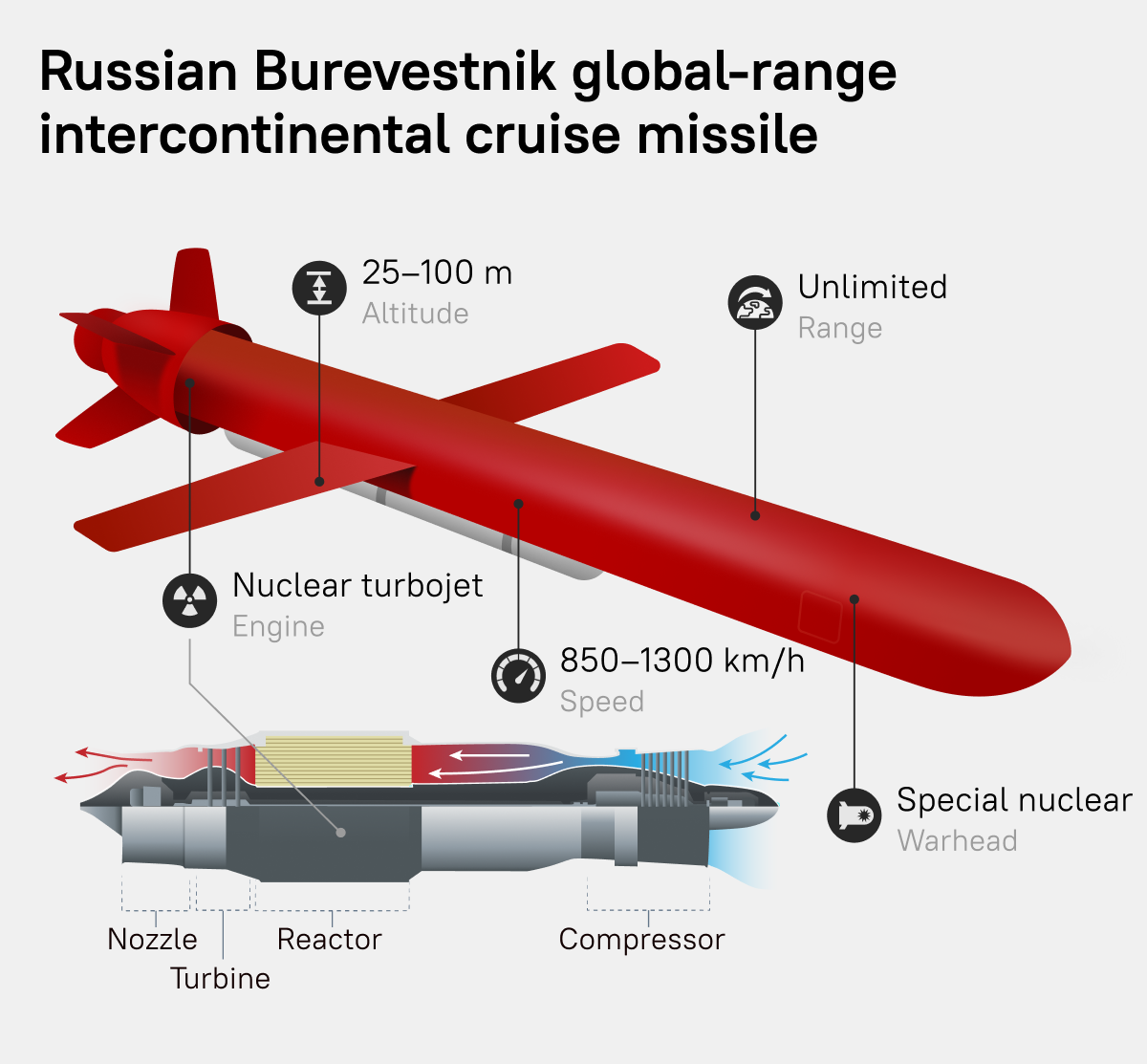
Burevestnik is designed around an air-breathing nuclear propulsion system. A small onboard nuclear reactor generates heat, which is used to heat incoming air. The heated air expands and is expelled through the engine, producing thrust.
This arrangement could allow the missile to remain airborne for extended periods without depending on conventional fuel supplies. However, its exact engineering design remains classified.
A 2026 study by researchers associated with the Massachusetts Institute of Technology examined its possible propulsion mechanism. Their modelling suggested that it may use a direct-cycle nuclear turbojet, in which air passes through the reactor and is heated directly. Such a system could release radioactive material through its exhaust.
Key Features
- Nuclear-powered propulsion: An onboard nuclear reactor is designed to provide sustained thrust.
- Extended range: Russia claims that the missile has virtually unlimited range compared with conventional cruise missiles.
- Low-altitude flight: Flying close to the ground could make detection by some radar systems more difficult.
- Unconventional trajectory: Its potential long endurance may allow it to approach targets from unexpected directions.
- Nuclear payload: It is designed to carry a nuclear warhead and serve as part of Russia’s strategic nuclear arsenal.
Test and Development
Russia first announced the Burevestnik programme in 2018. Its development has faced technical challenges and reported testing failures.
On 21 October 2025, Russia conducted a long-duration test flight. Four days later, Russia’s Chief of the General Staff, Valery Gerasimov, informed President Putin that the missile had travelled approximately 14,000 kilometres in 15 hours. Russia described the test as successful and announced preparations for its deployment.
However, these performance figures are Russian military claims and have not been independently established. A successful test also does not necessarily indicate that the missile is fully operational.
Strategic Significance
Burevestnik could provide Russia with another nuclear delivery system capable of approaching targets through unconventional routes. Its potential long range may complicate the planning of missile defence and early-warning systems.
The programme also reflects the growing use of advanced propulsion technologies in strategic weapons development. For Russia, it forms part of a broader effort to strengthen its nuclear deterrence capabilities.
Conclusion
The Burevestnik cruise missile represents an unusual application of nuclear technology in military propulsion. While its proposed long-range capability could complicate existing missile defence strategies, its operational readiness, reliability and environmental risks remain important concerns. It highlights the growing intersection of nuclear technology, aerospace engineering and strategic security.
Related reads.

Foreign Contribution (Regulation) Act (FCRA)
20 Nov 2026 4 min

Mombasa Declaration
20 Nov 2026 3 min

Zojila Tunnel
18 Nov 2026 3 min

Nyaya Setu AI Chatbot
18 Nov 2026 5 min

Black Rain
17 Nov 2026 4 min

Graded Response Action Plan (GRAP)
12 Nov 2026 4 min
Put it into practice
Reading is step one.
Turn what you've just read into exam-ready answers with mentor-led practice and our structured test series.