
Current Affairs
Graded Response Action Plan (GRAP)
Why in News?
The Commission for Air Quality Management (CAQM) invoked Stage III of the Graded Response Action Plan (GRAP) across Delhi-NCR on 6 November 2026, anticipating a further deterioration in air quality due to unfavourable meteorological conditions.
The decision came when Delhi's AQI was recorded at 382, falling under the 'Very Poor' category, with forecasts indicating a possibility of the 'Severe' category. Stage I and Stage II restrictions were already in force.
What is GRAP?
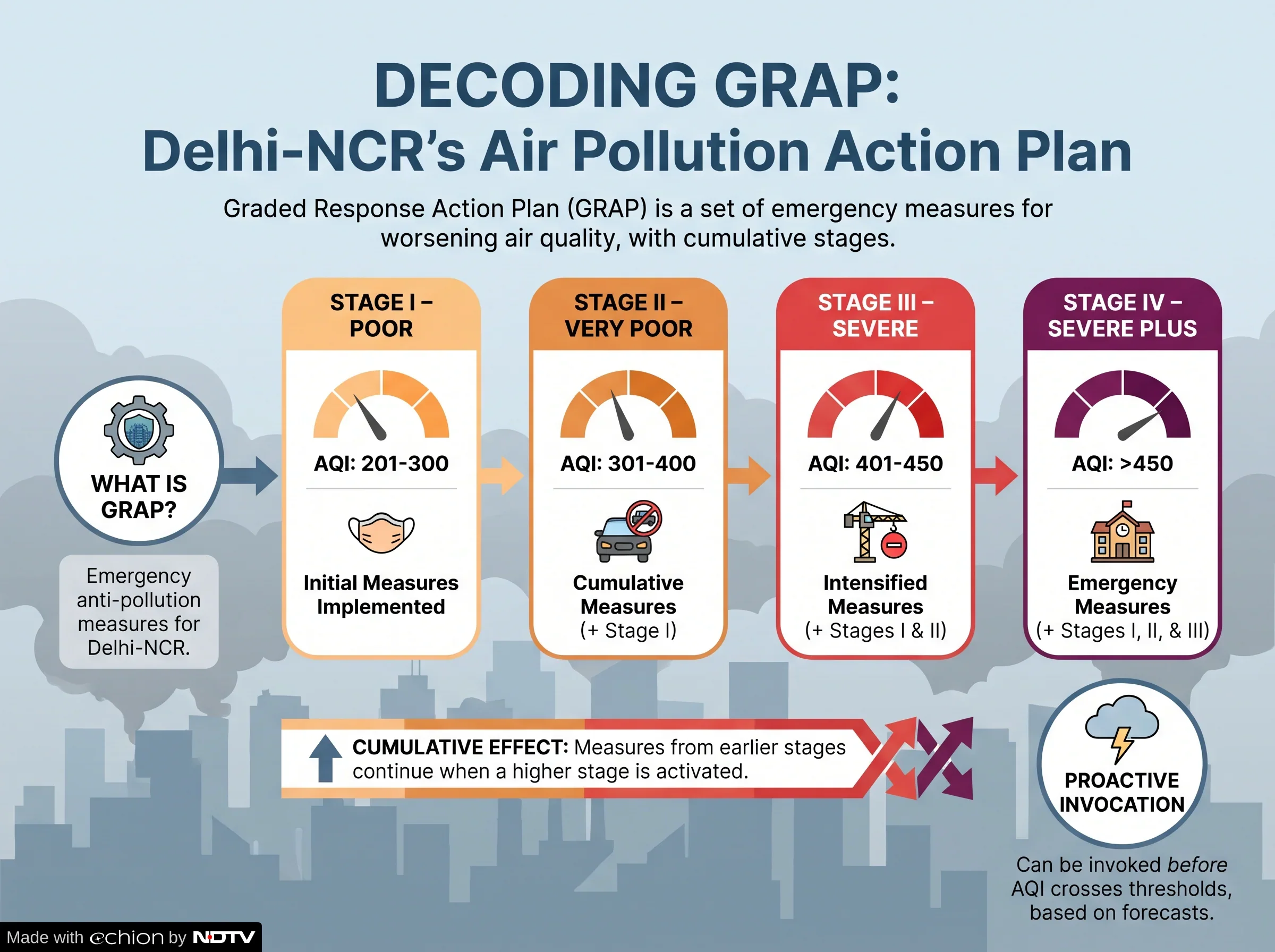
The Graded Response Action Plan (GRAP) is a set of emergency measures designed to prevent and control air pollution in Delhi-NCR. It prescribes progressively stricter actions according to the severity of air pollution.
GRAP was initially notified in 2017 following directions of the Supreme Court and recommendations of the Environment Pollution (Prevention and Control) Authority (EPCA). Its implementation and monitoring were subsequently brought under the Commission for Air Quality Management (CAQM).
The plan aims to control pollution sources such as vehicular emissions, construction dust, industrial activities, waste burning and other contributing factors.
Implementing Authority: CAQM
The Commission for Air Quality Management in National Capital Region and Adjoining Areas (CAQM) is a statutory body established under the Commission for Air Quality Management in National Capital Region and Adjoining Areas Act, 2021.
It replaced the EPCA and coordinates air pollution control measures across Delhi-NCR and adjoining areas.
Its major functions include:
- Coordinating actions among the Central Government, state governments and local authorities.
- Monitoring air quality and identifying sources of pollution.
- Issuing directions and enforcing measures to prevent and control air pollution.
- Coordinating research, investigation and implementation of pollution-control policies.
Four Stages of GRAP
GRAP classifies air quality into four stages based on the Air Quality Index (AQI). Each stage introduces additional restrictions, while measures under earlier stages continue.
Stage | AQI Category | AQI Range |
| Stage I | Poor | 201-300 |
| Stage II | Very Poor | 301-400 |
| Stage III | Severe | 401-450 |
| Stage IV | Severe+ | Above 450 |
Stage I - Poor Air Quality: Focuses on preventive measures such as regular mechanised road sweeping, water sprinkling, dust-control measures at construction sites and strict enforcement against open waste burning.
Stage II - Very Poor Air Quality: Introduces additional restrictions, including increased public transport services, higher parking fees to discourage private vehicle use, intensified road cleaning and restrictions on the use of certain diesel generator sets.
Stage III - Severe Air Quality: Includes stricter restrictions on construction and demolition activities, curbs on certain polluting vehicles, closure of stone crushers and mining activities, and restrictions on some industrial operations. Schools may shift to hybrid learning for specified classes, depending on the applicable directions.
Stage IV - Severe+ Air Quality: Introduces the most stringent measures, including restrictions on the movement of certain goods vehicles, suspension of specified construction activities, and consideration of additional emergency measures such as staggered office timings or work-from-home arrangements.
Major Sources of Air Pollution in Delhi-NCR
Air pollution in Delhi-NCR is caused by multiple sources, whose relative contribution changes with the season and weather conditions.
Vehicular Emissions: Cars, trucks, buses and other vehicles release particulate matter, nitrogen oxides and other pollutants.
Industrial Pollution: Emissions from industries, thermal power plants and diesel generator sets contribute to the regional pollution load.
Construction and Road Dust: Construction activities, demolition, uncovered materials and dust from roads are major sources of particulate pollution.
Stubble Burning: Agricultural residue burning in neighbouring states, particularly Punjab and Haryana, contributes to seasonal pollution during the post-monsoon period.
Weather Conditions: Low wind speed, temperature inversion and a shallow atmospheric boundary layer restrict the dispersion of pollutants, allowing them to accumulate near the surface.
Waste and Biomass Burning: Open burning of municipal waste, leaves and other biomass releases particulate matter and harmful gases.
Significance of GRAP
GRAP provides a coordinated mechanism for responding to deteriorating air quality before pollution reaches extremely hazardous levels. Its graded approach allows authorities to introduce restrictions according to the severity of pollution rather than relying on a single emergency response.
It also promotes coordination among different governments and agencies across NCR, recognising that air pollution does not remain confined within administrative boundaries. By targeting transport, construction, industries and other pollution sources, the plan seeks to reduce public exposure and limit further deterioration in air quality.
Challenges in Implementation
Despite its structured framework, GRAP faces several implementation challenges. Air pollution in Delhi-NCR originates from multiple sources across state boundaries, making coordination between different authorities essential. Restrictions are often temporary and may not address the structural causes of pollution.
Enforcement gaps, limited public transport alternatives, dependence on polluting fuels and inadequate monitoring of construction and industrial activities also affect its effectiveness. Moreover, adverse weather conditions can worsen pollution even when emission-control measures are in place.
Conclusion
GRAP is an important emergency mechanism for managing episodes of severe air pollution in Delhi-NCR. However, long-term improvement in air quality requires more than temporary restrictions. Stronger public transport, cleaner industrial practices, effective waste management, control of construction dust, sustainable agricultural practices and coordinated regional action are essential for addressing the underlying causes of air pollution.
Related reads.

Exercise IBSAMAR IX
08 Nov 2026 3 min

Khajuraho Temple Architecture
05 Nov 2026 4 min
Emissions Gap Report 2026
04 Nov 2026 4 min

12th BRICS Parliamentary Forum 2026
03 Nov 2026 3 min
Pradhan Mantri Viksit Gram Swaraj Yojana
02 Nov 2026 4 min

Uniform Civil Code (UCC)
30 Oct 2026 7 min
Put it into practice
Reading is step one.
Turn what you've just read into exam-ready answers with mentor-led practice and our structured test series.