
Current Affairs
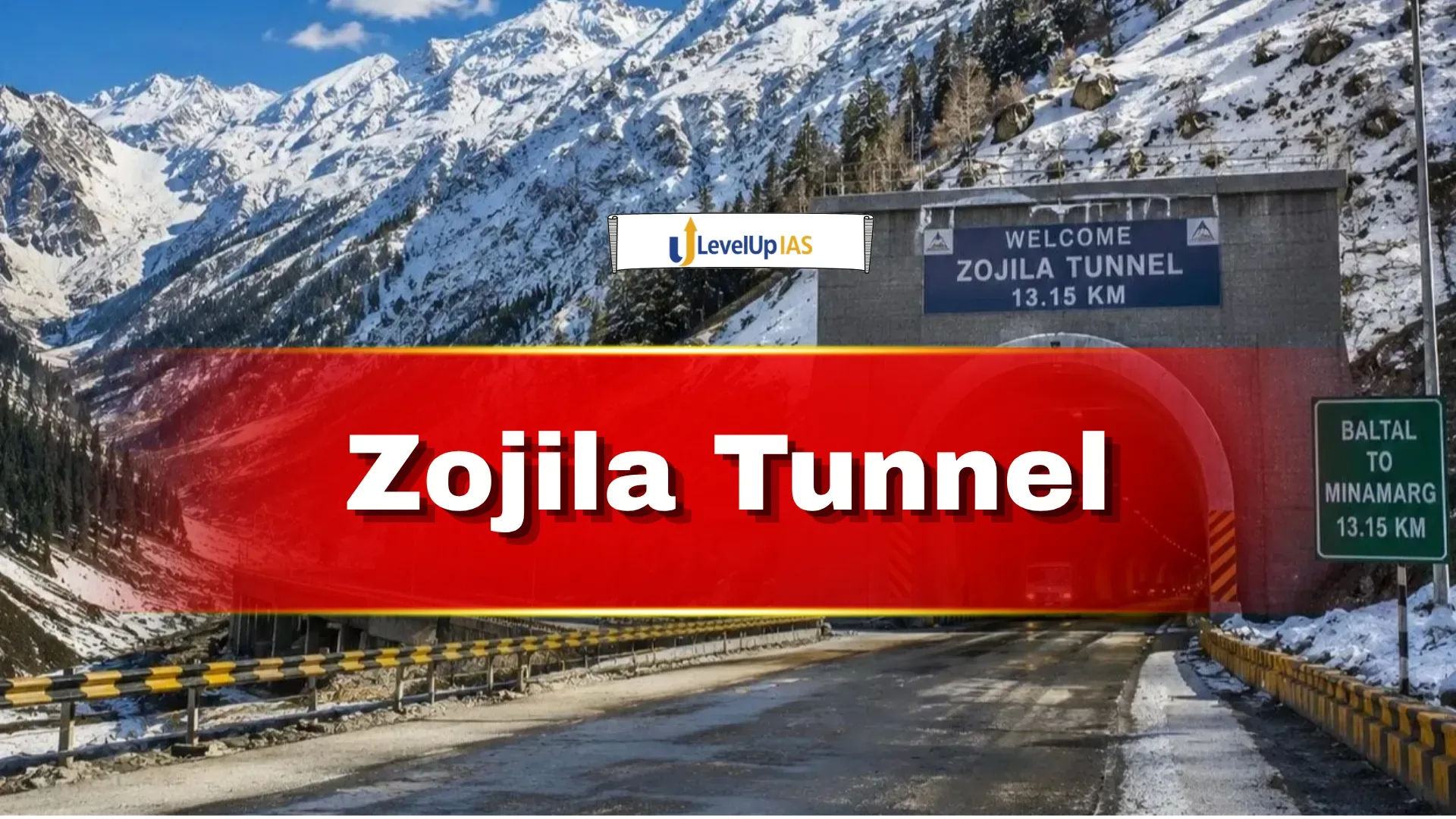
Zojila Tunnel
Why in News?
On 9 June 2026, the main tunnel of the Zojila Tunnel Project achieved a major construction breakthrough at its eastern portal in Minamarg, Kargil district. Union Minister for Road Transport and Highways Nitin Gadkari witnessed the milestone.
The breakthrough marks the joining of the tunnel excavation from both ends and brings India closer to establishing all-weather road connectivity between Jammu and Kashmir and Ladakh.
About the Zojila Tunnel
The Zojila Tunnel is a strategic infrastructure project being constructed across the Zojila Pass in the Himalayas. It is designed to provide year-round connectivity between Sonamarg in Jammu and Kashmir and Minamarg in Ladakh, bypassing the difficult and snowbound mountain pass.
- Location: Between Baltal and Minamarg on National Highway-1 (NH-1).
- Length: Approximately 13.15 km for the main tunnel; the project is also described as a 14.15 km bi-directional tunnel in NHIDCL's project description.
- Altitude: Approximately 2,900-3,310 metres above sea level.
- Implementing agency: National Highways and Infrastructure Development Corporation Limited (NHIDCL), under the Ministry of Road Transport and Highways.
- Construction cost: Approximately ₹6,808 crore.
- Construction began: October 2020.
- Expected completion: February 2028, as indicated by the Ladakh administration in April 2026.
The project is part of the development of the Sonamarg-Kargil section of NH-1.

Key Engineering Features
The project involves complex construction in a high-altitude Himalayan environment, where heavy snowfall, difficult geology and extreme weather pose significant challenges.
Its major features include:
- A bi-directional main tunnel designed to allow traffic in both directions.
- Modern ventilation systems and emergency cross-passage facilities.
- Automatic fire detection and suppression systems.
- CCTV surveillance, Variable Message Signs (VMS) and Supervisory Control and Data Acquisition (SCADA) systems for safety and traffic management.
- Two twin-tube, uni-directional Nilgrar tunnels with a combined length of approximately 4.8 km.
- Eight cut-and-cover sections, four bridges and 40 culverts.
- Snow galleries, catch dams, deflector dams and air-blast walls to protect the approach road from avalanches and other mountain hazards.
The project also uses the New Austrian Tunnelling Method (NATM), which involves controlled excavation and ground support based on the geological conditions encountered during construction.
Strategic and Economic Significance
1. All-weather connectivity: The Zojila Pass remains vulnerable to heavy snowfall and avalanches, often disrupting road connectivity for several months. The tunnel is expected to provide a reliable, year-round alternative.
2. Defence and national security: It will improve the movement of troops, military equipment, supplies and logistics towards strategically important border areas, strengthening India's preparedness in the region.
3. Reduced travel time: Once operational, the tunnel is expected to reduce travel time between Sonamarg and Minamarg from nearly two hours to around 30 minutes.
4. Tourism development: Better connectivity will encourage tourism in Sonamarg, Drass, Kargil and other parts of Ladakh, while supporting winter tourism and local businesses.
5. Regional economic development: Improved movement of people and goods will facilitate trade, create employment opportunities and improve access to essential services for communities in remote areas.
6. Regional integration: The project will strengthen connectivity between Jammu and Kashmir and Ladakh, supporting their economic and social integration.
Challenges Associated with the Project
Despite its strategic importance, the project faces several engineering and environmental challenges:
- Difficult geology: Unstable rock formations and variations in geological conditions can slow excavation and increase construction risks.
- Extreme climate: Heavy snowfall, freezing temperatures and harsh weather conditions make construction and transportation difficult.
- High-altitude conditions: Working at elevations above 2,900 metres creates additional challenges for workers, machinery and construction operations.
- Environmental concerns: Large-scale construction in the fragile Himalayan ecosystem can affect mountain slopes, drainage patterns and local biodiversity.
- Safety requirements: Long tunnels require reliable ventilation, fire protection, emergency evacuation arrangements and continuous monitoring.
Other Important Tunnels in Jammu and Kashmir
Tunnel | Key Features |
| Z-Morh (Sonamarg) Tunnel | 6.4 km tunnel inaugurated in January 2025; provides all-weather connectivity between Srinagar and Sonamarg. |
| Dr Syama Prasad Mookerjee Tunnel | Earlier known as the Chenani–Nashri Tunnel; approximately 9 km long and opened in 2017. It connects Udhampur and Ramban. |
The Z-Morh Tunnel and Zojila Tunnel together are important for improving the Srinagar-Sonamarg-Kargil-Leh connectivity corridor.
Conclusion
The Zojila Tunnel is a major step towards overcoming the geographical barriers that have historically limited connectivity in the Himalayan region. Beyond reducing travel time, it will strengthen national security, support economic development and improve the lives of people in remote areas. It reflects the growing importance of strategic infrastructure in India's border-region development.
Related reads.

Nyaya Setu AI Chatbot
18 Nov 2026 5 min

Black Rain
17 Nov 2026 4 min

Graded Response Action Plan (GRAP)
12 Nov 2026 4 min

Exercise IBSAMAR IX
08 Nov 2026 3 min

Khajuraho Temple Architecture
05 Nov 2026 4 min

Emissions Gap Report 2026
04 Nov 2026 4 min
Put it into practice
Reading is step one.
Turn what you've just read into exam-ready answers with mentor-led practice and our structured test series.