
Current Affairs
Khajuraho Temple Architecture
Why in News?
The Archaeological Survey of India (ASI) announced plans to restore the headless sandstone idol of Lord Vishnu at the Javari Temple in Khajuraho, Madhya Pradesh, by reattaching its missing head, which was recently traced to an ASI repository. The development has brought attention to the historical importance, architectural excellence and conservation of the Khajuraho temples.
About the Khajuraho Group of Monuments
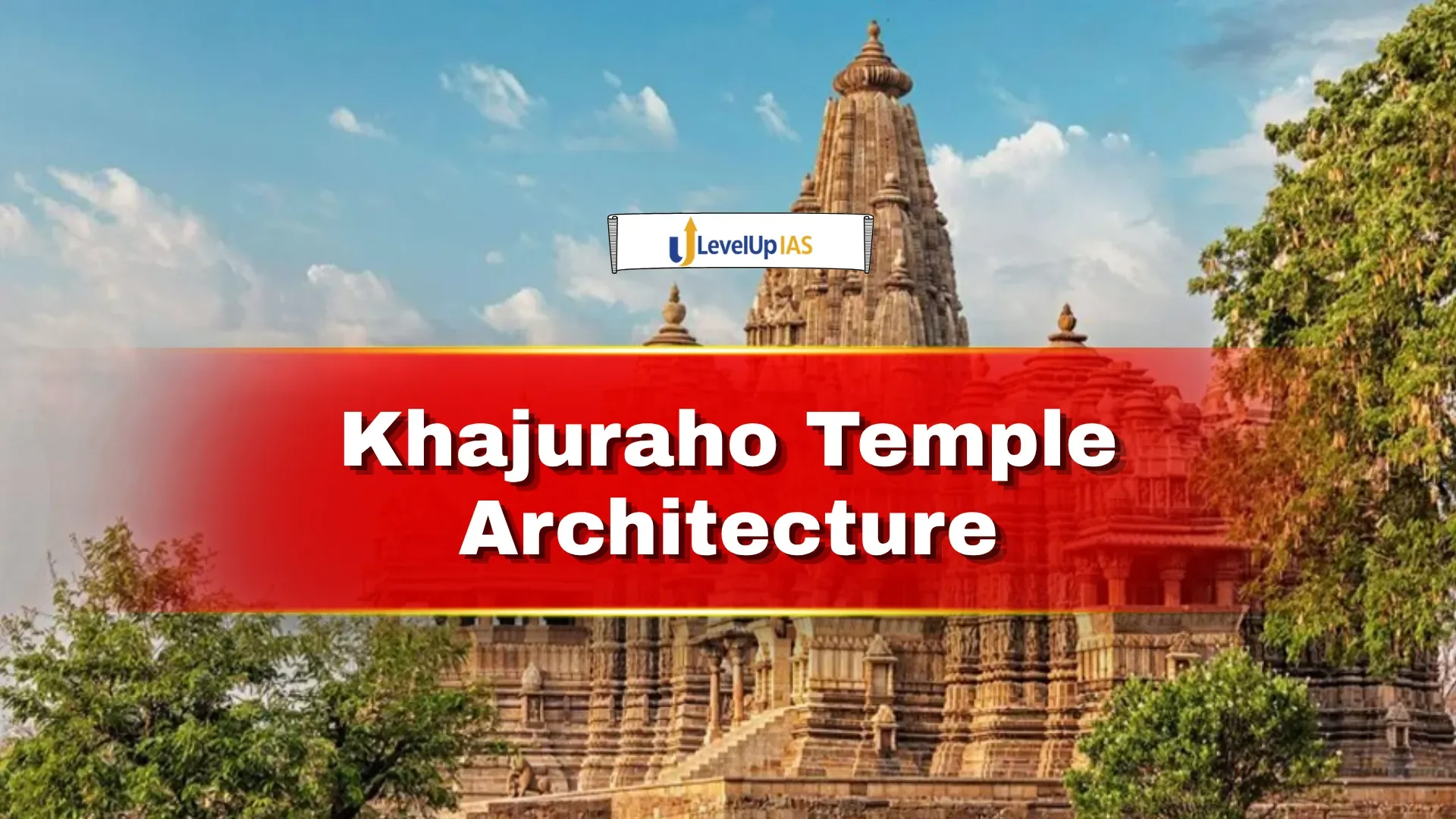
The Khajuraho Group of Monuments is a collection of medieval Hindu and Jain temples located in the Chhatarpur district of Madhya Pradesh. Built mainly between 950 and 1050 CE under the patronage of the Chandela (Chandella) dynasty, these temples represent one of the finest achievements of medieval Indian temple architecture.
Originally, the complex is believed to have consisted of around 85 temples, of which approximately 20 survive today. The surviving monuments are distributed across three groups:
- Western Group: Includes the Kandariya Mahadeva, Lakshmana and Vishvanatha temples.
- Eastern Group: Includes Hindu temples such as Javari and Vamana, along with Jain temples such as Parshvanatha and Adinatha.
- Southern Group: Includes the Duladeo and Chaturbhuj temples.
The temples were brought to wider attention in 1838 by British surveyor Captain T.S. Burt and were later documented by Alexander Cunningham.
Architectural Features of Khajuraho Temples
The Khajuraho temples represent the mature form of Nagara-style temple architecture, which developed in northern India. Their design is characterised by elevated platforms, curvilinear towers, interconnected halls and elaborate sculptural decoration.
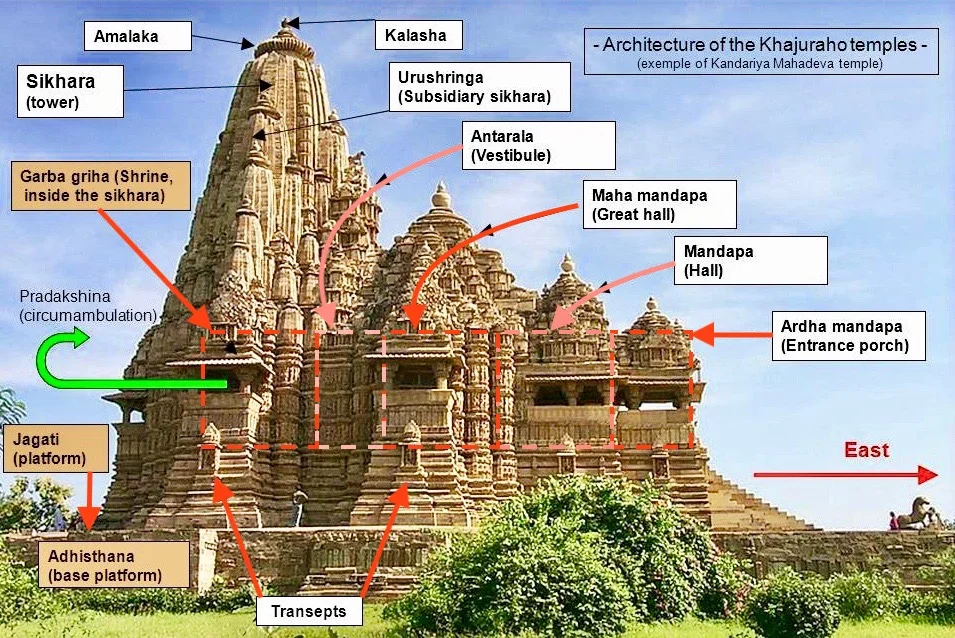
1. Elevated Platform (Jagati): Most temples are constructed on a raised and elaborately decorated platform called Jagati. It separates the sacred structure from its surroundings and provides a prominent architectural base.
2. Temple Plan and Components: The temples generally follow an axial arrangement in which different architectural spaces are connected in a sequence:
- Ardhamandapa: Entrance porch.
- Mandapa: Pillared assembly hall.
- Mah mandapa: Larger or main assembly hall, found in major temples.
- Antarala: Vestibule connecting the hall with the sanctum.
- Garbhagriha: Inner sanctum where the principal deity is installed.
Some temples also contain a circumambulatory passage (Pradakshinapatha) around the sanctum.
3. Shikhara and Urushringas: The temples feature tall, curvilinear towers called Shikharas above the sanctum. Smaller subsidiary spires, known as Urushringas, cluster around the main tower, creating a mountain-like appearance. This arrangement is particularly prominent in the Kandariya Mahadeva Temple and symbolically represents the sacred mountain.
4. Panchayatana Style: Some temples, including the Lakshmana and Vishvanatha temples, follow the Panchayatana arrangement. It consists of a central shrine surrounded by four subsidiary shrines at the corners of a common platform.
5. Material and Construction: The temples were primarily built using fine-grained sandstone, which allowed artisans to create intricate carvings. The stone blocks were carefully fitted together, demonstrating advanced craftsmanship.
Important Temples of Khajuraho
Kandariya Mahadeva Temple: The largest and one of the most elaborate surviving temples at Khajuraho, dedicated to Lord Shiva. It is known for its towering shikhara, clustered subsidiary spires and extensive sculptural decoration.
Lakshmana Temple: Dedicated to Lord Vishnu, it is an important example of the Panchayatana temple plan. Its sculptural panels and elaborate architectural design represent the mature Nagara tradition.
Vishvanatha Temple: Dedicated to Lord Shiva, it is noted for its sculptural richness and the presence of a large Nandi sculpture facing the main shrine.
Javari Temple: Located in the Eastern Group, this temple is dedicated to Lord Vishnu. It is known for its elevated platform, slender shikhara and intricately carved entrance arch (Makara Torana). The proposed restoration of its headless Vishnu idol is the recent development in the news.
Parshvanatha Temple: The largest surviving Jain temple at Khajuraho, dedicated to the Jain Tirthankara Parshvanatha. It is particularly noted for its detailed sculptural decoration.
Religious and Cultural Significance
The Khajuraho temples reflect the religious diversity and cultural life of medieval central India. The complex includes temples associated with Shaivism, Vaishnavism, Shaktism and Jainism, indicating the presence of multiple religious traditions under Chandela patronage.
Their sculptures also provide valuable insights into contemporary society, including clothing, jewellery, hairstyles, performing arts, social activities and religious practices. The representation of both sacred and secular themes demonstrates that temple art was not limited to religious imagery but also reflected broader aspects of human life.
UNESCO World Heritage Status
The Khajuraho Group of Monuments was inscribed on the UNESCO World Heritage List in 1986 under two criteria:
- Criterion (i): Represents a unique artistic creation through its distinctive architecture and exceptional sculptural decoration.
- Criterion (iii): Provides outstanding testimony to the culture of the Chandella dynasty, which flourished in central India during the 10th and 11th centuries.
The monuments are protected and managed by the Archaeological Survey of India under the Ancient Monuments and Archaeological Sites and Remains Act, 1958.
Conclusion
The Khajuraho temples represent a remarkable synthesis of architecture, sculpture, religion and social life during the medieval period. Their Nagara-style design and detailed artistic expression make them an important part of India's cultural heritage. The proposed restoration at Javari Temple also highlights the importance of scientific conservation and the preservation of historical monuments for future generations.
Related reads.

Emissions Gap Report 2026
04 Nov 2026 4 min

12th BRICS Parliamentary Forum 2026
03 Nov 2026 3 min
Pradhan Mantri Viksit Gram Swaraj Yojana
02 Nov 2026 4 min

Uniform Civil Code (UCC)
30 Oct 2026 7 min

CosmoCube Mission
29 Oct 2026 3 min

Essential Religious Practice (ERP)
29 Oct 2026 5 min
Put it into practice
Reading is step one.
Turn what you've just read into exam-ready answers with mentor-led practice and our structured test series.