
GS-II (Polity, Governance, IR)
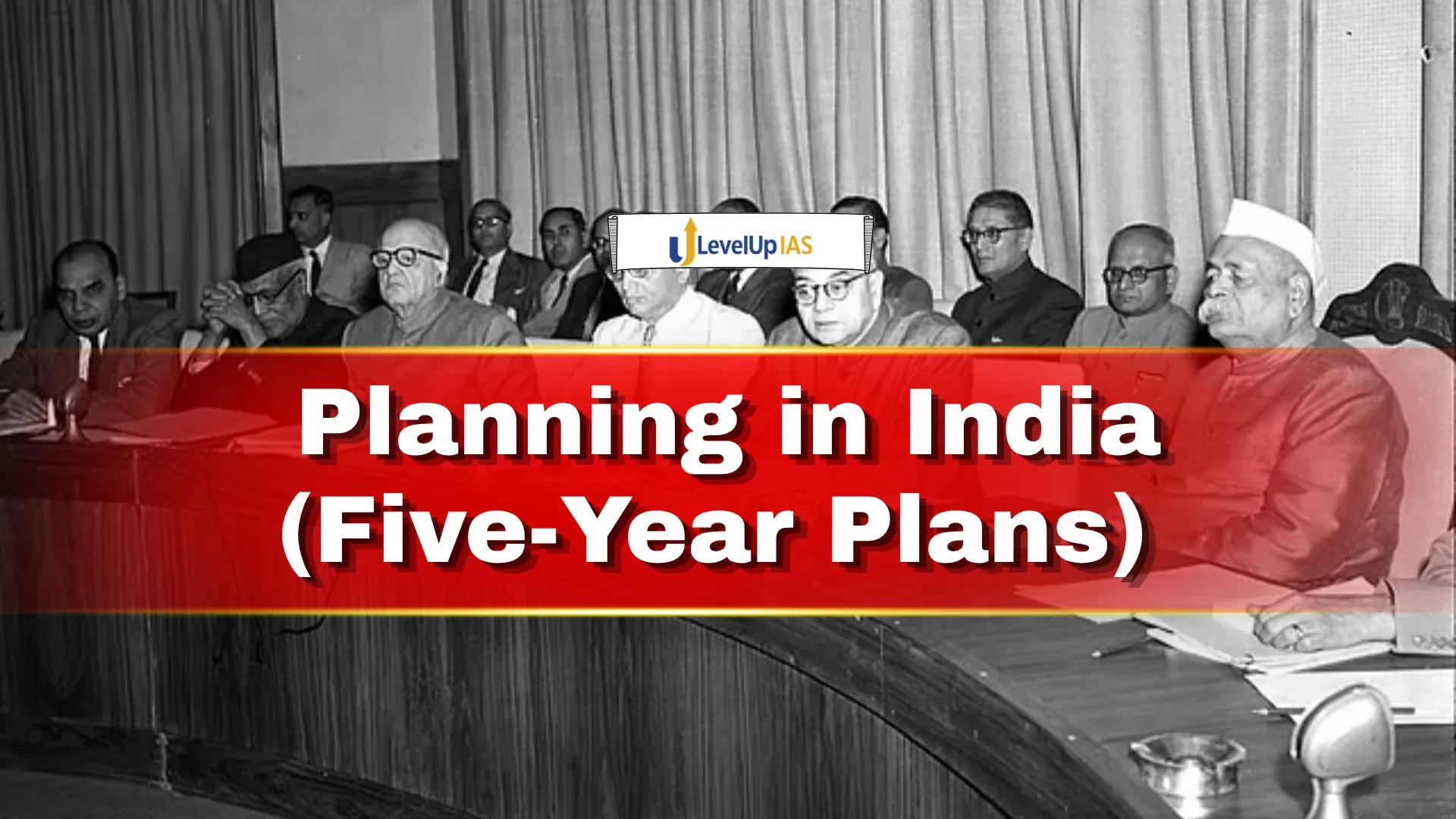
Planning in India (Five-Year Plans)
Content
- Introduction
- First Five Year Plan (1951-56)
- Second Five Year Plan (1956-61)
- Third Five Year Plan (1961-66)
- Fourth Five Year Plan (1969-74)
- Fifth Five Year Plan (1974-78)
- Sixth Five Year Plan (1980-85)
- Seventh Five Year Plan (1985-90)
- Eighth Five Year Plan (1992-97)
- Ninth Five Year Plan (1997-2002)
- Tenth Five Year Plan (2002-07)
- Eleventh Five Year Plan (2007-12)
- Twelfth Five Year Plan (2012-17)
- Conclusion
- FAQs
Introduction
The Five Year Plans in India represent a landmark phase in the country’s post-independence economic development. Introduced in 1951, these plans were designed to guide India’s transition from a colonial, agrarian economy to a modern, self-reliant, and industrialised nation. The planning framework provided a structured mechanism for resource allocation, setting developmental priorities, and achieving balanced socio-economic growth.
Between 1951 and 2017, India implemented twelve Five Year Plans under the Planning Commission of India. Over time, the planning approach evolved from state-led industrialisation to inclusive and sustainable growth strategies. However, with changing economic realities, globalization, and governance reforms, the Five Year Plan system was discontinued after 2017 and replaced by NITI Aayog in 2015, marking a shift towards flexible, cooperative federalism.
First Five Year Plan (1951-56)
The First Five Year Plan laid the foundation of planned development in independent India. The primary focus was on addressing the urgent challenges of food scarcity, low agricultural productivity, and post-partition economic instability. Agriculture, irrigation, and rural development were given top priority, as nearly 70 percent of the population depended on agriculture for livelihood.
This plan was based on the Harrod-Domar growth model, emphasizing capital formation through savings and investment. Major irrigation and multipurpose river valley projects such as Bhakra Nangal, Hirakund, and Damodar Valley were initiated during this period. Additionally, the establishment of Indian Institutes of Technology marked an important step in developing technical human resources.
The plan is considered successful, as the achieved growth rate of 3.6 percent exceeded the target of 2.1 percent, providing a strong foundation for future planning.
Second Five Year Plan (1956-61)
The Second Five Year Plan marked a decisive shift from agriculture to industrial development. It was designed under the leadership of P. C. Mahalanobis, whose model prioritized the development of heavy industries as the key driver of long-term economic growth.
The plan emphasized the establishment of basic and capital goods industries, including steel, machinery, and power. As part of this strategy, major steel plants were set up at Bhilai, Rourkela, and Durgapur. The public sector expanded significantly, reflecting the state’s dominant role in industrial development.
Import substitution became an important strategy to reduce dependence on foreign goods. However, rapid industrialisation also led to inflationary pressures and foreign exchange constraints, highlighting structural limitations of the economy at the time.
Third Five Year Plan (1961-66)
The Third Five Year Plan aimed at achieving balanced development between agriculture and industry with a long-term vision of self-reliance. It sought to make India a self-sustaining economy capable of maintaining growth independently.
However, the plan faced severe disruptions due to external shocks. The Sino-India war of 1962, the Indo-Pak war of 1965, and consecutive droughts significantly affected agricultural production and economic stability. These challenges exposed vulnerabilities in India’s planning system.
As a result, the plan failed to achieve its targets, with actual growth falling significantly below expectations.
Plan Holiday (1966-69)
Due to the failure of the Third Plan and prevailing economic instability, India entered a period known as the Plan Holiday. During this phase, instead of a five-year framework, three Annual Plans were implemented.
The focus shifted to short-term stabilization measures, including controlling inflation, ensuring food security, and restoring economic balance. This period acted as a corrective phase before the resumption of structured planning.
Fourth Five Year Plan (1969-74)
The Fourth Five Year Plan emphasized growth with stability and aimed to reduce regional disparities in development. It was guided by the Gadgil Formula, which focused on balanced allocation of resources across states.
A major feature of this period was the nationalisation of banks in 1969, which expanded institutional credit and strengthened rural financing. The Green Revolution also gained momentum, leading to a significant increase in food grain production and improving food security.
Despite these achievements, the overall economic growth remained below expectations due to global and domestic constraints.
Fifth Five Year Plan (1974-78)
The Fifth Five Year Plan marked a shift towards poverty alleviation and social justice. Its guiding philosophy was encapsulated in the slogan “Garibi Hatao,” reflecting the government’s focus on reducing inequality and poverty.
The Minimum Needs Programme was introduced to provide basic services such as education, healthcare, housing, and drinking water. Employment generation and rural development were also key priorities.
Although the plan initially emphasized redistribution and welfare, it was discontinued in 1978 following a change in government.
Rolling Plan (1978-80)
The Rolling Plan was introduced as an alternative to rigid five-year planning. Under this system, plans were revised annually based on performance and changing economic conditions.
While it introduced flexibility, it lacked long-term consistency and was eventually abandoned in 1980.
Sixth Five Year Plan (1980-85)
The Sixth Five Year Plan marked the beginning of a gradual shift towards economic liberalisation. It focused on modernization, efficiency improvement, and technological upgradation.
Population control and family planning were given importance due to rising demographic pressures. The establishment of NABARD in 1982 strengthened agricultural credit and rural development institutions.
Infrastructure development in energy, transport, and communication was also prioritized, laying the groundwork for future economic expansion.
Seventh Five Year Plan (1985-90)
The Seventh Five Year Plan emphasized technology-driven and productivity-oriented growth. Implemented under the leadership of Rajiv Gandhi, it focused on modernization through the adoption of computers, electronics, and telecommunications.
The plan marked the beginning of India’s shift towards a knowledge-based economy. Industrial efficiency and productivity were enhanced, and food security continued to remain a priority.
Annual Plans (1990-92)
Due to a severe economic crisis, the Five Year Plan framework was temporarily suspended during 1990-92. India faced a serious balance of payments crisis, rising fiscal deficit, and inflationary pressures.
This crisis led to the introduction of major economic reforms in 1991, popularly known as Liberalisation, Privatisation, and Globalisation (LPG). These reforms fundamentally changed India’s economic structure.
Eighth Five Year Plan (1992-97)
The Eighth Five Year Plan was the first plan after economic liberalisation. It marked a transition from a centrally planned economy to a market-oriented economic system.
The focus was on industrial modernization, infrastructure development, and human resource development. India also became a member of the World Trade Organisation in 1995, integrating further into the global economy.
The plan achieved relatively strong economic performance, reflecting the early benefits of reforms.
Ninth Five Year Plan (1997-2002)
The Ninth Five Year Plan focused on “Growth with Social Justice.” It aimed to balance economic growth with equitable distribution of benefits.
Poverty reduction, education, healthcare, and empowerment of weaker sections were key priorities. Public-private partnerships also began to gain importance during this phase.
Tenth Five Year Plan (2002-07)
The Tenth Plan introduced the concept of inclusive growth more explicitly. It aimed at achieving high economic growth while simultaneously reducing poverty and regional disparities.
Employment generation and human capital development were key focus areas, along with gender equality and social inclusion.
Eleventh Five Year Plan (2007-12)
The Eleventh Five Year Plan was based on the theme “Faster and More Inclusive Growth.” It emphasized expansion of education, health services, and skill development.
A landmark achievement of this period was the enactment of the Right to Education Act in 2009, ensuring free and compulsory education for children aged 6-14 years.
Environmental sustainability and equitable development were also important components of this plan.
Twelfth Five Year Plan (2012-17)
The Twelfth Five Year Plan was the final plan in India’s planning history. Its theme was “Faster, Inclusive and Sustainable Growth.”
It emphasized infrastructure development, energy access, environmental sustainability, and social equity. Skill development and employment generation were also key priorities.
After 2017, the Five Year Plan system was officially discontinued, marking the end of an era in Indian economic planning.
Conclusion
The Five Year Plans played a transformative role in shaping India’s post-independence development trajectory. They helped the country move from food scarcity and industrial backwardness to a more diversified and globally integrated economy. Although the system has been replaced by NITI Aayog and a more flexible policy framework, the legacy of the Five Year Plans continues to influence India’s developmental thinking, particularly in areas of planning, equity, and long-term economic vision.
FAQs
Q1. What is economic planning?
Economic planning is the systematic process by which the government formulates policies and allocates resources to achieve specific economic and social development goals within a defined period.
Q2. What are Five-Year Plans?
Five-Year Plans were comprehensive national development programmes prepared for a period of five years to promote economic growth, employment, poverty reduction, industrialization, agriculture, and infrastructure development.
Q3. When was the Planning Commission established?
The Planning Commission was established on 15 March 1950 by a Resolution of the Government of India to formulate and monitor Five-Year Plans.
Q4. When was the First Five-Year Plan launched?
The First Five-Year Plan (1951-1956) was launched in 1951, with its primary focus on agriculture, irrigation, and rehabilitation in the post-independence period.
Q5. What were the major objectives of the Five-Year Plans?
The key objectives were:
- Rapid economic growth
- Poverty alleviation
- Employment generation
- Agricultural and industrial development
- Balanced regional development
- Self-reliance and social justice
Related reads.
Zonal Councils, UPSC Polity
21 Sep 2026 7 min
Social Sector and Services
15 Sep 2026 7 min

Sessions of Parliament
12 Sep 2026 7 min

G7 Grouping and Its Summit
05 Aug 2026 5 min

Civil Society, GS 2
31 May 2026 7 min
Self Help Groups (SHGs), GS 2
29 May 2026 6 min
Put it into practice
Reading is step one.
Turn what you've just read into exam-ready answers with mentor-led practice and our structured test series.