
GS-II (Polity, Governance, IR)
Zonal Councils, UPSC Polity

Introduction
India’s federal system requires regular coordination between the Union and the States, particularly on issues involving neighbouring States. Zonal Councils provide a regional forum for such consultation and cooperation. They are statutory and advisory bodies established under the States Reorganisation Act, 1956 to promote inter-State and Centre-State coordination.
Background and Rationale
The idea of Zonal Councils was suggested by the first Prime Minister, Jawaharlal Nehru, in 1956, during the debates surrounding the recommendations of the States Reorganisation Commission. The reorganisation of States largely along linguistic lines had generated considerable regional and linguistic tensions. Nehru proposed grouping States into a few zones with advisory councils to develop a habit of cooperative working among them.
The objective was not to create another layer of government, but to provide a high-level forum where inter-State and Centre-State issues could be discussed before they developed into larger disputes. The idea therefore reflected an important principle of Indian federalism: regional cooperation can strengthen, rather than weaken, national integration.
The States Reorganisation Act, 1956 provided for five Zonal Councils Northern, Central, Eastern, Western and Southern. They became operational in 1957. The Act specifies their establishment, composition, functioning and secretarial arrangements.
Five Zonal Councils
The five Zonal Councils cover most of India, while the North-Eastern region has a separate institutional arrangement through the North Eastern Council (NEC).
At present, the five councils broadly comprise:
Zonal Council | States/Union Territories |
| Northern | Haryana, Himachal Pradesh, Punjab, Rajasthan, Jammu & Kashmir, Ladakh, Delhi and Chandigarh |
| Central | Uttar Pradesh, Uttarakhand, Madhya Pradesh and Chhattisgarh |
| Eastern | Bihar, Jharkhand, Odisha and West Bengal |
| Western | Goa, Gujarat, Maharashtra and Dadra and Nagar Haveli and Daman and Diu |
| Southern | Andhra Pradesh, Telangana, Karnataka, Kerala, Tamil Nadu and Puducherry |
The composition of the zones has changed over time because of the creation of new States and Union Territories. For instance, the present Western Zonal Council comprises Goa, Gujarat, Maharashtra and the Union Territory of Dadra and Nagar Haveli and Daman and Diu.
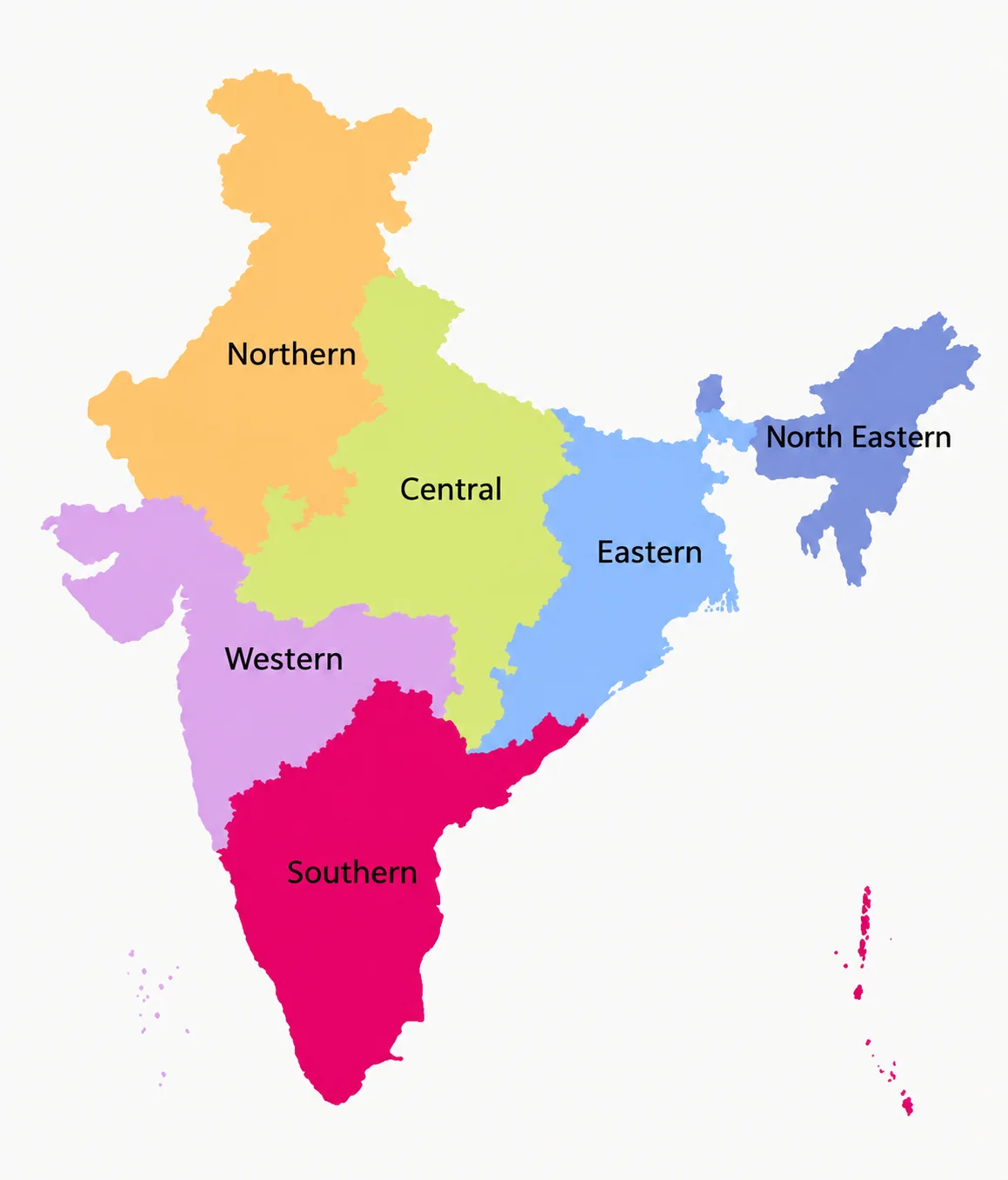
The North-Eastern States are not part of these five Zonal Councils. Their regional concerns are addressed through the North Eastern Council, constituted under the North Eastern Council Act, 1971. The NEC now covers all eight North-Eastern States, including Sikkim.
Composition and Organisation
The Union Home Minister is the Chairman of every Zonal Council. The Chief Ministers of the States belonging to the respective zone act as Vice-Chairman by rotation, with each holding the position for one year.
The Chief Minister and two other Ministers from each member State are represented in the Council. Union Territories in the respective zones are also represented. Union Ministers may participate in meetings when matters concerning their ministries are under discussion. Senior officials, including Chief Secretaries of member States, are associated with the functioning of the councils.
Each Zonal Council also has a Standing Committee consisting of the Chief Secretaries of the member States. These committees examine issues, undertake the necessary groundwork and facilitate their consideration before the full Council. This arrangement allows many administrative issues to be examined at the official level before they reach the political forum.
The Zonal Councils Secretariat, functioning under the Ministry of Home Affairs, provides institutional and administrative support to the councils and follows up on their recommendations. Thus, the councils are not merely occasional political meetings; they are supported by a continuing administrative mechanism.
Functions of Zonal Councils
The central feature of Zonal Councils is their advisory character. They can discuss matters in which two or more member States, or the Union and one or more States, have a common interest. Their recommendations are intended to facilitate coordination rather than impose legally binding decisions.
Under the States Reorganisation Act, the councils can consider matters related to economic and social planning, inter-State transport, linguistic minorities, border disputes and issues arising from the reorganisation of States. In practice, their agenda has expanded to include areas such as internal security, infrastructure, public welfare, disaster management, cybercrime, health, education and implementation of development programmes.
Their regional character is particularly important. A problem such as inter-State transport or a border dispute may affect neighbouring States differently from the rest of the country. A smaller regional forum enables the concerned States and Union representatives to focus on such issues while considering their wider national implications.
Zonal Councils and Cooperative Federalism
Zonal Councils represent an important institutional mechanism of cooperative federalism. Their significance is not limited to resolving disputes; they also facilitate policy coordination and sharing of administrative experiences.
For example, States facing similar challenges in policing, disaster management, trafficking, infrastructure or public service delivery can discuss common approaches. Similarly, issues involving more than one State such as transport connectivity, regional infrastructure or management of shared resources can be placed before a forum where the concerned governments participate directly.
This distinguishes Zonal Councils from purely constitutional mechanisms for dispute settlement. Their emphasis is on consultation, negotiation and consensus-building. The Ministry of Home Affairs describes them as regional forums of cooperative endeavour that allow States linked economically, politically and culturally to address specific regional concerns while keeping the national perspective in view.
Zonal Councils in Recent Years
The functioning of Zonal Councils has received renewed attention in recent years because of an increase in the frequency of their meetings and the broader range of issues placed before them.
At the 27th Eastern Zonal Council meeting in Ranchi in July 2025, issues concerning Fast Track Special Courts, banking facilities, emergency response systems, nutrition, education, health, power, urban planning and cooperative institutions were discussed. The meeting demonstrated how the councils have increasingly been used as platforms for coordinating implementation of policies that involve multiple levels of government.
In September 2026, the 28th Western Zonal Council meeting was held in Panaji, Goa, under the chairmanship of the Union Home Minister. The meeting discussed issues including public welfare, criminal justice, emergency response, food safety, banking access, nutrition, education, health, power-sector reforms, urban planning, cybercrime and digital infrastructure.
According to the Ministry of Home Affairs, 70 meetings of various Zonal Councils and their Standing Committees had been held from June 2014 to September 2026, reflecting the increased use of the mechanism for Centre-State and inter-State coordination.
Zonal Councils and the Inter-State Council
Zonal Councils and the Inter-State Council are often discussed together because both promote cooperative federalism, but they are institutionally different.
The Inter-State Council is a constitutional body under Article 263, whereas Zonal Councils are statutory bodies under the States Reorganisation Act, 1956. The Inter-State Council has an all-India perspective, while Zonal Councils are geographically focused and deal primarily with issues affecting particular groups of neighbouring States and Union Territories.
The regional focus of Zonal Councils can therefore complement the broader coordination mechanism provided by the Inter-State Council. Together, these institutions provide different levels of engagement within India’s federal system.
Significance and Challenges
The principal strength of Zonal Councils is their ability to bring political executives and senior administrators together in a structured regional forum. They can help prevent relatively manageable disagreements from becoming prolonged disputes and can improve coordination in areas where administrative boundaries do not correspond to the geographical spread of a problem.
However, their recommendations are advisory rather than legally binding. Their effectiveness consequently depends upon political willingness, regular meetings, administrative follow-up and implementation by the concerned governments. A council can provide a platform for consensus, but it cannot substitute for constitutional mechanisms, legislation or judicial adjudication where these are required.
The future effectiveness of Zonal Councils therefore depends less on simply increasing the number of meetings and more on ensuring systematic follow-up, measurable implementation and sustained participation by the States and Union government.
Conclusion
Zonal Councils provide an institutional platform for regional cooperation, consultation and consensus-building in India’s federal system. By addressing common inter-State concerns, they complement other mechanisms of Centre-State relations and strengthen the practice of cooperative federalism.
FAQs
1. What are Zonal Councils?
Zonal Councils are statutory bodies established under the States Reorganisation Act, 1956 to promote cooperation and coordination among States and between States and the Centre.
2. How many Zonal Councils are there in India?
There are five Zonal Councils:
- Northern Zonal Council
- Central Zonal Council
- Eastern Zonal Council
- Western Zonal Council
- Southern Zonal Council
3. Which States are covered under the Zonal Councils?
The five councils cover different groups of States and Union Territories based broadly on their geographical location. North Eastern States are not part of these five councils; they are dealt with through the North Eastern Council, established under a separate law.
4. Who is the Chairman of a Zonal Council?
The Union Home Minister is the Chairman of all Zonal Councils. The Chief Ministers of the States in the respective zone act as Vice-Chairmen by rotation, for a period of one year.
5. Who are the members of a Zonal Council?
The Chief Minister and two Ministers nominated by each State Government in the zone are members. For Union Territories, the President may nominate members. The Union Home Minister and, where applicable, other Union Ministers may also participate.
Related reads.
Social Sector and Services
15 Sep 2026 7 min
Sessions of Parliament
12 Sep 2026 7 min
Planning in India (Five-Year Plans)
07 Aug 2026 7 min

G7 Grouping and Its Summit
05 Aug 2026 5 min

Civil Society, GS 2
31 May 2026 7 min
Self Help Groups (SHGs), GS 2
29 May 2026 6 min
Put it into practice
Reading is step one.
Turn what you've just read into exam-ready answers with mentor-led practice and our structured test series.