
GS-II (Polity, Governance, IR)
Social Sector and Services
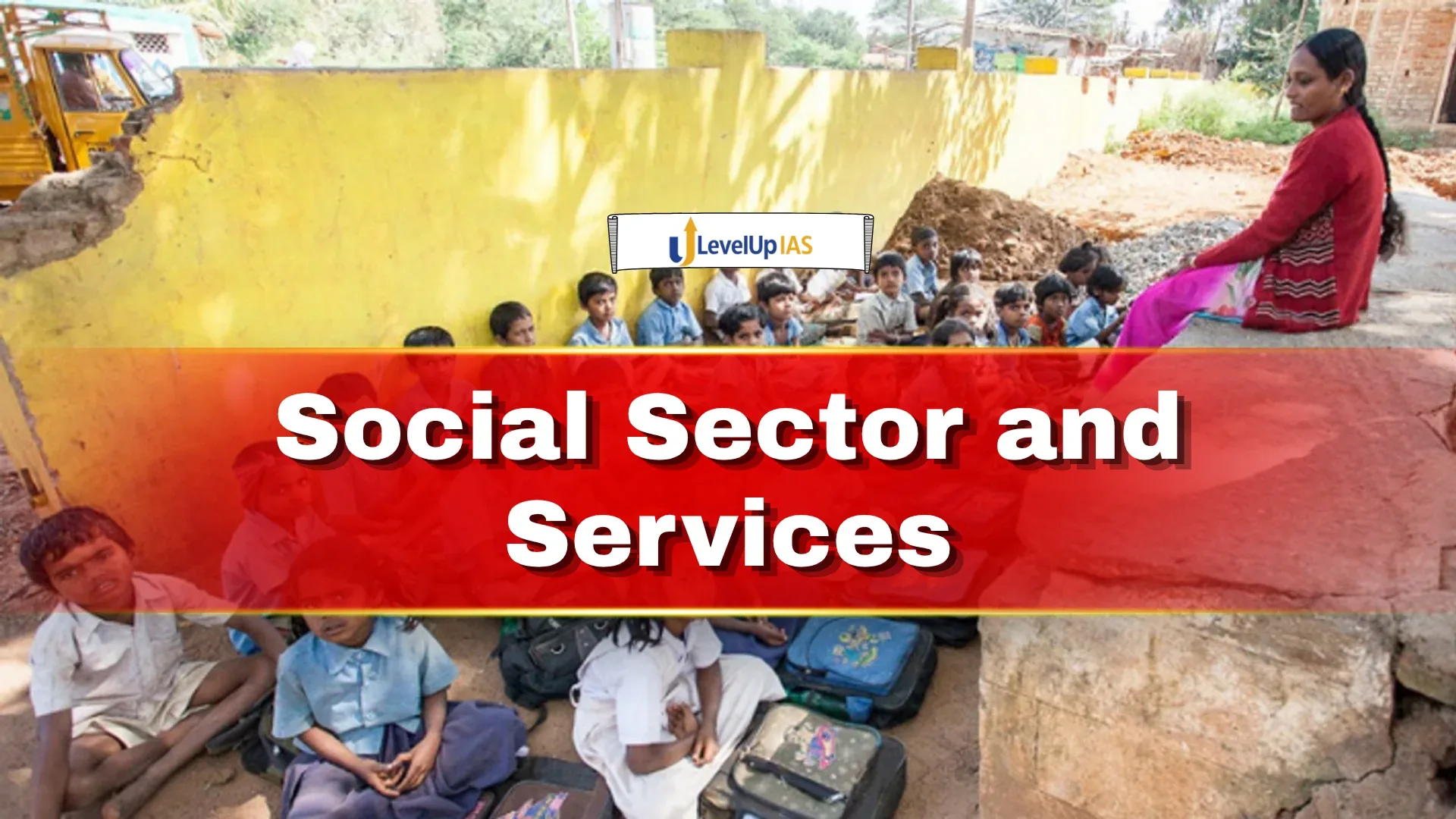
Introduction
The social sector broadly refers to those areas of public policy that directly influence people's well-being, capabilities and quality of life. It includes sectors such as education, healthcare, nutrition, drinking water and sanitation, housing, social security, women and child development, skill development and welfare of vulnerable sections. These services are essential for ensuring that economic development translates into improvements in human development and social well-being.
From the perspective of Social Justice, the importance of the social sector goes beyond welfare expenditure. Access to education, healthcare, nutrition and social security determines an individual's ability to participate equally in society. Therefore, social-sector interventions seek to reduce the disadvantages arising from poverty, caste, gender, disability, geographical location and other forms of social and economic exclusion.
Social Sector and Social Justice
Social justice essentially implies creating conditions in which individuals and groups can enjoy equality of opportunity, dignity, rights and access to resources and services. In a highly diverse and unequal society such as India, formal equality alone is insufficient. Historically disadvantaged groups may require additional support to overcome structural barriers.
This is reflected in the constitutional vision of the Indian state. Article 38 directs the State to promote the welfare of the people and minimise inequalities in income, status, facilities and opportunities. Article 39 calls for securing adequate means of livelihood and ensuring that the ownership and control of material resources are distributed to serve the common good. Article 41 deals with the right to work, education and public assistance within the limits of the state's economic capacity, while Article 46 specifically requires the State to promote the educational and economic interests of weaker sections, particularly Scheduled Castes and Scheduled Tribes, and protect them from social injustice and exploitation. Article 47 places improvement of nutrition, standard of living and public health among the State's primary duties.
Thus, social services are an important instrument through which the constitutional promise of substantive equality and social justice can be pursued.
Major Components of the Social Sector
Education
Education is one of the most important instruments of social transformation. It enhances human capabilities, promotes social mobility and enables individuals to participate more effectively in economic and political life. For disadvantaged communities, access to quality education can help break the intergenerational transmission of poverty and social exclusion.
The social-justice dimension of education therefore involves not merely increasing enrolment but ensuring equitable access, affordability, quality and learning outcomes. Barriers faced by girls, children with disabilities, tribal communities, economically weaker households and children living in remote areas require targeted interventions.
Education also has a wider democratic significance. A population with better educational opportunities is better equipped to understand rights, access public institutions and participate in democratic processes.
Health and Nutrition
Healthcare is another fundamental component of social justice because illness can push vulnerable households into poverty and restrict their ability to work, study and participate in society. A socially just health system must therefore ensure that essential healthcare is accessible and affordable irrespective of income or social status.
Public health includes preventive, promotive and curative dimensions, while nutrition is closely linked with health, cognitive development and productivity. Malnutrition among children can have long-term consequences for educational attainment and human capital formation.
Consequently, social-sector policy increasingly requires an integrated approach in which healthcare, nutrition, sanitation, drinking water and education reinforce one another. The Economic Survey also highlights this interdependence, noting that educational outcomes can be affected by healthcare, nutritional security, transport and household income.
Water, Sanitation and Housing
Basic amenities such as safe drinking water, sanitation and adequate housing are closely connected with human dignity and public health. Their absence disproportionately affects poorer households and marginalised communities.
From a social-justice perspective, the objective is therefore not simply to create infrastructure but to ensure universal and equitable access. For instance, a household having access to a water connection is meaningful only when the supply is regular, safe and affordable. Similarly, sanitation requires not only infrastructure but also behavioural and social change.
Housing also has a wider social dimension. Secure housing provides stability, improves health and education outcomes and protects vulnerable households from social and economic insecurity.
Social Security and Welfare
Social security seeks to protect individuals from economic and social risks such as old age, disability, illness, loss of livelihood and other vulnerabilities. It is particularly important in India because a large informal workforce may not have access to employment-linked social protection.
Social security measures can take the form of pensions, insurance, food support, maternity benefits, assistance to persons with disabilities and other welfare interventions. Their purpose is not merely income redistribution but preventing vulnerable individuals from falling into deeper deprivation.
An effective social-security system must therefore combine adequate coverage, portability, timely delivery and accessibility.
Welfare and Empowerment of Vulnerable Groups
Social-sector policy also has a specific role in addressing the disadvantages experienced by SCs, STs, OBCs, women, children, persons with disabilities, senior citizens, transgender persons, minorities and other vulnerable groups.
NITI Aayog identifies social justice interventions as involving three broad dimensions: social empowerment, economic empowerment, and social and financial inclusion. Social empowerment seeks to address discrimination and inequality; economic empowerment promotes employment and income-generating opportunities; and inclusion seeks to expand access to basic services and economic participation.
This shows why social justice cannot be achieved only through welfare transfers. It also requires removing discriminatory practices, expanding opportunities and enabling vulnerable groups to become active participants in development.
Role of the State in Social Services
The State has a central role in social-sector development because many essential services cannot be left entirely to market forces. Private provision may be concentrated in areas with greater purchasing power, while poor and geographically remote populations may remain underserved.
Public expenditure is therefore an important instrument for ensuring universal access and redistribution. The combined social-services expenditure of the Centre and States has increased over time, reflecting the growing importance of education, health, housing, sanitation, social security and welfare in public policy. The Economic Survey 2024-25 notes that social-services expenditure rose from ₹14.8 lakh crore in FY2021 to ₹25.7 lakh crore in FY2025 (Budget Estimates).
However, expenditure alone cannot guarantee social justice. The quality of institutions, availability of personnel, implementation capacity and responsiveness to local needs are equally important.
Major Challenges
The first major challenge is inequality in access. Social services are not experienced uniformly across regions and social groups. Rural areas, tribal regions and poorer households may face greater barriers in accessing quality healthcare, education and other essential services.
A second challenge is the gap between access and quality. Increasing the number of schools, hospitals or welfare beneficiaries does not necessarily produce better social outcomes. Quality of teaching, availability of healthcare professionals, nutritional outcomes and reliability of basic services matter equally.
Another concern is exclusion of vulnerable groups. Lack of awareness, documentation problems, geographical isolation, social discrimination and limited institutional capacity can prevent eligible people from receiving benefits.
There is also the challenge of balancing universalism and targeted welfare. Universal basic services can prevent exclusion, while targeted interventions are necessary to address the specific disadvantages faced by vulnerable communities.
Finally, social-sector outcomes depend on multiple factors. Education, health, nutrition, employment, sanitation and household income are interconnected. Consequently, fragmented interventions may have limited impact when the underlying causes of deprivation are not addressed together.
Way Forward
India's social-sector approach needs to move from merely measuring inputs and coverage towards outcomes and capabilities. The real measure of a school is not only enrolment but learning; of healthcare, not merely infrastructure but health outcomes; and of social security, not merely the number of beneficiaries but whether vulnerable people receive adequate and timely protection.
Greater emphasis should also be placed on universal access to essential services, targeted support for disadvantaged groups, stronger public institutions and community participation. Social audits, decentralisation and effective grievance-redressal mechanisms can make welfare systems more accountable.
At the same time, social justice requires moving beyond a welfare approach towards empowerment. Education, healthcare, skills, employment opportunities, financial inclusion and social protection should enable individuals to become economically and socially independent.
Conclusion
Social sector and services constitute the human foundation of social justice. They enable citizens to overcome structural disadvantages and participate more equally in the social, economic and political life of the country.
For India, the objective should not simply be greater welfare expenditure but equitable access, quality services, social inclusion and empowerment. A socially just development model must ensure that the benefits of growth reach those who have historically remained excluded from opportunities and basic services. In this sense, investment in the social sector is not merely expenditure on welfare; it is an investment in human capabilities, dignity and substantive equality.
FAQs
Q1. What is the social sector?
The social sector comprises areas that directly contribute to human well-being and quality of life, including education, healthcare, nutrition, sanitation, housing, social security and welfare.
Q2. What are the major components of social services in India?
Major social services include education, healthcare, drinking water and sanitation, housing, nutrition, social security, skill development and welfare services.
Q3. Why are social sector services important for development?
They improve human capital, productivity, health, education and living standards, while helping reduce poverty, inequality and social exclusion.
Q4. What is the role of government in the social sector?
The government provides public services, welfare programmes, social protection and financial support, particularly for vulnerable and disadvantaged sections of society.
Q5. What are the major challenges facing India’s social sector?
Key challenges include unequal access, regional disparities, inadequate infrastructure, quality gaps, affordability issues, malnutrition, unemployment and gaps in social protection.
Related reads.
Sessions of Parliament
12 Sep 2026 7 min
Planning in India (Five-Year Plans)
07 Aug 2026 7 min

G7 Grouping and Its Summit
05 Aug 2026 5 min
Civil Society, GS 2
31 May 2026 7 min
Self Help Groups (SHGs), GS 2
29 May 2026 6 min
Sociology Optional Paper - 2, Daily Answer Writing (DAMP PRO) for CSE 2025
25 Apr 2026 16 min
Put it into practice
Reading is step one.
Turn what you've just read into exam-ready answers with mentor-led practice and our structured test series.