
GS-II (Polity, Governance, IR)
Sessions of Parliament
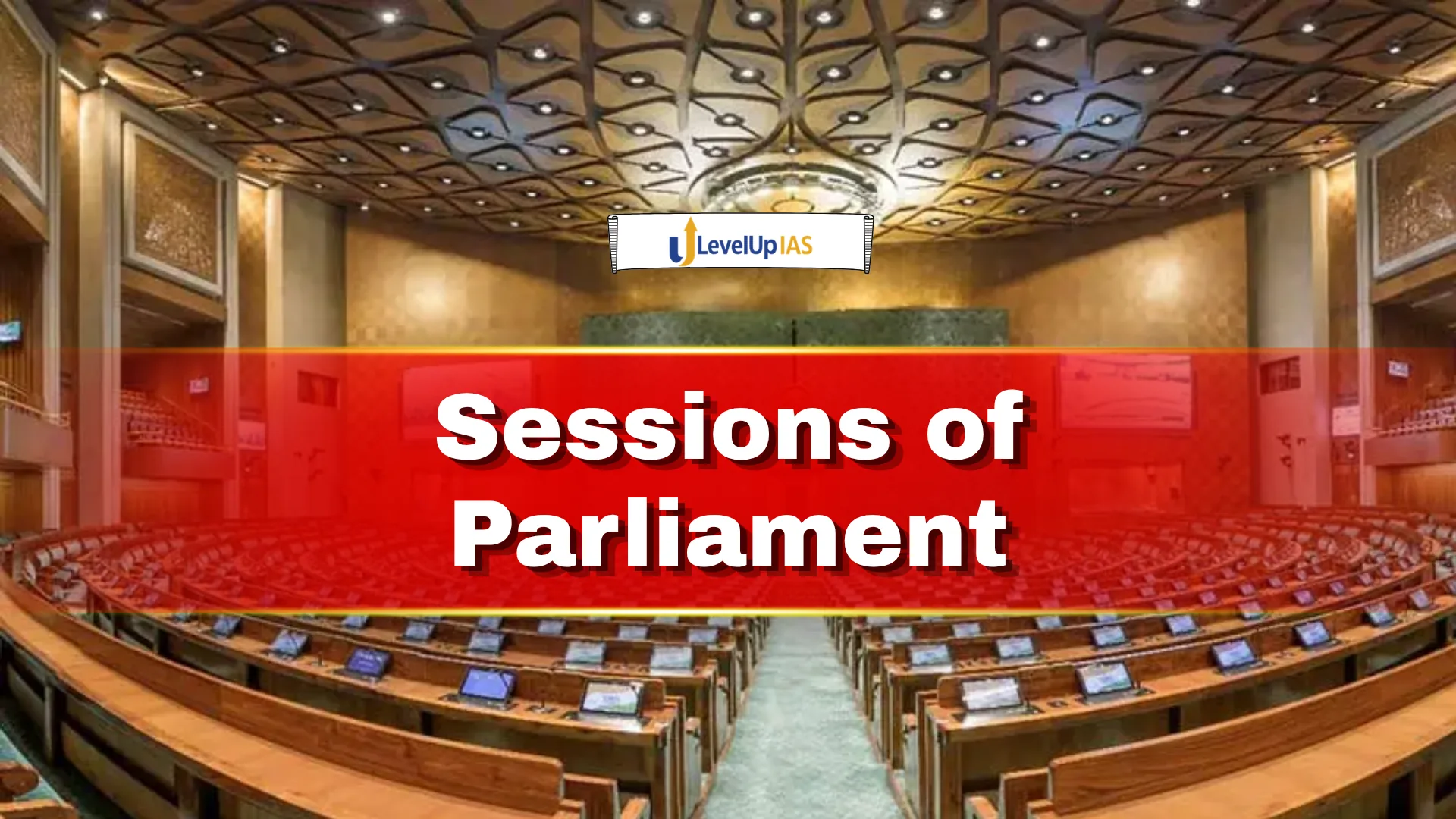
Introduction
The Parliament of India is the principal legislative body at the Union level and provides a constitutional forum for debate, law-making, financial control and discussion of matters of national importance. For Parliament to perform these functions, its Houses meet periodically in what are known as sessions of Parliament.
A session is the period between the first sitting of a House after it has been summoned and its prorogation. During a session, Members of Parliament participate in legislative and financial business, ask questions, raise public issues and hold the government accountable. The functioning of Parliament is governed by the Constitution of India as well as the Rules of Procedure and Conduct of Business of the Lok Sabha and Rajya Sabha.
Constitutional Provisions
The principal constitutional provision dealing with sessions of Parliament is Article 85. It provides that the President shall summon each House of Parliament from time to time. However, the Constitution imposes an important limitation: not more than six months shall intervene between the last sitting in one session and the first sitting in the next session.
Thus, Parliament must meet at least twice every year, although the Constitution does not prescribe a fixed number of sessions or a fixed number of sitting days. In practice, Parliament generally meets in three sessions every year — Budget, Monsoon and Winter.
Article 85 also empowers the President to prorogue either House or both Houses and to dissolve the Lok Sabha. While the President formally summons Parliament, the decision is taken on the advice of the government, following the established parliamentary procedure.
Major Sessions of Parliament
Budget Session
The Budget Session is generally the longest and most important session of Parliament. It usually begins in January or February and extends into March or April, with a recess in between to allow Parliamentary Committees to examine the detailed demands for grants.
The session begins with the President's Address to both Houses assembled together, at the commencement of the first session after each general election and at the beginning of the first session of every year. The Union Budget is presented in the Lok Sabha during this session. Parliament then discusses taxation, government expenditure, demands for grants and other legislative matters.
The Budget Session is therefore central to Parliamentary financial control over the executive, apart from its wider legislative and deliberative functions.
Monsoon Session
The Monsoon Session is generally held during July and August. It primarily deals with legislative business, including the introduction and consideration of Bills. It also provides an important platform for Members to raise issues of public importance and question government policies.
Through questions, debates and motions, the Opposition and other Members can scrutinise the functioning of the government and demand explanations on matters of national concern.
Winter Session
The Winter Session is generally held during November and December and is normally the last session of the calendar year. It provides an opportunity to consider pending legislative business, introduce new Bills and debate government policies and contemporary national issues.
Questions, motions and debates during this session also contribute to parliamentary scrutiny of the executive.
Special Session
The Constitution does not prescribe a separate category called a “Special Session” of Parliament. However, Parliament can be summoned to meet outside the usual pattern of the three regular sessions when circumstances require.
Special sittings or sessions have historically been associated with important national circumstances. For example, special parliamentary sittings have been held in connection with major national events and crises. The reference material notes occasions such as 1962 during the India-China War and 1971 during the India-Pakistan conflict.
It is important to distinguish this from Article 352, which refers specifically to a special sitting of the House in the context of approval of a Proclamation of Emergency.
From Summoning to Dissolution: Important Parliamentary Terms
A clear understanding of the different stages and terms associated with parliamentary sessions is important for distinguishing their constitutional effects.
Summoning marks the beginning of the process through which Parliament is called to meet. The dates and schedule are worked out through the parliamentary system, and the President formally summons the Houses. The constitutional requirement is that the gap between two sessions cannot exceed six months.
Adjournment means the suspension of a sitting of the House for a specified period, such as a few hours, days or weeks. It does not bring the session itself to an end, and pending business continues when the House reassembles.
Adjournment sine die means terminating a sitting of the House without fixing a date for its next meeting. The House may subsequently be summoned or reconvened as required.
Prorogation formally ends a session of Parliament. It is ordered by the President and can apply to either House. Therefore, adjournment ends a sitting, whereas prorogation ends the session.
Recess refers to the period between the prorogation of one session and the commencement of the next session. Since the Constitution requires Parliament to meet within six months of its previous sitting, the interval cannot exceed the prescribed constitutional limit.
Dissolution is different from all these procedures because it applies only to the Lok Sabha. It brings the House itself to an end and is followed by general elections. The Rajya Sabha, being a permanent House, is not subject to dissolution.
Lapsing of Bills on Dissolution of Lok Sabha
Dissolution of the Lok Sabha has important consequences for pending legislative business. Generally, Bills pending in the Lok Sabha, as well as Bills passed by the Lok Sabha but pending in the Rajya Sabha, lapse upon dissolution.
However, not every Bill lapses. A Bill pending only in the Rajya Sabha does not lapse merely because the Lok Sabha is dissolved. Similarly, a Bill that has already been passed by both Houses and is awaiting the President's assent does not lapse. A Bill returned by the President for reconsideration also does not lapse.
This distinction is important because prorogation does not cause pending Bills to lapse, whereas dissolution of the Lok Sabha may bring specific legislative business to an end.
Quorum and Voting in Parliament
For parliamentary proceedings to take place, a minimum number of members must be present. This is known as the quorum. It is one-tenth of the total membership of the House, including the presiding officer. The reference material identifies the quorum as 55 members in the Lok Sabha and 25 members in the Rajya Sabha. If the required quorum is absent, the presiding officer must adjourn or suspend the meeting until the quorum is available.
Voting is the mechanism through which the House takes decisions. Normally, questions are decided by a majority of members present and voting. The presiding officer does not ordinarily vote in the first instance but can exercise a casting vote in the event of a tie. Certain constitutional matters, however, require special majorities.
The principal methods of voting include voice vote, division and casting vote. In a voice vote, members indicate their opinion through “Aye” or “No”. When the result is disputed, a division can be conducted through electronic voting, slips or other prescribed methods.
Lame Duck Session
The term lame duck session refers to the final session of an outgoing Lok Sabha after a new Lok Sabha has been elected. Members of the outgoing House who have not been re-elected are commonly described as “lame ducks”.
The expression is therefore related to the transition between two Lok Sabhas rather than being a constitutionally prescribed regular session.
Conclusion
Sessions of Parliament are essential to the functioning of India's parliamentary democracy. They provide the institutional framework through which elected representatives make laws, approve public expenditure, question the executive and debate matters of national importance.
Although the Constitution does not prescribe a fixed number of parliamentary sessions or sitting days, Article 85 ensures that Parliament cannot remain without meeting for more than six months. Understanding the distinction between summoning, adjournment, adjournment sine die, prorogation, recess and dissolution is particularly important for understanding how parliamentary business is regulated.
FAQs
Q1. What are the Sessions of Parliament?
A session is the period during which Parliament meets and conducts its legislative and other parliamentary business. The President summons each House of Parliament.
Q2. What is the constitutional provision regarding parliamentary sessions?
Under Article 85, the President summons Parliament from time to time, and not more than six months can intervene between the last sitting of one session and the first sitting of the next session.
Q3. How many regular sessions does Parliament have in a year?
Traditionally, Parliament has three regular sessions: the Budget Session, Monsoon Session and Winter Session. However, the Constitution does not prescribe a fixed number of sessions.
Q4. What is the Budget Session?
The Budget Session is generally the longest parliamentary session and usually takes place from January/February to April/May. It primarily deals with the Union Budget, taxation and government expenditure.
Q5. What is the Monsoon Session?
The Monsoon Session is generally held during July-August and focuses on legislative business, financial matters and discussions on government policies and contemporary issues.
Related reads.
Making of the Indian Constitution
09 Oct 2026 7 min

UN Convention on the Law of the Sea (UNCLOS)
24 Sep 2026 7 min
Zonal Councils, UPSC Polity
21 Sep 2026 7 min
Social Sector and Services
15 Sep 2026 7 min
Planning in India (Five-Year Plans)
07 Aug 2026 7 min

G7 Grouping and Its Summit
05 Aug 2026 5 min
Put it into practice
Reading is step one.
Turn what you've just read into exam-ready answers with mentor-led practice and our structured test series.