
GS-I (History, Geography, Society)
Charter Act (1813), Modern History
Content
- Introduction
- Background and Causes
- Objectives
- Key Provisions
- Significance of the Act
- Limitations of the Act
- Conclusion
- FAQs
Introduction
The Charter Act of 1813 marks an important phase in the evolution of British rule in India. It reflects a transition from a purely commercial approach of the East India Company to a more regulated and state-supervised governance structure. While it extended the Company’s rule for another 20 years, it also began to dilute its monopoly and opened the door for deeper British intervention in India’s economy, society, and administration.
Background
- By the early 19th century, the East India Company had transformed from a trading body into a powerful political authority controlling vast territories in India. However, its functioning came under increasing criticism in Britain.
- Economically, Britain was undergoing industrial expansion, and there was strong pressure from merchants and manufacturers to access Indian markets. The Company’s monopoly over trade was seen as an obstacle to free trade principles.
- Politically, many members of the British Parliament believed that the Company’s administration was corrupt and inefficient. There was a growing demand for greater accountability and direct supervision by the British government.
- At the same time, social and religious groups in Britain, particularly evangelical Christians, pushed for permission to send missionaries to India. They argued for spreading Western education and Christianity among Indians.
- Thus, the Charter Act of 1813 emerged in a context where economic liberalism, political reform, and social intervention all converged.
Objectives of the Act
The Charter Act essentially renewed the Company’s charter for another two decades but under stricter supervision. The intention was not to abruptly end Company rule but to gradually reduce its commercial dominance and bring its political functions under closer control of the British Crown.
The Charter Act aimed to strike a balance allowing the Company to continue governing India while opening up economic opportunities for other British interests and introducing elements of social reform.
Key Provisions of the Act
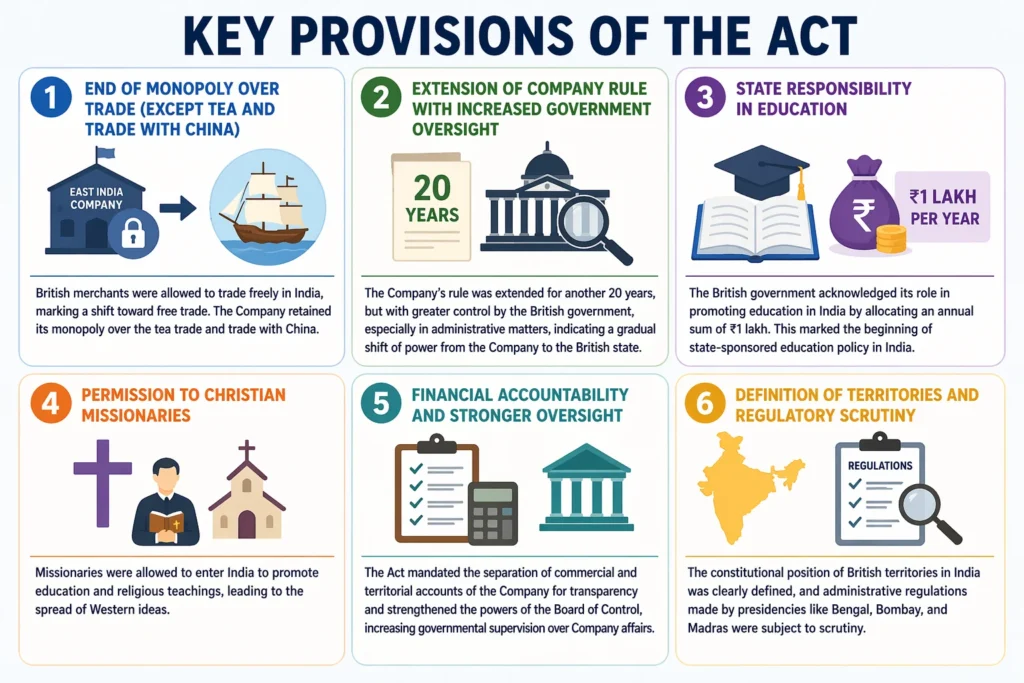
- One of the most significant changes introduced by the Charter Act was the end of the Company’s monopoly over trade with India. British merchants were now allowed to trade freely in India, which marked a shift toward free trade. However, the Company retained its monopoly over the tea trade and trade with China, as these remained highly profitable sectors.
- The Charter Act also extended the Company’s rule for another 20 years, but this extension came with increased oversight by the British government. The Crown asserted greater control, especially in administrative matters, indicating a gradual shift of power from the Company to the British state.
- Another important feature was the introduction of state responsibility in education. For the first time, the British government acknowledged its role in promoting education in India by allocating an annual sum of ₹1 lakh. Although modest, this provision marked the beginning of state-sponsored education policy in India.
- The Charter Act also permitted Christian missionaries to enter India. This was a major change, as earlier the Company had resisted such activities to avoid disturbing social stability. Now, missionaries were allowed to promote education and religious teachings, leading to the spread of Western ideas.
- Additionally, the Charter Act required better financial accountability. It mandated the separation of commercial and territorial accounts of the Company, ensuring more transparency. The powers of the Board of Control were also strengthened, increasing governmental supervision over Company affairs.
- For the first time, the constitutional position of British territories in India was clearly defined, and administrative regulations made by presidencies like Bengal, Bombay, and Madras were subject to scrutiny.
Significance of the Act
- The Charter Act holds immense importance as it marked the beginning of the end of the East India Company’s commercial monopoly. By opening Indian trade to British merchants, it integrated India more closely into the global capitalist economy.
- Economically, while this increased British exports to India, it also had negative consequences. Cheap machine-made goods from Britain flooded Indian markets, severely affecting traditional industries, especially textiles. This led to deindustrialisation in many parts of India.
- Administratively, the Act strengthened the role of the British government in Indian affairs. It laid the foundation for a more centralised and regulated governance structure, which would evolve further in later Acts.
- The provision for education, though limited, was a turning point. It marked the beginning of modern education policy in India and eventually led to debates such as Orientalist vs Anglicist and later reforms like Macaulay’s Minute.
- Socially and culturally, the entry of missionaries introduced Western education, ideas, and values. Over time, this contributed to social reform movements and intellectual awakening in India, though it also generated resistance.
- Most importantly, the Charter Act paved the way for future reforms. It signaled a shift from a trading empire to a governing empire, which ultimately culminated in the transfer of power to the British Crown in 1858.
Limitations of the Charter Act
- Despite its reforms, the Charter Act of 1813 had several limitations. The allocation of ₹1 lakh for education was grossly inadequate for a country as vast as India. It was more symbolic than transformative.
- The Company, although weakened commercially, still retained significant administrative powers. Many critics argued that the Act did not go far enough in curbing its authority.
- The permission for missionary activities was controversial, as it was seen by many Indians as an attempt to impose foreign religious and cultural values. This created social tensions in some regions.
- Moreover, the opening of Indian markets to British goods harmed indigenous industries. Local artisans and craftsmen were unable to compete with cheaper British imports, leading to economic distress.
- Finally, the Charter Act did not establish full parliamentary control over Indian administration. The Company still enjoyed considerable autonomy, which delayed deeper reforms.
Conclusion
The Charter Act of 1813 represents a crucial turning point in the history of British India. It marked the gradual decline of the East India Company’s commercial role and the rise of the British government’s political control.
While it introduced important reforms in trade, education, and administration, it also exposed contradictions of colonial rule promoting development in some areas while causing exploitation in others.
FAQs
Q1. What is the Charter Act of 1813?
The Charter Act, 1813 was a significant law passed by the British Parliament to renew the charter of the East India Company with important changes.
Q2. Why was the Charter Act of 1813 enacted?
It was enacted due to pressure from British merchants and industrialists who demanded free trade with India.
Q3. What were the key provisions of the Act?
Ended Company’s monopoly over trade in India (except tea and trade with China)
Allowed Christian missionaries to propagate religion
Permitted British subjects to trade in India
Allocated funds for education (₹1 lakh annually)
Q4. What was the significance of the Act?
It marked the beginning of economic exploitation through free trade and opened India to Western education and missionary activities.
Q5. What were the limitations of the Act?
It did not end the Company’s political control and still retained monopoly over tea and China trade.
Click on the question to see the Answers
Visit LevelUp IAS- Click Here
Related reads.
Independence and Partition of India
14 Sep 2026 8 min

Revolutionary Nationalism in India
12 Sep 2026 10 min
Indian National Movement – II (1918-1929)
10 Sep 2026 10 min
Regional States of North and South India
09 Sep 2026 9 min

Wind System, UPSC Geography
08 Sep 2026 9 min

Indian National Movement (Extremists) - I (1905-1918)
07 Sep 2026 10 min
Put it into practice
Reading is step one.
Turn what you've just read into exam-ready answers with mentor-led practice and our structured test series.