One Nation One Election
Content
- Why in News?
- Introduction
- Historical Background
- Advantages
- Disadvantages
- Constitutional and Legal Requirements
- Challenges in Implementation
- Significance
- Way Forward
- Conclusion
Why in News?
The Lok Sabha has recently extended the tenure of the Joint Parliamentary Committee (JPC) constituted to examine the ‘One Nation, One Election’ proposal, highlighting the role of parliamentary committees in detailed legislative scrutiny.
Introduction
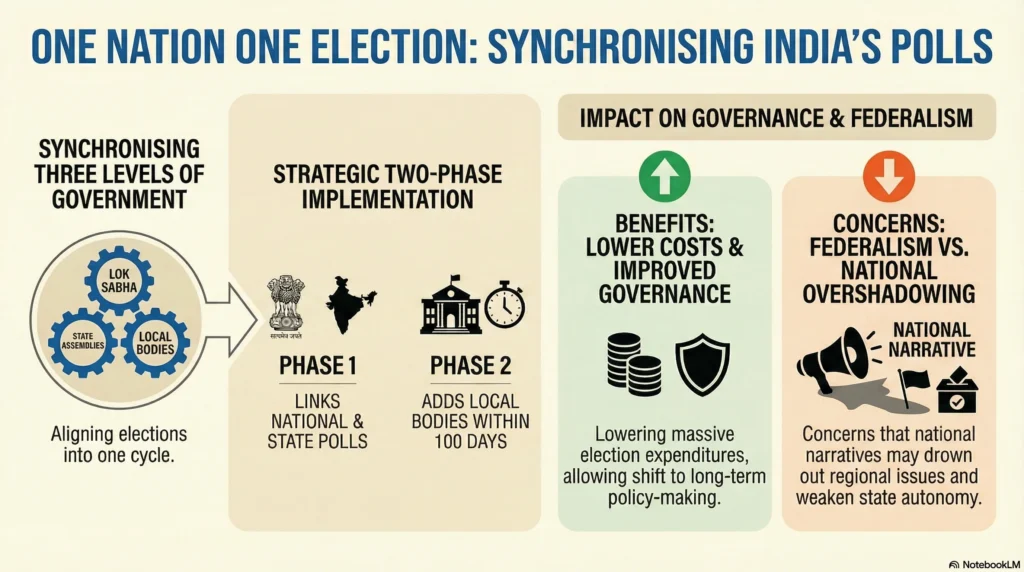
The concept of One Nation One Election (ONOE) refers to the idea of conducting simultaneous elections for the Lok Sabha, State Legislative Assemblies, and local bodies.
The objective is to synchronise electoral cycles so that voters cast their votes for multiple levels of government at the same time, thereby improving efficiency and governance.
Concept and Phased Implementation
The proposal envisions a two-phase implementation strategy.
- In the first phase, elections to the Lok Sabha and State Assemblies would be conducted simultaneously.
- In the second phase, elections to local bodies (Panchayats and Municipalities) would be held within 100 days of the general elections.
- This phased approach aims to gradually align electoral cycles across the country.
Historical Background
India initially followed a system of simultaneous elections during the early years after independence, particularly in 1951-52, 1962, and 1967. However, this cycle was disrupted due to the premature dissolution of State Assemblies and the Lok Sabha in 1970, leading to the current system of staggered elections.
The idea has been revived in recent years to address concerns related to cost, governance disruption, and administrative burden.
Advantages of One Nation One Election
- The proposal offers several potential benefits in terms of governance and efficiency.
- One major advantage is reduction in election expenditure, as conducting multiple elections separately involves significant financial and administrative costs.
- It can also enable governments to focus on long-term policy-making, as frequent elections often lead to short-term populist measures.
- Simultaneous elections may improve voter turnout, as citizens participate in a single, consolidated electoral process.
- Additionally, it ensures efficient deployment of security forces and administrative machinery, which are otherwise repeatedly engaged during separate elections.
- It may also create a more level playing field, reducing the financial burden on smaller political parties.
Disadvantages and Concerns
- Despite its advantages, the proposal raises several critical concerns.
- Synchronising elections in a diverse federal polity like India is administratively complex, especially in cases of premature dissolution of legislatures.
- There are also concerns regarding federalism, as aligning State election cycles with the Centre may affect the autonomy of states.
- Simultaneous elections may influence voter behaviour, with national issues overshadowing state-specific concerns, thereby weakening regional political discourse.
- Critics argue that the system may favour national parties over regional parties, potentially altering the political balance.
- Further, fixed election cycles could reduce government accountability, as the pressure of frequent elections acts as a mechanism of public scrutiny.
Constitutional and Legal Requirements
The implementation of ONOE requires significant constitutional amendments, as the current framework does not support synchronised elections.
Key provisions that may need amendment include:
- Article 83 – Duration of Parliament
- Article 85 – Sessions and dissolution of Lok Sabha
- Article 172 – Duration of State Legislatures
- Article 174 – Sessions and dissolution of State Assemblies
These amendments are necessary to fix tenures and harmonise election schedules across the country.
Key Challenges in Implementation
- The proposal faces multiple structural and operational challenges.
- One major issue is the logistical requirement, including a large number of electronic voting machines (EVMs) and trained personnel.
- There is also the challenge of handling mid-term dissolutions, which could disrupt the synchronised cycle.
- The risk of national issues overshadowing regional priorities remains a significant concern in a diverse democracy.
- Additionally, questions have been raised about the potential erosion of federal principles, as states may have limited flexibility in determining their electoral timelines.
Significance of the Proposal
The One Nation One Election Bill represents an important step towards electoral reform in India.
It seeks to enhance governance efficiency, reduce costs, and minimise disruptions caused by frequent elections, such as the imposition of the Model Code of Conduct.
At the same time, it raises important debates about democratic accountability, federalism, and representation, making it a crucial topic in India’s political discourse.
Way Forward
- A balanced and consultative approach is essential for implementing ONOE.
- There is a need for broad political consensus, involving all stakeholders including states, political parties, and constitutional bodies.
- The government should explore flexible models, such as partial synchronisation or a two-cycle election system, to address practical challenges.
- Ensuring safeguards for federalism and regional representation will be critical to maintain the democratic balance.
- Strengthening institutional mechanisms and conducting pilot implementations can help in assessing feasibility before full-scale adoption.
Conclusion
The One Nation One Election Bill aims to reform India’s electoral system by introducing simultaneous elections, offering potential benefits in efficiency and governance. However, its implementation involves complex constitutional, political, and logistical challenges, requiring careful deliberation and consensus-building.
Thus, the proposal represents a trade-off between efficiency and democratic diversity, making it a critical issue for India’s constitutional and political future.
Visit LevelUp IAS- Click Here