
Current Affairs
Gaganyaan Mission
Introduction
The Gaganyaan Mission is India’s first indigenous human spaceflight programme, being developed by the Indian Space Research Organisation (ISRO) in collaboration with Indian research institutions, academia and industry. The mission aims to demonstrate India’s capability to undertake human spaceflight to Low Earth Orbit (LEO) and safely return astronauts to Earth.
Under the approved programme, India plans two unmanned missions followed by a manned mission. The human spaceflight is designed to place a crew of three astronauts in a 400-km orbit for approximately three days before bringing them safely back to Earth.
A successful Gaganyaan mission would mark a major milestone in India’s space programme and place the country among nations possessing indigenous human-spaceflight capabilities.
Objectives of Gaganyaan
The immediate objective is to demonstrate India's indigenous capability to safely transport humans into space and bring them back to Earth.
However, the significance of Gaganyaan extends beyond a single mission. It is expected to establish the technological and institutional foundation for a sustained Indian human space exploration programme.
The mission will also provide opportunities for conducting microgravity experiments, allowing Indian scientists to study phenomena that cannot be adequately replicated under Earth's gravity.
In the longer term, the technologies developed for Gaganyaan can support more ambitious activities, including future human-spaceflight missions, space exploration and scientific research.
Major Technologies Involved
Human spaceflight is considerably more complex than conventional satellite launches because the launch vehicle and spacecraft must protect human life throughout launch, orbit, re-entry and recovery. Gaganyaan therefore requires the development and validation of several critical technologies.
Human-Rated LVM3
The Launch Vehicle Mark-3 (LVM3), one of ISRO's most powerful launch vehicles, has been modified and human-rated for Gaganyaan.
The human-rated LVM3 has a three-stage propulsion system comprising solid, liquid and cryogenic stages. Unlike an ordinary satellite launch, the vehicle incorporates additional safety and redundancy requirements necessary for carrying astronauts.
The launch system will work together with the Crew Escape System and Orbital Module to ensure crew safety throughout the mission.
Orbital Module
The Orbital Module (OM) is the spacecraft that will operate in orbit and consists of two major components:
- Crew Module (CM)
- Service Module (SM)
It contains redundant avionics and systems required for navigation, communication, guidance and spacecraft operations.
Crew Module
The Crew Module is the habitable section where astronauts will live during the mission. It is designed to provide an environment suitable for human survival during launch, orbital operations and re-entry.
It incorporates life-support systems, crew interfaces, avionics, communication and navigation systems, and deceleration systems.
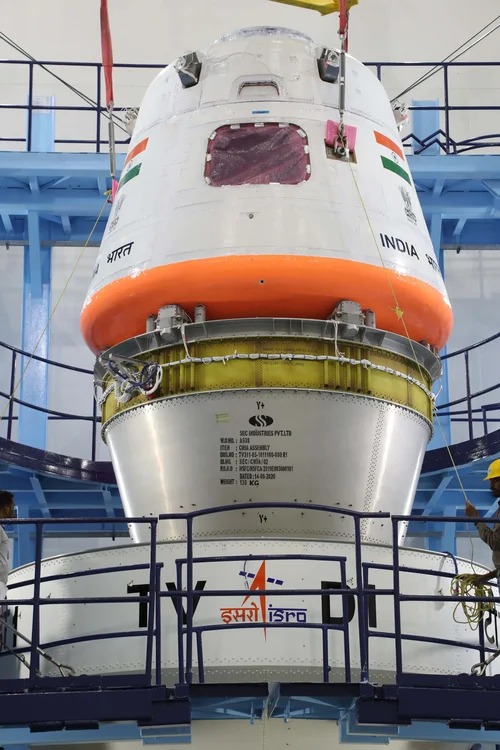
Its double-walled structure consists of a pressurised metallic inner structure and an unpressurised external structure protected by a Thermal Protection System (TPS). The thermal protection is particularly important during atmospheric re-entry, when the spacecraft encounters extremely high temperatures.
The Crew Module is therefore not merely a living space; it is also the principal component responsible for ensuring the crew's safety during the return journey and touchdown.
Service Module
The Service Module provides essential support to the Crew Module while the spacecraft remains in orbit.
It contains systems related to propulsion, thermal management, power generation, avionics and deployment mechanisms. Unlike the pressurised Crew Module, the Service Module is an unpressurised structure.
Crew Escape System
One of the most critical safety technologies of Gaganyaan is the Crew Escape System (CES).
In a human mission, an emergency during launch cannot be treated in the same way as a satellite failure. The astronauts must have the ability to separate rapidly from the launch vehicle and move to a safe trajectory.
ISRO has therefore undertaken in-flight abort demonstrations to validate the Crew Escape System.
The Test Vehicle Abort Mission-1 (TV-D1) demonstrated the system's ability to separate the Crew Module from the launch vehicle during an emergency and represented an important step towards establishing crew safety during the most hazardous phase of the mission.
Life Support and Crew Safety
A human spacecraft must maintain an environment broadly compatible with human survival. The Gaganyaan programme therefore requires a sophisticated Environmental Control and Life Support System to manage the crew's atmosphere and other essential conditions.
The programme also involves emergency escape provisions and systems for crew management, recovery and rehabilitation.
Astronauts face challenges that are fundamentally different from those encountered in unmanned spacecraft. These include microgravity, radiation exposure, fatigue, sleep disturbances and psychological stress.
Maintaining a stable, Earth-like environment inside a confined spacecraft for the duration of the mission is therefore a major technological requirement.
Astronaut Training
Human spaceflight requires extensive training because astronauts must be prepared not only for normal mission operations but also for emergencies.
The Astronaut Training Facility in Bengaluru provides training in areas such as classroom instruction, physical fitness, simulator operations and flight-suit training.
Training also includes microgravity familiarisation through parabolic flights, aero-medical training, recovery and survival training, and crew simulators.
Such training prepares astronauts to operate spacecraft systems, respond to emergencies and survive potentially difficult conditions during launch, spaceflight and recovery.
Significance of Gaganyaan
Gaganyaan has significance far beyond placing three Indians in space.
Scientific Significance
The mission will create opportunities for microgravity research in areas such as biology, medicine and materials science. Experiments in microgravity can produce insights that may have applications both in space and on Earth.
Technological Development
Human spaceflight requires high levels of reliability, redundancy and precision. The technologies developed for Gaganyaan can strengthen India's capabilities in life-support systems, spacecraft technology, human-rated launch vehicles, robotics, avionics and space medicine.
Economic Benefits
The programme can stimulate India's growing space industry by creating demand for advanced components, engineering capabilities and specialised services. It can also encourage technology spin-offs and generate skilled employment.
Inspiration for Youth
A successful human-spaceflight programme can encourage young Indians to pursue science, technology, engineering and mathematics, strengthening the country's future scientific and technological workforce.
International Cooperation
Human spaceflight can strengthen India's engagement with other spacefaring nations through joint research, astronaut training, technology exchange and future collaborative missions.
Challenges
The most fundamental challenge is crew safety. Human missions have extremely low tolerance for failure, making every component and system subject to rigorous testing and redundancy requirements.
India must also develop and validate complex indigenous technologies, including the human-rated launch vehicle, life-support systems, crew escape mechanisms and re-entry systems.
Another challenge is maintaining an Earth-like environment within the limited volume of a spacecraft. Oxygen, carbon dioxide, temperature, pressure, water and waste management must all be carefully controlled.
Astronauts must also cope with microgravity, radiation, physical fatigue and psychological stress. Long-duration human missions would make these challenges even more complex.
Developing adequate training, simulation, recovery and rehabilitation capabilities is another important requirement for building a sustainable human-spaceflight programme.
Way Forward
The Gaganyaan programme should be viewed as the first step towards India's long-term human presence in space, rather than an isolated mission.
India needs to continue extensive testing of the launch vehicle, Crew Module, escape systems and life-support technologies before undertaking increasingly complex missions.
The capabilities developed through Gaganyaan can subsequently support long-duration human missions, microgravity research, space-station activities and deeper space exploration.
Greater participation of Indian industry and academia can further strengthen the country's human-spaceflight ecosystem and reduce dependence on external capabilities.
Conclusion
The Gaganyaan Mission represents a transition from India's established strength in unmanned space missions to human spaceflight. Its success will demonstrate India's ability to launch, sustain and safely return humans from space using largely indigenous capabilities.
More importantly, Gaganyaan can serve as a technological foundation for India's future ambitions in human space exploration, microgravity research and sustained space activities. It is therefore not merely a mission to place astronauts in orbit, but a strategic investment in India's long-term scientific and technological capabilities.
Related reads.

Satkosia Tiger Reserve
23 Sep 2026 2 min

EU’s Carbon Border Adjustment Mechanism (CBAM)
22 Sep 2026 4 min

ASEAN: Association of Southeast Asian Nations
16 Sep 2026 6 min

National Food Security Act (NFSA), 2013
16 Sep 2026 6 min
Borophene
15 Sep 2026 3 min

WTO Agreement on Fisheries Subsidies
14 Sep 2026 3 min
Put it into practice
Reading is step one.
Turn what you've just read into exam-ready answers with mentor-led practice and our structured test series.