
Current Affairs
India-Bhutan Trans-Boundary River Cooperation
Why in News?
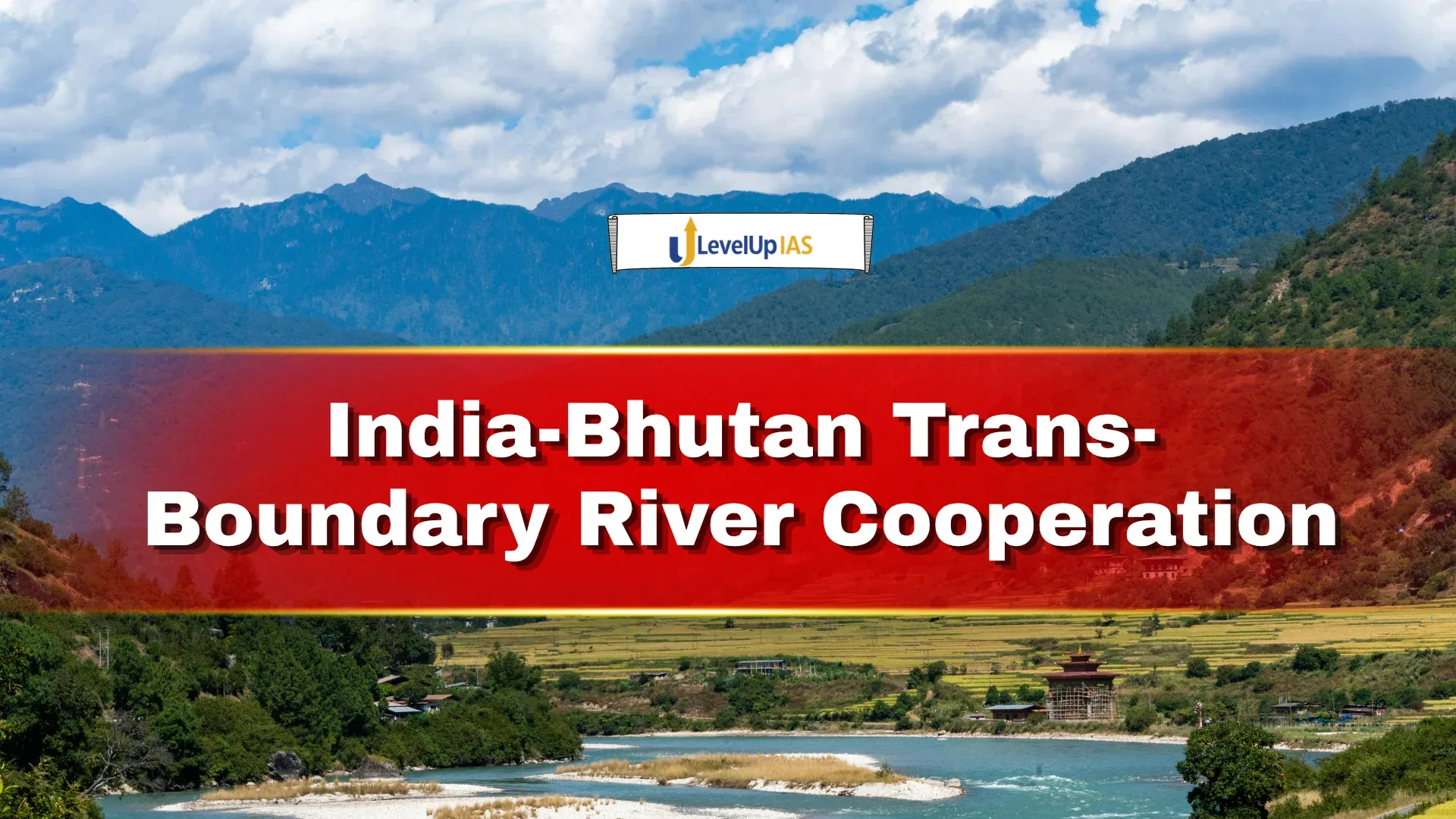
An Indian delegation led by the Secretary of Water Resources recently visited Bhutan to strengthen bilateral cooperation on trans-boundary rivers. The visit highlights the importance of water diplomacy between India and Bhutan, particularly in the areas of hydropower generation, flood management and technical data sharing.
Introduction
India and Bhutan share a unique and deep-rooted partnership centred on the sustainable management of their shared water resources. Several perennial rivers originating in the Bhutanese Himalayas flow southwards into the Indian states of Assam and West Bengal, making cooperation essential for both countries.
The partnership combines Bhutan’s significant hydropower potential with India’s energy requirements and downstream interests. Over the years, this cooperation has evolved from individual hydropower projects towards broader collaboration involving river management, flood forecasting, hydro-meteorological data and disaster preparedness.
Major Rivers
Several important rivers originating in Bhutan form the basis of India-Bhutan trans-boundary river cooperation:
- Manas River: The largest river system of Bhutan, it flows into Assam and joins the Brahmaputra.
- Sankosh River: It forms the border between Bhutan and India along certain stretches.
- Wang Chhu (Raidak): An important river supporting major hydropower projects.
- Amo Chhu (Torsa): It flows from Bhutan into West Bengal.
- Punatsangchhu: An important river system and the site of major joint hydropower infrastructure.
These rivers are important not only for electricity generation but also for agriculture, ecosystems and the livelihoods of communities in downstream areas.
Three Pillars of Cooperation
1. Hydropower Generation
Hydropower forms the most prominent component of India-Bhutan water cooperation. Bhutan possesses substantial hydropower potential because of its mountainous terrain and perennial rivers, while India provides financial and technical assistance and remains an important market for Bhutanese electricity.
Major projects include Chukha, Tala, Mangdechhu, Kuri Chhu and Punatsangchhu-I & II. The Chukha Hydropower Project, with a capacity of 336 MW, became an important model of bilateral cooperation. The 720 MW Mangdechhu Project is another significant project in the partnership.
The Punatsangchhu-I and Punatsangchhu-II projects have capacities of 1,200 MW and 1,020 MW, respectively.
2. Flood Management
The same rivers that provide hydropower can also create flood risks in downstream Indian areas, particularly during the monsoon.
India and Bhutan therefore cooperate on flood forecasting and early-warning mechanisms. Timely information about river water levels enables downstream authorities in Assam and West Bengal to take precautionary measures and reduce the impact of floods.
3. Technical Data Sharing
Reliable hydrological information is crucial for managing trans-boundary rivers. India supports a hydro-meteorological network in Bhutan, including observation stations that provide information on water levels and related conditions.
Sharing such data improves flood forecasting, supports water-resource planning and strengthens disaster preparedness on both sides of the border.
Significance of the Partnership
India-Bhutan river cooperation has significance extending beyond hydropower.
For Bhutan, hydropower is a major contributor to its economy and an important source of export revenue, particularly through electricity exports to India. Hydropower development also helps Bhutan utilise its natural resources for economic development.
For India, Bhutanese hydropower provides access to clean and renewable electricity, which can contribute to meeting growing energy requirements and balancing the national power grid.
The partnership also strengthens India-Bhutan relations by creating long-term economic interdependence and cooperation in infrastructure, energy and water management.
Emerging Focus: GLOF and Climate Risks
Climate change is adding a new dimension to trans-boundary water cooperation. Changes in glaciers and the formation or expansion of glacial lakes can increase the risk of Glacial Lake Outburst Floods (GLOFs).
Such floods can rapidly release large volumes of water downstream, threatening infrastructure and communities in both Bhutan and India. Consequently, greater emphasis is being placed on glacial monitoring, early-warning systems and sharing of relevant information.
Way Forward
India and Bhutan need to move towards a more integrated river-basin approach, combining hydropower development with flood management, ecological considerations and climate-risk assessment.
Strengthening real-time data sharing, early-warning mechanisms and technical capacity can improve disaster preparedness. At the same time, hydropower projects should incorporate appropriate environmental and social safeguards.
Conclusion
India-Bhutan trans-boundary river cooperation demonstrates how shared Himalayan water resources can become a foundation for partnership rather than conflict. Through hydropower development, flood forecasting and technical cooperation, both countries can pursue their developmental interests while addressing common climate and disaster risks.
The future of this partnership lies in combining energy security, water security and ecological resilience through sustained bilateral cooperation.
Related reads.

Loggerhead Sea Turtle
19 Oct 2026 4 min

West Nile Fever
18 Oct 2026 3 min

Satkosia Tiger Reserve
23 Sep 2026 2 min

EU’s Carbon Border Adjustment Mechanism (CBAM)
22 Sep 2026 4 min
ASEAN: Association of Southeast Asian Nations
16 Sep 2026 6 min

National Food Security Act (NFSA), 2013
16 Sep 2026 6 min
Put it into practice
Reading is step one.
Turn what you've just read into exam-ready answers with mentor-led practice and our structured test series.