
Current Affairs
Proba-3 Mission

Why in News?
Recently, the European Space Agency (ESA) lost contact with one of the two spacecraft powering its Proba-3 mission. The development has brought attention to the mission’s unique technological design, which involves two independent spacecraft flying together with extremely high precision. Proba-3 is particularly significant because it aims to demonstrate how multiple spacecraft can work together to perform observations that would traditionally require a single, much larger spacecraft.
About Proba-3 Mission
Proba-3 is the European Space Agency’s first mission dedicated to precision formation flying. Unlike conventional space missions in which scientific instruments are mounted on a single spacecraft, Proba-3 uses two separate spacecraft that operate in close coordination. The mission is designed to demonstrate whether these spacecraft can maintain their relative position and orientation with the accuracy required for sophisticated scientific observations.
The primary scientific objective of Proba-3 is to create an artificial eclipse of the Sun. During a natural solar eclipse, the Moon blocks the bright disc of the Sun, allowing the much fainter solar corona to become visible. Proba-3 seeks to reproduce this phenomenon artificially by using one spacecraft to block the Sun’s direct light while the other observes the exposed corona.
The mission consists of two small spacecraft:
- Occulter spacecraft: Positioned between the Sun and the observing spacecraft, it is designed to block the Sun’s bright disc and cast a shadow.
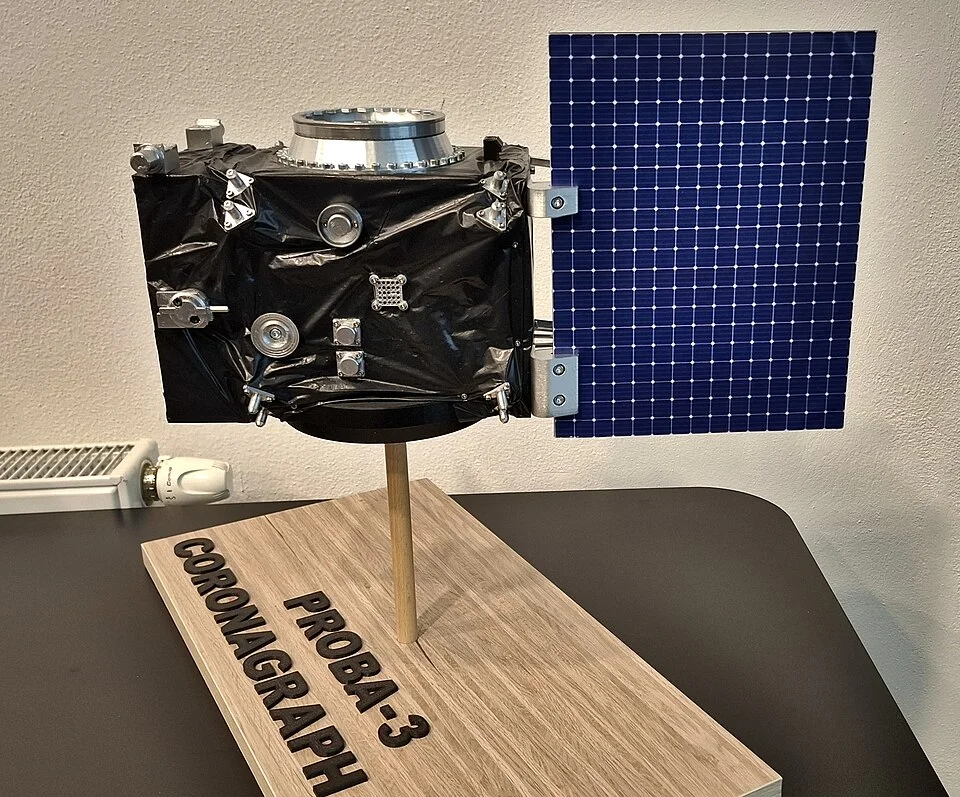
- Coronagraph spacecraft: It carries the telescope that observes the solar corona once the direct sunlight has been blocked.
How Does Proba-3 Create an Artificial Eclipse?
The two spacecraft are designed to fly in formation at a separation of approximately 150 metres. The Occulter is precisely positioned so that it can cast its shadow onto the telescope of the Coronagraph spacecraft. In this arrangement, the two independent spacecraft effectively function as a single large scientific instrument despite being physically separated.
This precision is central to the mission. The Occulter has to remain accurately aligned with the Sun and the Coronagraph so that the intense light from the solar disc is blocked without obstructing the region of the corona that scientists want to observe. Even a relatively small positional error could affect the quality of the observation.
The artificial eclipse created in this manner provides an important advantage over natural solar eclipses. A natural eclipse occurs only for a short period and is dependent on the alignment of the Sun, Moon and Earth. Proba-3, on the other hand, is designed to allow the Coronagraph to observe the faint solar corona for many hours at a time, providing scientists with a much longer window for studying solar activity.
Scientific Importance
The main scientific focus of Proba-3 is the solar corona, the outermost atmosphere of the Sun. Although the corona is extremely hot and highly dynamic, it is difficult to observe directly because the much brighter solar disc overwhelms its faint light. By creating an artificial eclipse, Proba-3 can significantly reduce this problem and obtain clearer observations.
The Coronagraph will observe the corona in visible, ultraviolet and polarised light. These observations can provide information about the structure and behaviour of the solar atmosphere and contribute to a better understanding of solar phenomena.
An important area of interest is the origin of coronal mass ejections (CMEs). These are powerful eruptions of solar material that can travel through interplanetary space and interact with Earth’s space environment. When directed towards Earth, such events can affect satellites and other space-based systems and may also disrupt power grids. Improved observations of the corona can therefore contribute to understanding the processes responsible for these eruptions.
Proba-3 will also measure total solar irradiance, which refers to the amount of solar energy received. Monitoring changes in the Sun’s energy output is important for understanding variations in solar activity and their possible influence on Earth’s climate.
Precision Formation Flying
The technological significance of Proba-3 extends beyond solar observation. Its central innovation is the demonstration of precision formation flying, where two independent spacecraft maintain an extremely accurate relative position while moving through space.
This approach could have important implications for the future of space science. Instead of constructing one extremely large spacecraft carrying all the required instruments, future missions could potentially use multiple smaller spacecraft that coordinate with one another. Such a concept could allow scientists to create large or distributed observing systems while keeping individual spacecraft relatively small.
Proba-3 therefore represents both a scientific mission and a technology demonstration. Its success would demonstrate that spacecraft can autonomously coordinate their positions with the precision necessary for complex scientific operations.
Significance of the Mission
The importance of Proba-3 lies in the combination of advanced spacecraft technology and solar science. By creating an artificial eclipse, it seeks to overcome one of the fundamental challenges in observing the Sun’s faint corona. At the same time, its precision formation-flying technology demonstrates a new approach to designing future space missions.
Its observations of the solar corona and coronal mass ejections can contribute to a better understanding of solar activity and its potential effects on technological systems on Earth. Meanwhile, the mission’s formation-flying experiment could provide a foundation for future missions involving multiple spacecraft working together as a single scientific system.
Conclusion
The Proba-3 mission demonstrates how innovative spacecraft design can open new possibilities for scientific research. Its two-spacecraft configuration allows an Occulter to create an artificial eclipse while a Coronagraph observes the otherwise difficult-to-study solar corona. Through this arrangement, the mission seeks to improve understanding of solar activity, including coronal mass ejections and variations in solar irradiance.
At the technological level, Proba-3 is an important demonstration of precision formation flying, showing the potential of coordinated multi-spacecraft systems in future space exploration.
Related reads.

Loggerhead Sea Turtle
19 Oct 2026 4 min

West Nile Fever
18 Oct 2026 3 min

Satkosia Tiger Reserve
23 Sep 2026 2 min

EU’s Carbon Border Adjustment Mechanism (CBAM)
22 Sep 2026 4 min

ASEAN: Association of Southeast Asian Nations
16 Sep 2026 6 min

National Food Security Act (NFSA), 2013
16 Sep 2026 6 min
Put it into practice
Reading is step one.
Turn what you've just read into exam-ready answers with mentor-led practice and our structured test series.