
Current Affairs
White Gut Disease (WGD)
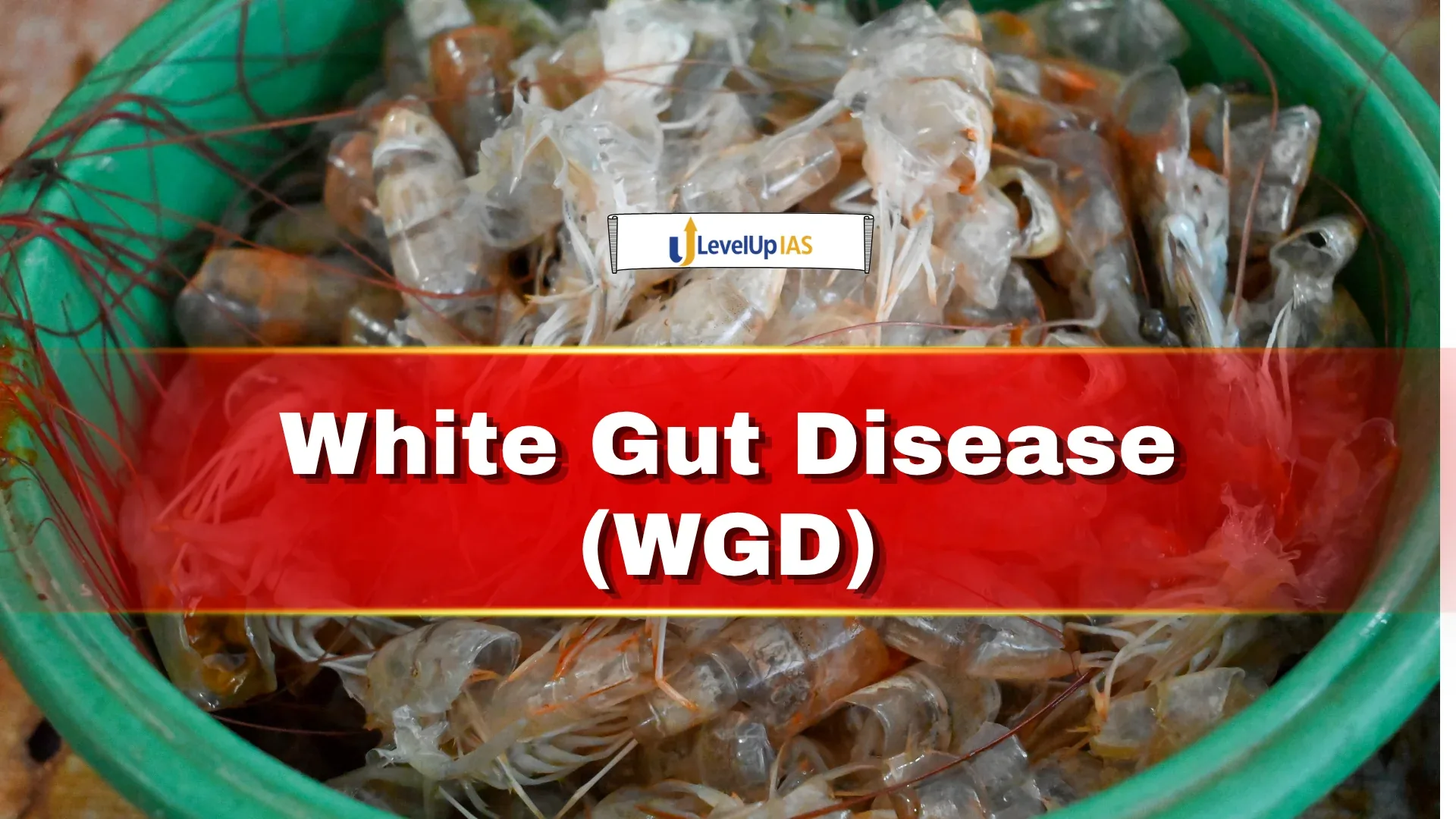
Why in News?
Recently, the Andhra Pradesh Fisheries Department issued an alert regarding the outbreak of White Gut Disease (White Feces Disease) in shrimp farms across the state. Farmers have been advised to maintain strict pond hygiene, improve water quality, strengthen biosecurity measures, and immediately report suspected cases to fisheries authorities to prevent further spread.
What is White Gut Disease?
White Gut Disease is a digestive disorder affecting cultured shrimp, particularly the Pacific White Shrimp (Litopenaeus vannamei), which accounts for the majority of India's shrimp production. The disease derives its name from one of its most visible symptoms—the appearance of floating white faecal strings on the pond surface. Internally, affected shrimp exhibit damaged or empty intestines, resulting in poor nutrient absorption, slow growth, and increased mortality.
Unlike viral diseases such as White Spot Syndrome Virus (WSSV), White Gut Disease does not have a single identifiable causative agent. Scientific studies suggest that it develops due to the interaction of several factors, including harmful bacteria, protozoan parasites, deteriorating water quality, nutritional deficiencies, environmental stress, and poor farm management practices. Consequently, effective disease control requires improving the overall culture environment rather than targeting a single pathogen.
If not detected and managed at an early stage, the disease can spread rapidly within ponds, significantly reducing survival rates and causing substantial financial losses to shrimp farmers.
Symptoms and Diagnosis
The disease usually develops gradually and initially manifests as reduced feeding activity. Farmers often observe shrimp consuming less feed, followed by slower growth and poor weight gain. As the disease progresses, the intestines become brownish or damaged, while characteristic white faecal strings begin floating on the pond surface. Affected shrimp may also develop soft shells, become weak and lethargic, and exhibit reduced survival rates.
Since these symptoms may resemble those of other shrimp diseases, laboratory diagnosis and continuous pond monitoring are essential for accurate identification and timely intervention.
Impact on India's Shrimp Industry
The outbreak of White Gut Disease has serious implications for India's aquaculture economy. Shrimp farming has become one of the fastest-growing components of the fisheries sector and contributes significantly to agricultural exports. Disease outbreaks reduce productivity, increase input costs, and lower export-quality production, thereby affecting both farmers' incomes and India's reputation in international seafood markets.
The disease also exposes the vulnerability of intensive aquaculture systems where high stocking densities, poor water quality, and inadequate biosecurity create favourable conditions for disease outbreaks. Frequent disease episodes discourage investment, reduce profitability, and increase financial risks for small and marginal shrimp farmers.
Given the growing global emphasis on food safety, traceability, and sustainable aquaculture, effective disease management has become essential not only for domestic production but also for maintaining access to premium export markets.
Shrimp Farming in India
Shrimp farming is one of the most important segments of India's Blue Economy. India ranks among the world's largest exporters of farmed shrimp, with Pacific White Shrimp (Litopenaeus vannamei) contributing the overwhelming share of production. Andhra Pradesh remains the leading shrimp-producing state, followed by Gujarat, Odisha, Tamil Nadu, and West Bengal.
The sector provides direct and indirect employment to millions of people through hatcheries, feed industries, processing units, cold-chain logistics, export houses, and allied activities. Shrimp exports also contribute substantially to India's foreign exchange earnings.
However, despite its remarkable growth, the industry continues to face multiple challenges. Recurring disease outbreaks, dependence on imported broodstock, climate-induced changes in water quality, fluctuations in global demand, tariff uncertainties, and stringent sanitary standards imposed by importing countries such as the United States, the European Union, China, and Japan remain major concerns for the sector.
Measures for Prevention and Control
Since White Gut Disease is multifactorial, prevention remains the most effective strategy. Good aquaculture practices focus on maintaining a healthy pond ecosystem rather than treating the disease after it appears.
Farmers are advised to maintain optimum water quality by regularly monitoring dissolved oxygen, pH, salinity, ammonia, and other critical parameters. Proper pond sanitation, periodic removal of organic waste, balanced feeding practices, and the use of certified disease-free shrimp seed significantly reduce disease risk.
Strict biosecurity measures, including controlled entry of personnel, disinfection of equipment, and regular health surveillance, help prevent the introduction and spread of pathogens. Early reporting of unusual symptoms to fisheries authorities enables timely intervention and minimizes production losses.
Government Initiatives
Recognising the growing importance of sustainable aquaculture, the Government has introduced several initiatives to strengthen disease management and improve shrimp production.
The Pradhan Mantri Matsya Sampada Yojana (PMMSY) promotes sustainable fisheries development through investments in quality seed production, infrastructure, cold-chain facilities, value addition, and capacity building.
The Marine Products Export Development Authority (MPEDA) has introduced the SHAPHARI Certification, which promotes antibiotic-free, traceable, and internationally compliant shrimp production, thereby enhancing India's credibility in global seafood markets.
The Sustainable Aquaculture in Mangrove Ecosystem (SAIME) programme encourages environmentally responsible shrimp farming while conserving fragile mangrove ecosystems, particularly in the Sundarbans.
To reduce dependence on imported broodstock and improve disease resistance, the Government is also establishing Nuclear Breeding Centres for the development of indigenous, high-quality shrimp broodstock.
Simultaneously, institutions such as ICAR-Central Institute of Brackishwater Aquaculture (ICAR-CIBA), ICAR-National Bureau of Fish Genetic Resources (ICAR-NBFGR), National Surveillance Programme for Aquatic Animal Diseases (NASPAAD), State Institute of Fisheries Technology (SIFT), Andhra Pradesh Fisheries University, and MPEDA are working together to strengthen disease surveillance, research, farmer awareness, and scientific management practices.
Way Forward
The recent outbreak highlights the need to shift from reactive disease control towards preventive aquaculture management. Greater investment in aquatic animal health surveillance, indigenous broodstock development, scientific pond management, digital disease monitoring, and farmer capacity building is essential for ensuring long-term sustainability.
Strengthening biosecurity standards, promoting responsible aquaculture practices, improving research on emerging shrimp diseases, and enhancing coordination among research institutions, state governments, and farmers will be critical for protecting India's shrimp industry from future disease outbreaks.
Conclusion
The outbreak of White Gut Disease serves as an important reminder that the success of India's aquaculture sector depends not only on production but also on ecological sustainability and effective disease management. As India seeks to strengthen its Blue Economy and expand seafood exports, ensuring healthy aquaculture systems through scientific farming, robust biosecurity, institutional coordination, and continuous surveillance will be essential. A resilient and sustainable shrimp farming sector will not only safeguard farmers' livelihoods but also reinforce India's position as a leading global exporter of high-quality seafood.
Related reads.

Satkosia Tiger Reserve
23 Sep 2026 2 min

EU’s Carbon Border Adjustment Mechanism (CBAM)
22 Sep 2026 4 min

ASEAN: Association of Southeast Asian Nations
16 Sep 2026 6 min

National Food Security Act (NFSA), 2013
16 Sep 2026 6 min

Borophene
15 Sep 2026 3 min

WTO Agreement on Fisheries Subsidies
14 Sep 2026 3 min
Put it into practice
Reading is step one.
Turn what you've just read into exam-ready answers with mentor-led practice and our structured test series.