
GS-I (History, Geography, Society)
Thermohaline Circulation
Introduction
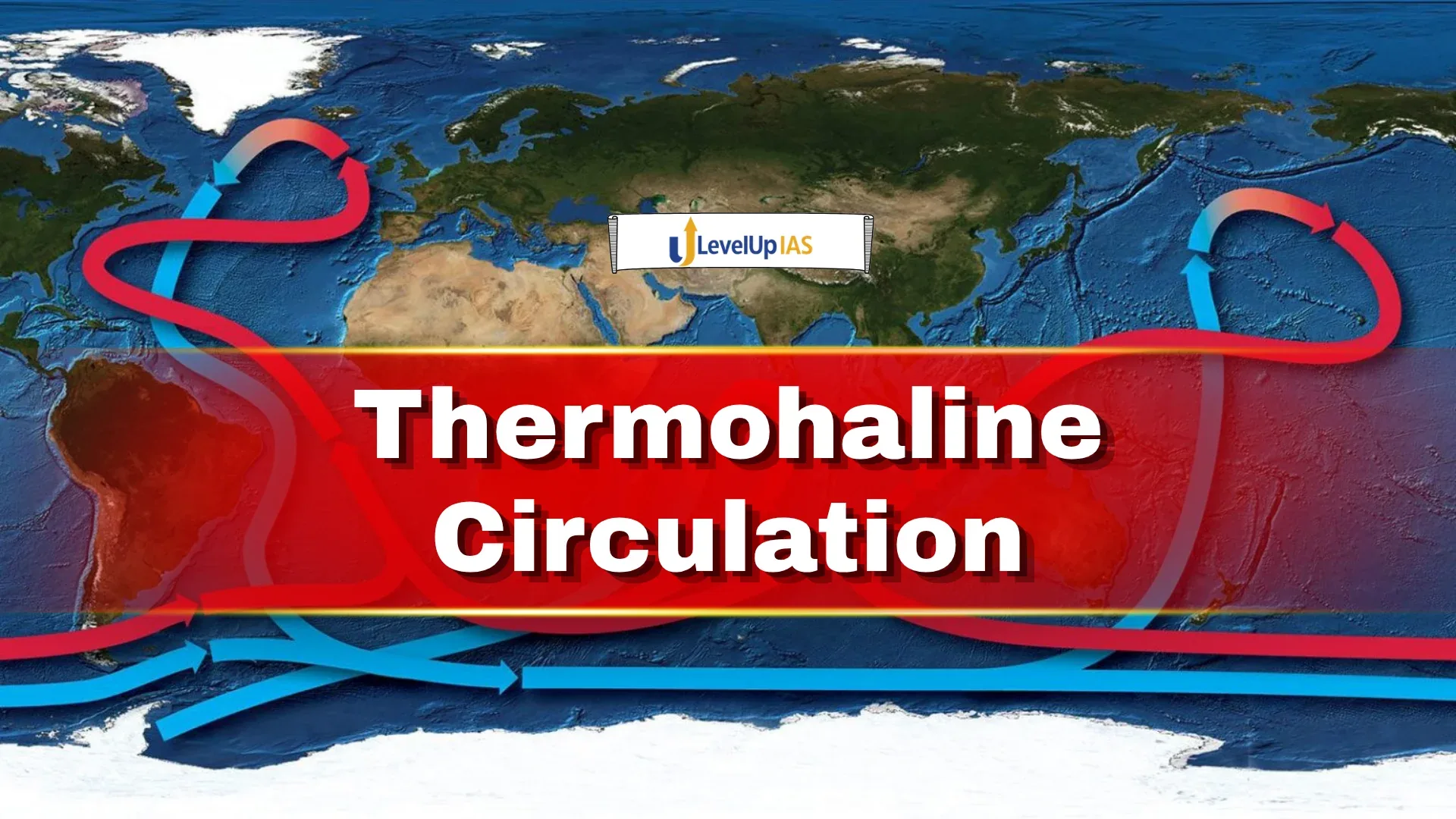
The oceans are connected by a complex system of currents that transport water, heat, dissolved gases and nutrients across the globe. While surface currents are primarily driven by winds, deep-ocean currents are strongly influenced by differences in seawater density. This density-driven circulation is known as thermohaline circulation.
The term thermohaline combines thermo, meaning temperature, and haline, meaning salinity. Since both temperature and salinity influence the density of seawater, their variations generate vertical and horizontal movements that connect the surface and deep ocean.
Thermohaline circulation forms an important component of the global ocean overturning circulation, often illustrated as the global ocean conveyor belt. It plays a crucial role in regulating climate, redistributing heat and transporting carbon and nutrients between ocean basins.
Mechanism of Thermohaline Circulation
The fundamental principle of thermohaline circulation is that differences in seawater density cause water to sink, spread at depth and eventually return towards the surface.
1. Cooling and Increase in Density
In high-latitude regions, particularly the North Atlantic and around Antarctica, seawater loses heat to the cold atmosphere. Cooling increases the density of seawater, allowing it to sink beneath warmer, less-dense water.
2. Sea-Ice Formation and Salinity
When sea ice forms, most of the salt is excluded from the ice and remains in the surrounding seawater. This process, known as brine rejection, increases the salinity and density of the surrounding water, encouraging it to sink.
However, temperature and salinity do not always reinforce one another. Freshwater input from rainfall, rivers, melting ice and other sources can reduce salinity and inhibit sinking.
3. Deep-Water Movement
Once dense water sinks, it spreads through the deep ocean, following the ocean's density structure and seabed topography. These deep currents transport cold water across large distances and between ocean basins.
4. Upwelling and Return Flow
Deep water eventually returns towards the surface through a combination of wind-driven upwelling, mixing and other oceanic processes. Surface currents then transport water back towards regions where deep-water formation occurs, completing the broad circulation system.
The entire process is extremely slow compared with many wind-driven surface currents. A parcel of water may take roughly a thousand years or longer to travel through the global conveyor system, although the actual timescale varies with the route and water mass.
Major Regions of Deep-Water Formation
The two principal regions associated with modern deep-ocean overturning are the North Atlantic Ocean and the Southern Ocean surrounding Antarctica.
1. North Atlantic Deep Water (NADW)
North Atlantic Deep Water forms when relatively warm, salty surface waters transported northward lose heat to the atmosphere in subpolar regions. Cooling increases their density, and some water sinks to intermediate and deep levels.
This deep water subsequently flows southward through the Atlantic Ocean. Its formation is central to the Atlantic Meridional Overturning Circulation (AMOC), which connects northward-moving upper-ocean waters with southward-moving deep waters.
The formation and movement of North Atlantic Deep Water influence the distribution of heat and dissolved substances throughout the Atlantic and contribute to the global overturning system.
2. Antarctic Bottom Water (AABW)
Antarctic Bottom Water is among the densest water masses in the global ocean. It forms mainly along the continental margins of Antarctica, including regions of the Weddell Sea and Ross Sea.
Intense cooling and sea-ice formation increase the density of surrounding seawater. The resulting dense water sinks and spreads northward along the ocean floor, occupying some of the deepest parts of the Atlantic, Indian and Pacific oceans.
Antarctic Bottom Water is a major component of the lower branch of global overturning circulation and contributes to the ventilation of the deep ocean.
Global Ocean Conveyor Belt
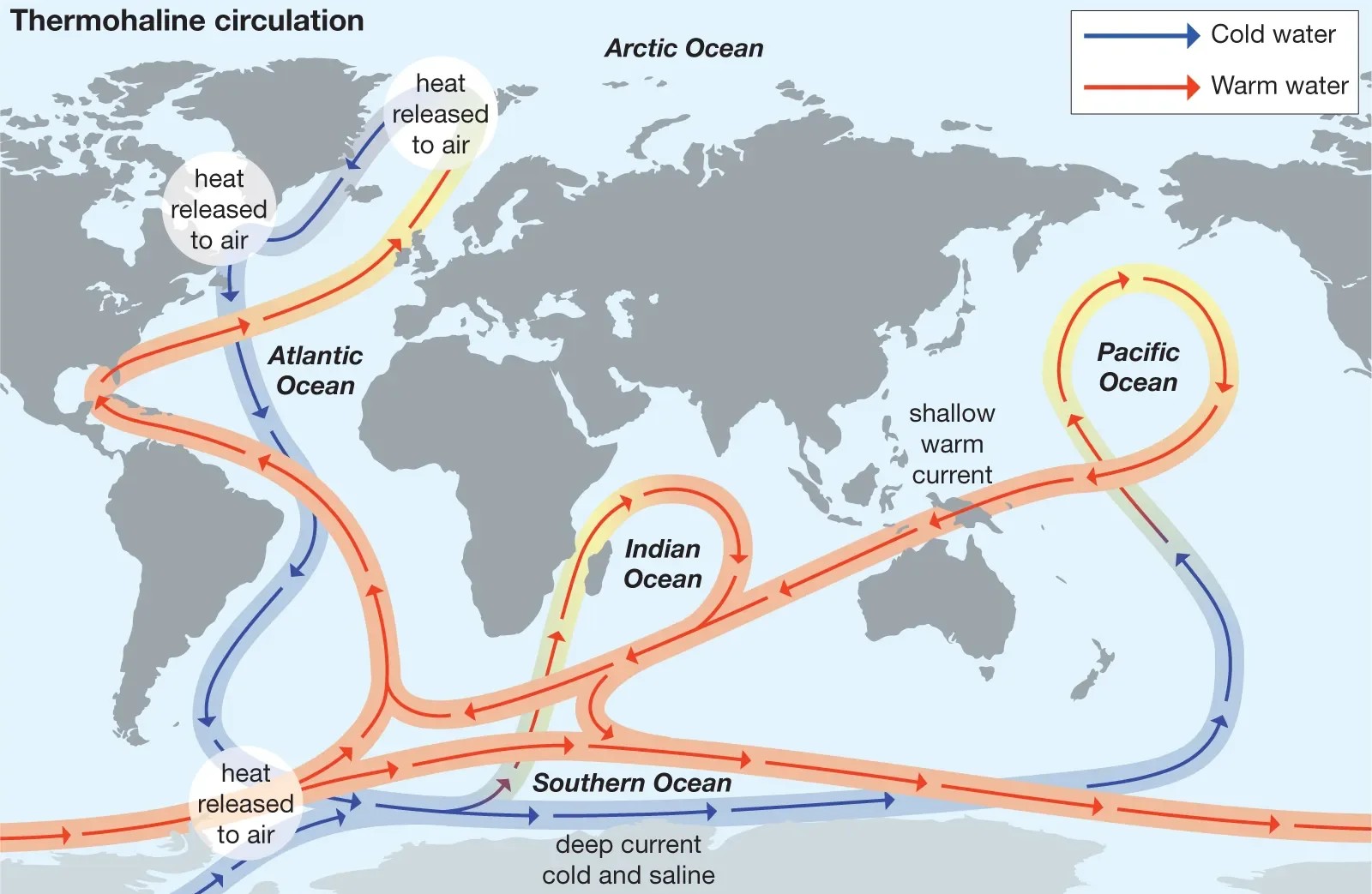
The global ocean conveyor belt is a simplified representation of the interconnected circulation of surface and deep waters around the world. It illustrates how water masses formed in one region influence ocean circulation far beyond their origin.
The process can be understood through the following sequence:
- Relatively warm, salty surface water moves northward in the Atlantic Ocean.
- In the North Atlantic, cooling and changes in salinity increase water density, causing some water to sink and form deep water.
- The deep water flows southward through the Atlantic and reaches the Southern Ocean.
- Around Antarctica, additional dense water forms, while the Antarctic Circumpolar Current and mixing connect different ocean basins.
- Deep waters spread into the Indian and Pacific oceans, where upwelling and mixing return portions of them towards the surface.
- Surface circulation transports water through the interconnected oceans, eventually contributing to the return flow towards the Atlantic.
This model is useful for understanding global circulation, but the actual ocean does not operate as one simple, continuous current. It consists of interconnected circulation pathways, water masses and overturning cells.
Water Masses and Their Relationship with Thermohaline Circulation
A water mass is a body of seawater with characteristic temperature, salinity and density properties acquired in its region of formation. Once formed, it can spread through the ocean while retaining identifiable characteristics, although mixing gradually modifies them.
Water masses are important because they help oceanographers trace the origin, movement and transformation of ocean water.
Two significant examples are:
Antarctic Bottom Water: A very cold, dense water mass formed around Antarctica that spreads through the deepest parts of the global ocean.
Mediterranean Water: The Mediterranean Sea experiences high evaporation, which increases the salinity of its waters. As this relatively salty water exits through the Strait of Gibraltar, it descends into the Atlantic to an intermediate depth because it is denser than much of the surrounding water at that level.
These examples demonstrate that water-mass formation depends on local climatic conditions, evaporation, freshwater input, cooling and mixing. Their subsequent movement contributes to the wider circulation of ocean waters.
Significance of Thermohaline Circulation
1. Global Climate Regulation
Thermohaline circulation redistributes heat between low and high latitudes. The movement of relatively warm water towards higher latitudes and cold water towards lower latitudes influences ocean-atmosphere heat exchange and regional climate patterns.
2. Carbon Storage and the Global Carbon Cycle
Deep-water formation transports dissolved carbon from the surface into the ocean interior. This process contributes to the ocean's role as a major carbon reservoir and affects the exchange of carbon dioxide between the ocean and atmosphere.
3. Nutrient Distribution and Marine Productivity
Deep waters contain nutrients regenerated through the decomposition of sinking organic matter. When these waters return towards the surface, nutrients can support phytoplankton growth and marine food webs.
4. Oxygen Supply to the Deep Ocean
The sinking of oxygen-rich surface water helps ventilate the deep ocean. Changes in circulation can affect the distribution of dissolved oxygen, influencing deep-sea ecosystems and biogeochemical processes.
5. Influence on Sea Level and Regional Weather
Changes in large-scale ocean circulation can alter the distribution of heat and water between regions, influencing regional sea level, temperature and precipitation patterns. These effects can have implications for coastal communities and marine ecosystems.
Thermohaline Circulation and Climate Change
Climate change may influence thermohaline circulation by altering ocean temperature, salinity and the supply of freshwater to high-latitude regions. Increased warming and freshwater input from melting ice can reduce seawater density and potentially affect deep-water formation.
The Atlantic Meridional Overturning Circulation is of particular scientific interest because it transports heat northward through the Atlantic and is connected to deep-water formation in the North Atlantic. Changes in its strength can affect regional climate, marine ecosystems and sea-level patterns.
However, the global ocean overturning system includes several interconnected processes, and its response to climate change varies by region and timescale. It is therefore important to distinguish changes in the AMOC from changes in the entire global conveyor system.
Conclusion
Thermohaline circulation is a fundamental mechanism of global ocean circulation, driven by density differences arising primarily from variations in temperature and salinity. Through the formation of North Atlantic Deep Water and Antarctic Bottom Water, it connects surface waters with the deep ocean and links different ocean basins.
Its influence extends beyond oceanography to climate regulation, carbon storage, nutrient distribution and marine ecosystems. Understanding thermohaline circulation is therefore essential for assessing the role of oceans in the Earth's climate system and predicting the consequences of ongoing climate change.
FAQs
1. What is Thermohaline Circulation?
Thermohaline circulation is the large-scale movement of ocean water driven by differences in water density caused by temperature and salinity variations. It operates in both deep and upper ocean layers.
2. What is the meaning of Thermohaline?
The term combines two words:
- Thermo: Temperature
- Haline: Salinity
Both factors influence seawater density and ocean circulation.
3. How does Thermohaline Circulation work?
In polar regions, seawater cools and becomes denser. Sea-ice formation also leaves salt in the surrounding water, increasing its salinity and density. This dense water sinks, flows through the deep ocean and eventually returns towards the surface through mixing and upwelling.
4. What is the Global Ocean Conveyor Belt?
The global ocean conveyor belt is the interconnected system of deep-ocean and surface currents that redistributes water, heat, salt, nutrients and carbon around the world. Thermohaline circulation is a major driver of this system.
5. Where does Thermohaline Circulation mainly originate?
Important deep-water formation regions include the North Atlantic and the Southern Ocean around Antarctica, where cooling and salinity changes can make seawater dense enough to sink.
Related reads.

Ocean Waves
19 Oct 2026 7 min

Decolonisation in Asia and Africa
18 Oct 2026 8 min
Temperature Distribution in Oceans
10 Oct 2026 9 min

Globalisation and Its Effects
09 Oct 2026 8 min

Tides in Oceanography
08 Oct 2026 7 min

Land Reforms in India
08 Oct 2026 8 min
Put it into practice
Reading is step one.
Turn what you've just read into exam-ready answers with mentor-led practice and our structured test series.