
GS-I (History, Geography, Society)
Tides in Oceanography
Introduction
Tides are the periodic rise and fall of sea level caused primarily by the gravitational forces of the Moon and the Sun, along with the rotation of the Earth. They are among the most regular movements of ocean water and play an important role in shaping coastlines, influencing marine ecosystems, navigation, fisheries and coastal activities.
The Moon exerts the stronger tidal influence because of its proximity to Earth, although the Sun also contributes significantly. The interaction between the positions of the Earth, Moon and Sun, together with the configuration of ocean basins and coastlines, determines the timing and magnitude of tides.
Causes of Tides
Gravitational Pull of the Moon
The Moon is the principal force behind tides. Its gravitational attraction produces a tidal bulge on the side of Earth facing the Moon. A second bulge develops on the opposite side due to the Earth-Moon system's rotational and inertial effects.
As the Earth rotates, different coastal areas move through these tidal bulges, producing alternating periods of high tide and low tide. This explains why many coastal regions experience two high tides and two low tides during a lunar day.
Gravitational Influence of the Sun
The Sun is much more massive than the Moon, but its much greater distance from Earth means that its tidal influence is weaker than that of the Moon.
The Sun's gravitational force either reinforces or partially opposes the Moon's tidal effect, depending on their relative positions. This interaction produces the important phenomena of spring tides and neap tides.
.webp)
Earth's Rotation
Earth's rotation causes different parts of the coastline to pass through areas of high and low water. A complete tidal cycle is approximately 24 hours and 50 minutes, corresponding to the lunar day. Consequently, successive high tides at a location are generally about 12 hours and 25 minutes apart.
Types of Tides
Tides can be classified according to their daily pattern, the relative position of the Sun and Moon, and tidal range.
Based on Daily Periodicity
1. Semi-Diurnal Tides
These tides produce two high tides and two low tides during a lunar day, with the successive high and low tides being approximately equal in height.
This is the most common tidal pattern and is found along many Atlantic coastlines.
2. Diurnal Tides
A diurnal tidal pattern has one high tide and one low tide during a lunar day. Such tides occur in certain regions where the configuration of the ocean basin and Earth's geography favours a single tidal cycle.
3. Mixed Tides
Mixed tides involve two high tides and two low tides of unequal heights during a lunar day. They are common along several Pacific coastlines.
The actual tidal pattern at a particular location is strongly influenced by the shape and depth of the ocean basin, coastlines and continental barriers.
Spring and Neap Tides
Spring Tides
Spring tides occur around the new moon and full moon, when the Sun, Moon and Earth are approximately aligned.
At these times, the gravitational effects of the Sun and Moon reinforce one another. The result is a larger tidal range, with higher-than-average high tides and lower-than-average low tides.
Spring tides occur approximately twice during each lunar month. The term "spring" refers to the water "springing forth" and has no connection with the spring season.
Neap Tides
Neap tides occur around the first and third quarter phases of the Moon, when the Sun and Moon are approximately at right angles with respect to Earth.
The solar and lunar tidal forces partially counteract one another, resulting in the smallest tidal range, relatively lower high tides and higher low tides.
Like spring tides, neap tides occur approximately twice during each lunar month.
Perigean Spring Tides
When a spring tide occurs around the time the Moon is at perigee, its closest point to Earth, the tidal range can become particularly large. These are commonly referred to as perigean spring tides or, popularly, "king tides."
Tidal Range
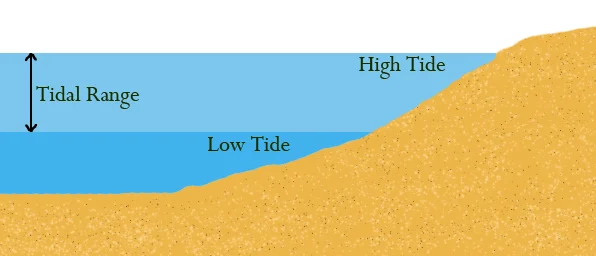
The tidal range is the vertical difference between the level of high tide and low tide at a particular location.
Tidal ranges vary considerably from one coast to another because of differences in:
- Shape and depth of ocean basins
- Coastal configuration
- Width and depth of continental shelves
- Resonance within enclosed or semi-enclosed seas
- Position of the coastline relative to tidal waves
The Bay of Fundy in Canada is famous for its exceptionally large tidal range, while some enclosed seas experience comparatively small tidal variations.
Based on tidal range, tides are commonly classified as:
Type | Approximate Tidal Range |
| Microtidal | Less than 2 m |
| Mesotidal | 2-4 m |
| Macrotidal | More than 4 m |
These categories are useful for understanding differences in coastal environments and tidal processes.
Tidal Currents and Tidal Bore
Tides do not simply cause vertical changes in sea level. They also generate horizontal movements of water known as tidal currents. These currents are particularly important in bays, estuaries and narrow coastal channels, where they can influence sediment transport, navigation and marine ecosystems.
A tidal bore occurs when an incoming high tide forms a powerful wave or wall of water that moves upstream through a narrow river or estuary. Tidal bores are associated with certain funnel-shaped estuaries and rivers, including the Qiantang River in China and areas around the Bay of Fundy.
Factors Affecting the Height and Pattern of Tides
Although the gravitational forces of the Moon and Sun are the fundamental causes, actual tides at a location are affected by several geographical factors.
Coastal configuration: Narrow bays and funnel-shaped estuaries can amplify tidal ranges.
Ocean depth: Variations in depth influence the speed and behaviour of tidal waves.
Continental barriers: Continents interrupt the movement of tidal waves and produce different tidal systems in different ocean basins.
Latitude and lunar position: The Moon's position relative to Earth's equator affects the distribution and relative height of tidal bulges.
Atmospheric conditions: Strong winds and changes in atmospheric pressure can modify observed sea levels, sometimes producing water levels substantially different from predicted astronomical tides.
Importance of Tides
Tides have considerable geographical, ecological and economic significance.
Navigation and Ports
Tidal information is essential for navigation and port operations. Changes in water depth can determine when large vessels can safely enter or leave shallow harbours.
Fisheries
Many marine organisms respond to tidal cycles for feeding, movement and reproduction. Fishermen also use knowledge of tides to determine suitable fishing times and locations.
Coastal Ecosystems
Intertidal zones are periodically submerged and exposed, creating distinctive habitats for molluscs, crustaceans, seaweeds, birds and other organisms. Tidal movements also help circulate nutrients in coastal waters.
Coastal Landforms
Tidal currents contribute to erosion, transportation and deposition of sediments. They influence the development of estuaries, tidal flats, sandbars, mudflats and other coastal features.
Tidal Energy
The predictable movement of tidal water can be harnessed to generate tidal energy. Tidal power is therefore considered a potential source of renewable energy in suitable coastal regions.
Salt Production
In some coastal areas, tidal water is channelled into shallow evaporation ponds for salt production. Tidal movements are therefore linked to traditional coastal livelihoods as well.
Coastal Planning
Knowledge of tidal behaviour is important for coastal infrastructure, flood management, harbour construction and disaster preparedness, particularly in areas exposed to storm surges and coastal flooding.
Tides and Coastal Geography
Tides interact continuously with waves, currents and sediment processes. Their repeated movement can influence the formation and evolution of estuaries, tidal marshes, mudflats and tidal channels.
In estuarine environments, the incoming tide transports seawater inland while outgoing tidal currents carry water and sediment towards the sea. These processes make tidal zones highly dynamic geographical environments.
Tidal action is also significant for coastal ecosystems because periodic flooding and exposure create environmental conditions to which specialised organisms have adapted.
Conclusion
Tides represent a complex interaction between the gravitational forces of the Moon and Sun, Earth's rotation and the physical configuration of ocean basins and coastlines. Their regular rise and fall produce different tidal patterns, including diurnal, semi-diurnal, mixed, spring and neap tides.
Beyond being a fundamental oceanographic phenomenon, tides have important implications for coastal geomorphology, marine ecosystems, navigation, fisheries, coastal settlements and renewable energy. Understanding tidal processes is therefore essential for both physical geography and the sustainable management of coastal environments.
FAQs
1. What are Tides?
Tides are the periodic rise and fall of sea level caused mainly by the gravitational forces of the Moon and the Sun, along with Earth’s rotation.
2. What causes Tides?
Tides are primarily caused by the gravitational attraction of the Moon and Sun and the centrifugal effect associated with the Earth-Moon system.
3. Why does the Moon have a greater influence on Tides?
Although the Sun is much more massive, the Moon is much closer to Earth. Therefore, its tidal-generating force is greater.
4. What is a Spring Tide?
A spring tide occurs when the Sun, Moon and Earth are aligned, during the New Moon and Full Moon. It produces a higher high tide and lower low tide, resulting in a greater tidal range.
5. What is a Neap Tide?
A neap tide occurs when the Sun and Moon are positioned approximately 90° apart relative to Earth, during the first and third quarters of the Moon. It produces a smaller tidal range.
Related reads.

Land Reforms in India
08 Oct 2026 8 min

The Mughal Art and Architecture
07 Oct 2026 9 min

Cold War, World History
07 Oct 2026 8 min

Rock-Cut Architecture in India
06 Oct 2026 7 min

Buddhist Architecture: Stupas, Chaityas and Viharas
06 Oct 2026 6 min

Indian Independence Act, 1947
05 Oct 2026 6 min
Put it into practice
Reading is step one.
Turn what you've just read into exam-ready answers with mentor-led practice and our structured test series.