
Current Affairs
Coastal Regulation Zone (CRZ)
Why in News?
Recently, the Supreme Court dismissed an appeal against the National Green Tribunal (NGT) order that had rejected a plea challenging the Coastal Regulation Zone (CRZ) clearance granted for the addition of two floors to a sea-facing bungalow in Mumbai. The case has once again brought the Coastal Regulation Zone framework into focus, highlighting the need to balance environmental conservation with developmental activities in ecologically fragile coastal areas.
Introduction
India possesses a coastline of over 7,500 km, stretching across nine coastal states, four Union Territories, and two island territories. These coastal regions are among the country's most productive ecological zones, supporting rich biodiversity, fisheries, ports, tourism, industries, mangrove forests, coral reefs, estuaries, and the livelihoods of millions of people. However, rapid urbanisation, tourism infrastructure, industrial expansion, and climate change have placed unprecedented pressure on these fragile ecosystems.
Recognising the ecological significance of coastal areas, the Government of India introduced the Coastal Regulation Zone (CRZ) Notification under the provisions of the Environment (Protection) Act, 1986, to regulate developmental activities along the coastline while ensuring long-term environmental sustainability.
Today, the CRZ framework forms one of India's most important coastal management instruments and remains highly relevant from both the Geography and Environment perspective of the UPSC examination.
What is the Coastal Regulation Zone (CRZ)?
The Coastal Regulation Zone (CRZ) refers to the coastal stretches of seas, bays, estuaries, creeks, rivers and backwaters that are influenced by tidal action, where developmental activities are regulated to conserve fragile ecosystems while permitting sustainable economic development.
The concept was formally introduced through the CRZ Notification, 1991, issued by the Ministry of Environment and Forests under the Environment (Protection) Act, 1986. Since then, the notification has undergone several revisions to accommodate changing developmental needs, scientific understanding and climate-related concerns. The latest comprehensive framework is provided under the CRZ Notification, 2019, issued by the Ministry of Environment, Forest and Climate Change (MoEFCC).
The primary objective of the CRZ framework is not to prohibit development altogether but to ensure that economic activities are carried out without causing irreversible damage to coastal ecosystems.
Objectives of the Coastal Regulation Zone
The Coastal Regulation Zone framework seeks to maintain a balance between environmental conservation and sustainable development. Its major objectives include protecting coastal ecosystems such as mangroves, coral reefs, sand dunes, mudflats and nesting grounds of marine species. It also aims to regulate unplanned construction activities, preserve biodiversity, safeguard the livelihoods of coastal communities, reduce vulnerability to coastal hazards, and promote climate-resilient coastal management.
Another important objective is to prevent indiscriminate urbanisation in environmentally sensitive coastal areas while allowing carefully regulated infrastructure projects that are essential for national development.
Evolution of the CRZ Framework
India's coastal management policy has evolved considerably over the past three decades.
The CRZ Notification of 1991 marked the first comprehensive attempt to regulate developmental activities along India's coastline. It prohibited certain activities such as setting up hazardous industries, land reclamation, and indiscriminate construction in ecologically sensitive areas.
However, implementation challenges, increasing developmental requirements and numerous amendments led to the formulation of the CRZ Notification, 2011, which introduced better protection for local fishing communities, enhanced safeguards for ecologically sensitive zones and integrated coastal zone management principles.
The CRZ Notification, 2019 further revised the framework by encouraging sustainable economic development while maintaining environmental safeguards. It relaxed certain development norms in urban coastal areas, promoted tourism infrastructure in designated zones and decentralised the clearance mechanism for several categories of projects.
Coastal Regulation Zone Classification
For effective regulation, India's coastline has been classified into different categories based on ecological sensitivity and existing development.
CRZ-I
CRZ-I represents the most environmentally sensitive coastal areas. These include mangroves, coral reefs, sand dunes, mudflats, nesting grounds of turtles, salt marshes, seagrass beds, national parks, marine protected areas and regions between the Low Tide Line (LTL) and High Tide Line (HTL).
Development in these areas is highly restricted. Only activities that are directly related to conservation, strategic defence, pipelines, transmission lines or essential public utilities are generally permitted after obtaining environmental clearance.
CRZ-II
CRZ-II comprises areas that have already been substantially developed and are located within existing municipal limits or urban settlements.
Construction is generally allowed on the landward side of existing roads or authorised structures, subject to local building regulations and environmental safeguards.
Most major coastal cities, including Mumbai, Chennai and Visakhapatnam, contain significant portions classified under CRZ-II.
CRZ-III
CRZ-III covers relatively undisturbed rural coastal areas that do not fall under CRZ-I or CRZ-II. These regions generally possess lower levels of urbanisation but remain ecologically significant.
The notification further divides this category into:
- CRZ-III A: Areas with population density greater than 2,161 persons per sq. km.
- CRZ-III B: Areas having lower population density.
Development within these regions is regulated through No Development Zones (NDZs), although certain housing and public infrastructure projects may be permitted under specified conditions.
CRZ-IV
CRZ-IV includes the water area extending from the Low Tide Line up to the territorial waters, along with tidal water bodies such as rivers, estuaries, lagoons, creeks and backwaters that are influenced by tidal action.
Activities such as fishing, navigation and traditional livelihood practices are generally permitted, whereas disposal of untreated waste, industrial effluents and activities harmful to marine ecology are strictly regulated.
Activities Prohibited under CRZ
The CRZ framework prohibits several activities that may adversely affect coastal ecosystems.
These include the establishment of new hazardous industries, discharge of untreated sewage or industrial waste into coastal waters, dumping of municipal solid waste, land reclamation without approval, mining of beach sand, destruction of mangroves and coral reefs, and construction that adversely affects the natural movement of sand or coastal hydrology.
These restrictions are intended to preserve the ecological integrity of coastal regions and reduce long-term environmental degradation.
Permissible Activities
While environmental protection remains the central objective, the CRZ framework also permits several activities that are considered essential or environmentally compatible.
These include ports, harbours, jetties, defence infrastructure, coastal roads in approved cases, renewable energy projects, desalination plants, fishing-related infrastructure, public utilities, eco-tourism facilities, beach tourism projects, and housing for traditional coastal communities, subject to environmental safeguards and statutory approvals.
CRZ Notification 2019: Major Changes
The CRZ Notification, 2019 introduced several significant reforms aimed at balancing environmental conservation with economic development.
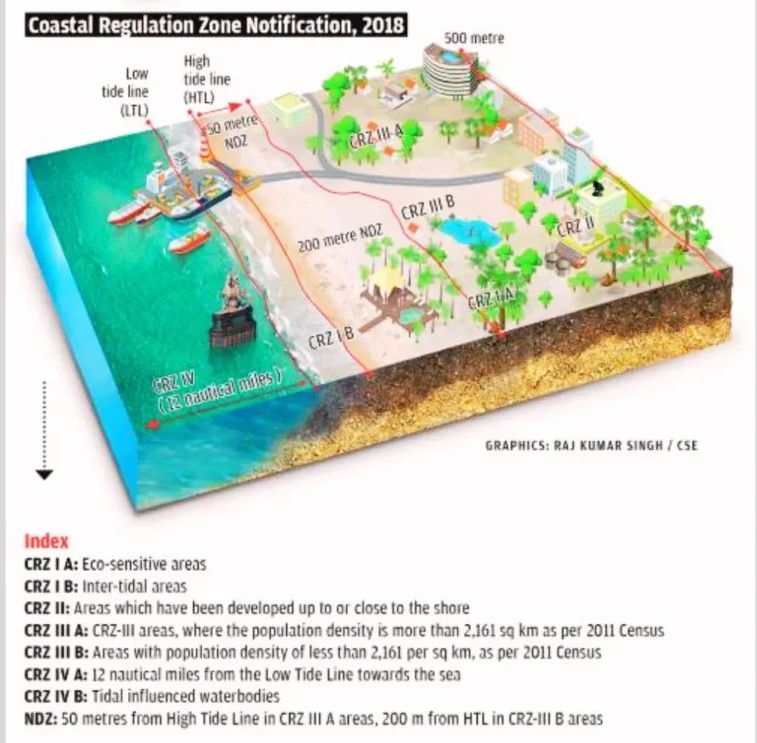
It reduced the No Development Zone in densely populated rural areas from 200 metres to 50 metres, thereby allowing greater scope for housing and infrastructure development. Floor Space Index (FSI) restrictions in CRZ-II urban areas were relaxed according to prevailing municipal regulations, facilitating urban redevelopment.
The notification also promoted sustainable tourism by permitting temporary tourism-related infrastructure in designated coastal areas while ensuring ecological safeguards. Another important reform was the decentralisation of project approvals, allowing several categories of CRZ clearances to be processed by state authorities instead of requiring approval from the Central Government.
Challenges in Implementation
Despite its importance, implementation of the CRZ framework faces several challenges.
Rapid urbanisation and rising land values have led to frequent violations through illegal constructions and encroachments in coastal areas. Weak monitoring capacity, overlapping institutional responsibilities, delays in preparing Coastal Zone Management Plans (CZMPs), inadequate enforcement by local authorities and frequent legal disputes further complicate implementation.
Climate change has emerged as an additional challenge, as sea-level rise, coastal erosion, saltwater intrusion and increasing cyclone intensity require more dynamic coastal management strategies than those originally envisaged under the CRZ framework.
Balancing infrastructure development, tourism promotion and environmental conservation continues to remain one of the most difficult policy challenges for coastal governance in India.
Way Forward
India's coastal governance needs to move towards an integrated, science-based and climate-resilient approach.
Preparation and periodic updating of Coastal Zone Management Plans using satellite imagery and GIS technologies should be expedited. Stronger coordination among central, state and local authorities is necessary to improve compliance and enforcement. Illegal constructions in CRZ areas must be dealt with through timely action and effective monitoring mechanisms.
Nature-based solutions such as mangrove restoration, dune conservation and wetland protection should become central components of coastal management strategies. Local fishing communities and coastal residents must be actively involved in decision-making to ensure that conservation measures are socially inclusive and economically sustainable.
Given the increasing frequency of extreme weather events, future CRZ regulations should also incorporate climate adaptation measures, disaster risk reduction and ecosystem-based coastal protection.
Conclusion
The Coastal Regulation Zone framework represents one of India's most important environmental governance mechanisms for achieving sustainable management of its vast coastline. It seeks to strike a delicate balance between ecological conservation, economic development and the livelihood needs of coastal communities.
While recent judicial scrutiny highlights the growing importance of CRZ clearances in developmental projects, the larger objective remains the protection of fragile coastal ecosystems from irreversible degradation. Strengthening scientific planning, ensuring effective enforcement and promoting climate-resilient coastal development will be essential for safeguarding India's coastal heritage while enabling sustainable growth in the decades ahead.
Related reads.

Satkosia Tiger Reserve
23 Sep 2026 2 min
EU’s Carbon Border Adjustment Mechanism (CBAM)
22 Sep 2026 4 min

ASEAN: Association of Southeast Asian Nations
16 Sep 2026 6 min

National Food Security Act (NFSA), 2013
16 Sep 2026 6 min

Borophene
15 Sep 2026 3 min

WTO Agreement on Fisheries Subsidies
14 Sep 2026 3 min
Put it into practice
Reading is step one.
Turn what you've just read into exam-ready answers with mentor-led practice and our structured test series.