
Current Affairs
CosmoCube Mission
Why in News?
The proposed CosmoCube mission has drawn attention for its plan to study the early universe using a compact satellite in lunar orbit. The mission aims to detect faint radio signals from neutral hydrogen dating back to the period before the formation of the first stars. By observing from behind the Moon, the satellite could avoid much of the radio interference coming from Earth.
What Is the CosmoCube Mission?
CosmoCube is a proposed space mission focused on studying the Cosmic Dark Ages, a period in the universe’s history when the first stars had not yet formed. The project is associated with researchers at the University of Cambridge and aims to use a small satellite to observe low-frequency radio signals from the early universe.
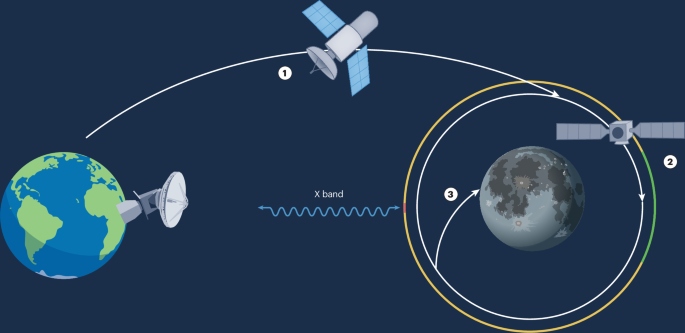
The mission is designed to operate in lunar orbit, where the Moon can shield the spacecraft from radio signals originating on Earth. This could provide more suitable conditions for detecting the extremely weak signals that conventional Earth-based observations struggle to isolate.
How Will CosmoCube Study the Early Universe?
CosmoCube aims to detect the 21-centimetre signal of neutral hydrogen. This radio signal originates from a transition between two energy levels of the hydrogen atom. As the universe expands, the signal from the early universe is stretched to longer wavelengths and lower frequencies.
By studying this redshifted signal, scientists hope to learn more about the conditions that existed before the first stars and galaxies formed. The observations may also help researchers understand how matter was distributed in the early universe and how dark matter influenced the formation of cosmic structures.
Why Is the Moon’s Far Side Important?
Radio astronomy requires an environment with minimal interference. Signals from telecommunications, broadcasting and other human activities can overwhelm the faint radio emissions scientists are trying to detect. The Moon can block much of this Earth-based interference when the spacecraft passes behind it.
A lunar-orbiting instrument also operates beyond Earth's ionosphere, which can affect the propagation of low-frequency radio waves. These conditions make the lunar environment an important area of interest for researchers studying the early universe.
What Are the Cosmic Dark Ages?
The Cosmic Dark Ages began after the universe cooled enough for neutral hydrogen atoms to form and the Cosmic Microwave Background radiation to be released. It was a period before the first stars began shining, when the universe did not yet contain the familiar sources of visible light.
The end of this period led into Cosmic Dawn, when the first stars and galaxies started to form. Studying the transition between these stages can help scientists reconstruct the early evolution of the universe.
Significance of the Mission
CosmoCube could help scientists investigate a period of cosmic history that remains difficult to observe directly. Its findings may improve understanding of the formation of the first stars and galaxies, the distribution of hydrogen and the role of dark matter in shaping the universe.
The mission could also demonstrate the scientific value of compact satellites and lunar-orbit observations for radio astronomy. However, its proposed objectives will depend on the successful development, launch and operation of the spacecraft.
India’s Related Initiative: PRATUSH
India is also working towards studying the early universe through PRATUSH (Probing ReionizATion of the Universe using Signal from Hydrogen), an initiative associated with the Raman Research Institute in Bengaluru and involving ISRO.
PRATUSH aims to observe the faint 21-centimetre hydrogen signal to investigate the early universe and the processes associated with the formation of the first stars. Both CosmoCube and PRATUSH reflect scientific interest in using specialised radio instruments to study the universe’s earliest stages.
Conclusion
CosmoCube represents a proposed approach to exploring the early universe from lunar orbit. By using the Moon as a natural shield against terrestrial radio interference, the mission aims to study the 21-centimetre hydrogen signal and improve understanding of the period before the first stars formed.
Related reads.

Essential Religious Practice (ERP)
29 Oct 2026 5 min

India’s Carbon Credit Trading Scheme (CCTS)
28 Oct 2026 6 min

National Co-operative Development Corporation (Amendment) Act, 2026
27 Oct 2026 6 min

Indian Star Tortoise
26 Oct 2026 4 min

Election Commission of India (ECI)
24 Oct 2026 7 min

18th BRICS Summit 2026
24 Oct 2026 5 min
Put it into practice
Reading is step one.
Turn what you've just read into exam-ready answers with mentor-led practice and our structured test series.