
Current Affairs
India’s Carbon Credit Trading Scheme (CCTS)

Why in News?
India’s Carbon Credit Trading Scheme (CCTS) has entered an important implementation phase, with greenhouse gas emission verification underway for industries covered under its compliance mechanism.
As reported on 21 October 2026, the first issuance of Carbon Credit Certificates is expected after verification and regulatory assessment are completed. The scheme has also gained international significance after the United Kingdom recognised India’s CCTS as an eligible carbon-pricing mechanism under its Carbon Border Adjustment Mechanism (CBAM), potentially allowing eligible Indian exports to receive relief for carbon prices already paid in India, subject to UK rules.
What Is the Carbon Credit Trading Scheme (CCTS)?
The Carbon Credit Trading Scheme (CCTS) is a market-based mechanism introduced by the Government of India to reduce greenhouse gas (GHG) emissions by assigning economic value to emission reductions and enabling the trading of Carbon Credit Certificates (CCCs).
The scheme was notified in June 2023 under the framework established by the Energy Conservation (Amendment) Act, 2022. It forms the foundation of the Indian Carbon Market (ICM) and encourages industries and other eligible entities to reduce emissions through energy efficiency, cleaner technologies and low-carbon practices.
One Carbon Credit Certificate represents one tonne of carbon dioxide equivalent (tCO₂e) of greenhouse gas emission reduction or removal.
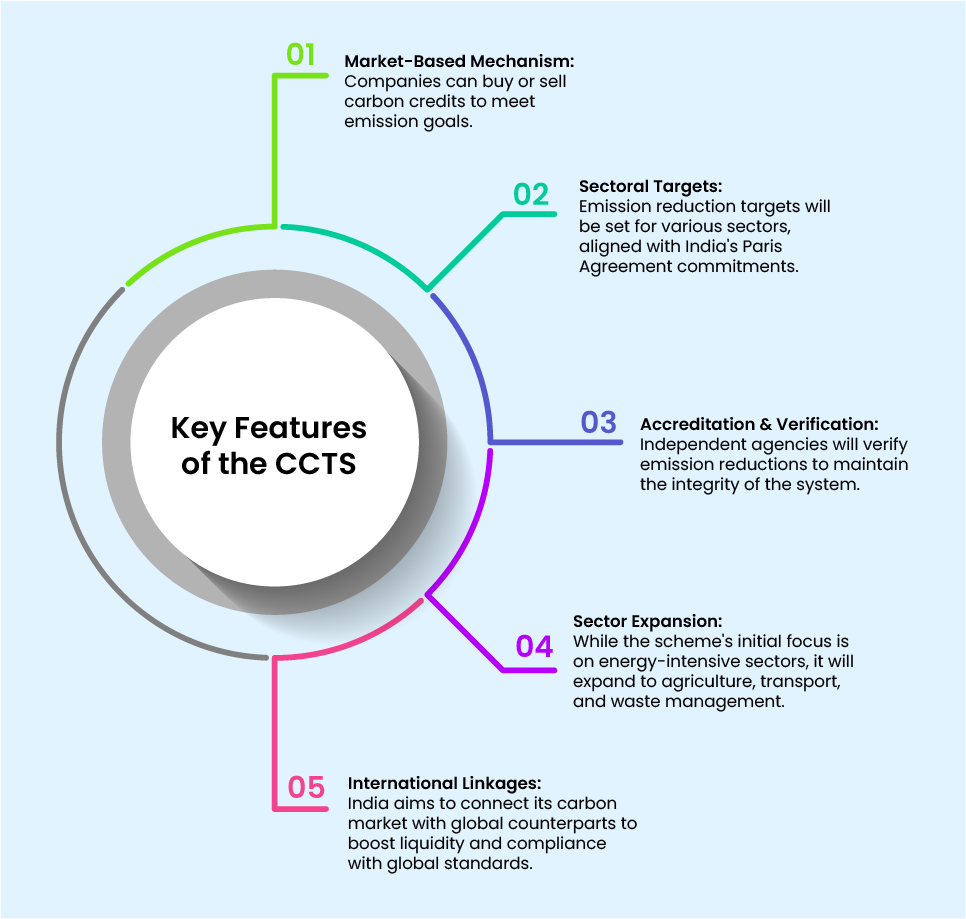
Objectives of the CCTS
- Reduce greenhouse gas emissions: Encourage industries to lower their emissions through measurable targets and financial incentives.
- Promote cleaner technologies: Encourage energy efficiency, renewable energy adoption and low-carbon industrial processes.
- Create a carbon market: Establish a system in which eligible emission reductions can be converted into tradable certificates.
- Encourage private investment: Create financial incentives for businesses and project developers to invest in climate-friendly activities.
- Support India’s climate commitments: Contribute to India’s efforts to reduce the emission intensity of its GDP and achieve its long-term net-zero target for 2070.
- Improve industrial competitiveness: Encourage resource efficiency and help Indian businesses adapt to evolving international carbon-pricing requirements.
How Does India’s Carbon Credit Trading Scheme Work?
The CCTS operates through two mechanisms: the Compliance Mechanism and the Offset Mechanism.
1. Compliance Mechanism
The Compliance Mechanism applies to designated energy-intensive industries known as obligated entities.
- The government establishes sector-specific Greenhouse Gas Emission Intensity (GEI) targets for designated industrial entities.
- Emission intensity measures the quantity of greenhouse gases emitted relative to a unit of production or output.
- Entities that perform better than their notified targets may receive Carbon Credit Certificates.
- Entities that fail to meet their targets may need to purchase and surrender eligible certificates to meet their obligations.
- This creates a financial incentive for industries to reduce emissions and improve production efficiency.
The mechanism focuses on reducing emissions per unit of output rather than imposing a fixed cap on total emissions. Consequently, production can increase while emission intensity declines.
2. Offset Mechanism
The Offset Mechanism allows eligible entities that are not covered by mandatory compliance targets to participate voluntarily in the carbon market.
- Entities can register eligible projects that reduce, remove or avoid greenhouse gas emissions.
- Projects must follow approved methodologies and undergo the required monitoring, reporting and verification procedures.
- Verified emission reductions may qualify for the issuance of Carbon Credit Certificates.
- The mechanism creates opportunities for activities such as renewable energy, green hydrogen, industrial energy efficiency, biogas and mangrove afforestation.
The Offset Mechanism broadens participation in climate action beyond industries covered by the mandatory compliance framework.
Legal and Institutional Framework
The Indian Carbon Market is supported by a legal and institutional structure designed to regulate carbon-credit generation, verification and trading.
1. Energy Conservation (Amendment) Act, 2022
The amendment to the Energy Conservation Act, 2001, provides the legal foundation for India’s carbon market. It empowers the Central Government to establish a carbon trading scheme and provide for the issuance of carbon credit certificates.
2. National Steering Committee for the Indian Carbon Market (NSCICM)
The committee provides overall direction for the Indian Carbon Market. It includes representatives from relevant ministries and institutions and guides the development of the market’s rules, procedures and institutional arrangements.
3. Bureau of Energy Efficiency (BEE)
Established in 2002 under the Energy Conservation Act, 2001, BEE serves as the administrator of the CCTS.
Its responsibilities include developing the carbon-market framework, establishing emission-intensity targets in coordination with the relevant institutions, approving methodologies and overseeing implementation-related procedures.
4. Grid Controller of India Limited
Grid Controller of India Limited, also known as Grid-India, functions as the registry for the Indian Carbon Market. The registry supports the recording and administration of carbon-credit transactions.
5. Central Electricity Regulatory Commission (CERC)
CERC provides regulatory oversight for carbon-credit trading activities conducted through the designated power-exchange framework.
Transition from Perform, Achieve and Trade (PAT) to CCTS
India previously used the Perform, Achieve and Trade (PAT) scheme to improve energy efficiency in energy-intensive industries. Under PAT, designated industrial units received energy-consumption targets and could trade Energy Saving Certificates (ESCerts).
The CCTS represents a shift towards a framework that directly focuses on greenhouse gas emission intensity and uses Carbon Credit Certificates.
Basis | PAT Scheme | CCTS |
| Primary focus | Energy efficiency | Greenhouse gas emission intensity |
| Tradable instrument | Energy Saving Certificates (ESCerts) | Carbon Credit Certificates (CCCs) |
| Main objective | Reduce specific energy consumption | Reduce or remove greenhouse gas emissions |
| Approach | Targets energy savings | Uses carbon-credit generation and trading |
The transition aims to strengthen the link between industrial performance and measurable emission reductions.
Current Implementation Status
The government has progressively expanded the compliance mechanism.
- In October 2025, GEI targets were notified for 282 obligated entities in aluminium, cement, chlor-alkali, and pulp and paper.
- In January 2026, targets were notified for an additional 208 entities in petroleum refineries, petrochemicals, textiles and secondary aluminium.
- This brought the number of obligated entities covered by notified targets to 490.
- The government has also established monitoring, reporting and verification arrangements and procedures for accrediting carbon verification agencies.
As of October 2026, emissions verification is progressing, with the issuance of carbon credits expected to follow the completion of verification and regulatory assessment.
Significance of the CCTS for India
1. Industrial Decarbonisation
The scheme encourages industries to adopt cleaner technologies, improve energy efficiency and reduce emissions per unit of production.
2. Economic Incentives for Climate Action
Carbon credits provide a potential financial return for entities that achieve verified emission reductions beyond their applicable targets.
3. Support for India’s Climate Goals
The CCTS can contribute to India’s climate commitments, including reducing the emission intensity of GDP by 45% by 2030 from the 2005 level and achieving net-zero emissions by 2070.
4. Growth of Green Investment
The scheme can encourage investment in renewable energy, green hydrogen, industrial efficiency, waste management and other low-carbon activities.
5. International Trade and Competitiveness
Recognition of India’s CCTS under the UK’s CBAM framework could help eligible exporters obtain relief for carbon prices already paid in India. The benefit depends on the effective carbon price paid, applicable eligibility conditions and supporting evidence required under UK rules.
6. Development of a Domestic Carbon Market
A functioning Indian Carbon Market can improve transparency in carbon-credit transactions and create a structured mechanism for valuing emission reductions.
Challenges Associated with the CCTS
- Credibility of carbon credits: Credits must represent genuine, measurable and verifiable emission reductions.
- Monitoring and verification: Reliable emissions data and independent verification are essential to prevent inaccurate reporting and double counting.
- Carbon-price uncertainty: Price volatility may make it difficult for businesses to plan investments and compliance costs.
- Implementation capacity: Smaller entities and project developers may face technical and financial barriers to participation.
- Risk of greenwashing: Weak standards could allow entities to claim climate benefits without achieving meaningful emission reductions.
- International compatibility: Differences between domestic and foreign carbon-pricing systems may complicate the recognition of credits and the calculation of carbon-price relief.
Conclusion
India’s Carbon Credit Trading Scheme is an important step towards establishing a market-based framework for industrial decarbonisation. By assigning economic value to verified emission reductions, the scheme seeks to encourage cleaner technologies, improve energy efficiency and mobilise investment in low-carbon activities.
Its long-term effectiveness will depend on credible verification, transparent trading, predictable market rules and meaningful emission reductions. A well-functioning Indian Carbon Market can support India’s climate objectives while helping industries adapt to the growing role of carbon pricing in international trade.
Related reads.

National Co-operative Development Corporation (Amendment) Act, 2026
27 Oct 2026 6 min

Indian Star Tortoise
26 Oct 2026 4 min

Election Commission of India (ECI)
24 Oct 2026 7 min

18th BRICS Summit 2026
24 Oct 2026 5 min

Thiksey Monastery
23 Oct 2026 4 min

Pradhan Mantri Jan Arogya Yojana (AB-PMJAY)
23 Oct 2026 4 min
Put it into practice
Reading is step one.
Turn what you've just read into exam-ready answers with mentor-led practice and our structured test series.