
Current Affairs
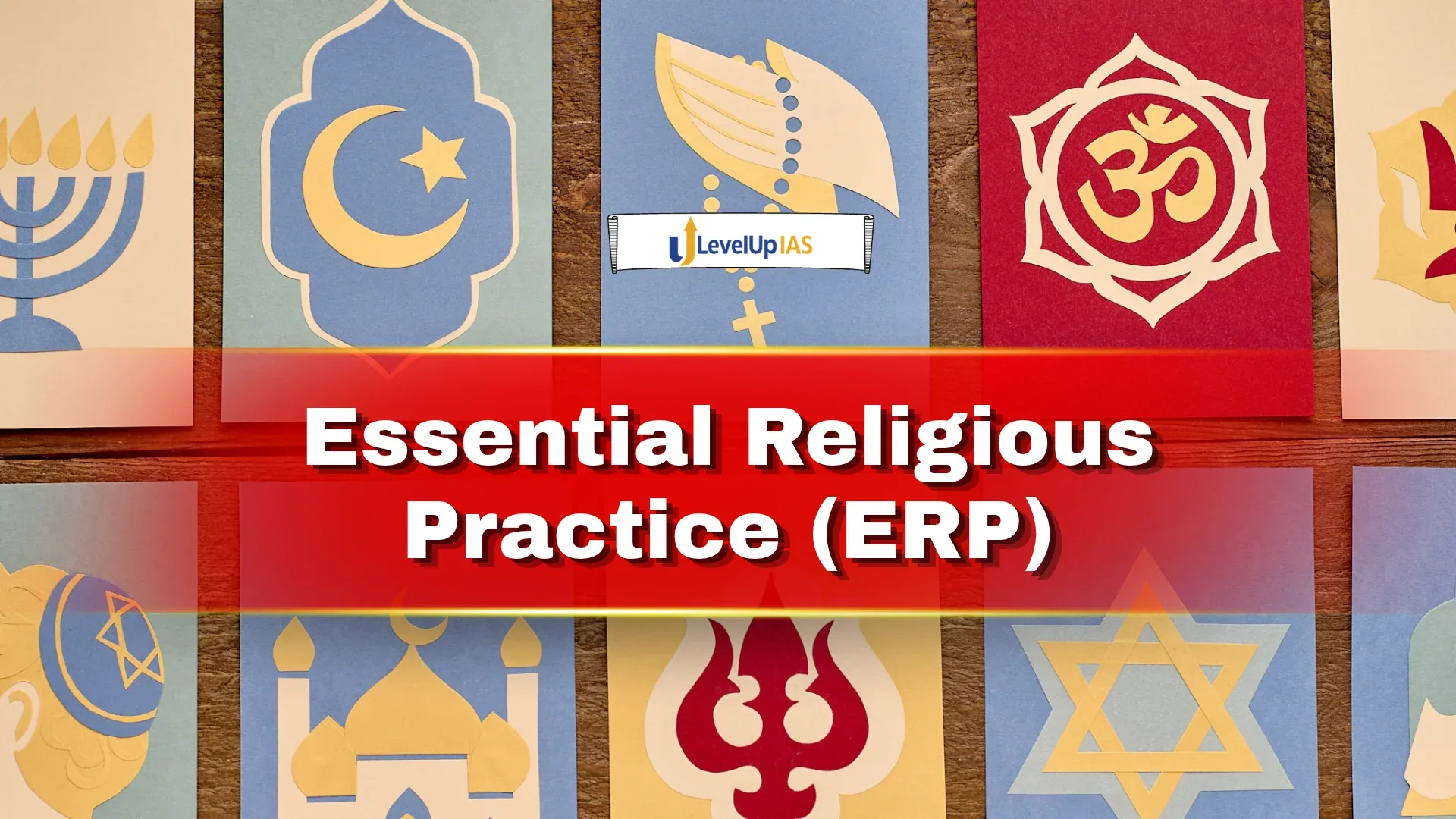
Essential Religious Practice (ERP)
Why in News?
In August 2026, the Allahabad High Court dismissed a petition filed by a schoolgirl from Prayagraj seeking permission to wear a headscarf (hijab) along with her school uniform. In Sukaina Rizvi v. State of Uttar Pradesh and Others (2026), the Court held that the petitioner had not provided sufficient factual or authoritative religious material to establish that wearing a headscarf was an essential religious practice in Islam.
It also observed that a school could prescribe a uniform provided its dress code was uniform, bona fide, non-discriminatory and intended to maintain discipline and institutional identity. The ruling has brought renewed attention to the constitutional relationship between religious freedom, institutional rules and the judicial doctrine of Essential Religious Practice (ERP).
What Is Essential Religious Practice (ERP)?
The Essential Religious Practice (ERP) doctrine is a judicial test used by Indian courts to determine whether a particular religious practice is essential or integral to a religion and, consequently, merits protection under the constitutional guarantee of religious freedom.
The doctrine emerged from the Supreme Court's interpretation of Articles 25 and 26 of the Constitution. Courts examine religious doctrines, beliefs, practices, historical background and relevant evidence to determine whether a practice is fundamental to a religion.
The doctrine is significant because not every practice claimed to be religious is automatically protected as an essential religious practice. Religious freedom is also subject to constitutional limitations, including public order, morality, health and other provisions of Part III of the Constitution.
Constitutional Provisions Related to ERP
- Article 25: Guarantees freedom of conscience and the right to freely profess, practise and propagate religion, subject to public order, morality, health and the other provisions of Part III.
- Article 26: Grants religious denominations the right to establish and maintain religious institutions, manage their own affairs in matters of religion, own property and administer it according to law, subject to public order, morality and health.
- Article 14: Guarantees equality before the law and equal protection of the laws.
- Article 19(1)(a): Protects freedom of speech and expression, which may be relevant where religious attire is also claimed as a form of personal expression.
- Article 21: Protects life and personal liberty, including interests relating to dignity and personal autonomy.
Landmark Judicial Rulings on Essential Religious Practice
1. Shirur Mutt Case (1954)
In Commissioner, Hindu Religious Endowments, Madras v. Sri Lakshmindra Thirtha Swamiar of Shirur Mutt, the Supreme Court laid the foundation for the ERP doctrine.
The Court distinguished religious matters from secular activities associated with religious institutions. It held that religious freedom extends beyond beliefs and doctrines to religious practices, rituals and observances that are integral to a religion.
The judgment became a foundational precedent for determining the scope of constitutional protection for religious practices.
2. Santhara (Sallekhana) Case (2015)
Santhara, also known as Sallekhana, is a Jain religious practice involving voluntary fasting until death under prescribed circumstances.
In 2015, the Rajasthan High Court ruled against the practice, holding that it was not protected as an essential religious practice and raising questions about its legality under the right to life.
The Supreme Court subsequently stayed the High Court's judgment, allowing the matter to remain open for further judicial consideration.
The case raised important questions about religious freedom, the right to life and the limits of judicial intervention in religious practices.
3. Triple Talaq Case (2017)
In Shayara Bano v. Union of India (2017), the Supreme Court invalidated the practice of instant triple talaq, by which a Muslim man could pronounce talaq three times to end a marriage immediately.
The judgment involved different judicial opinions, with the majority setting aside the practice on constitutional and legal grounds. The essentiality of the practice within Islam was also examined in the proceedings.
The case highlighted the relationship between religious practices, gender equality and constitutional protection.
4. Sabarimala Temple Entry Case (2018)
In Indian Young Lawyers Association v. State of Kerala (2018), the Supreme Court considered the restriction on women of menstruating age entering the Sabarimala temple.
The majority held that the exclusion violated constitutional guarantees, including equality and religious freedom. The case raised important questions about the ERP doctrine, gender equality, the rights of religious denominations and the constitutional limits on religious customs.
The broader questions surrounding the judgment have continued to be the subject of judicial consideration.
5. Hijab Case: Karnataka High Court and Supreme Court (2022)
In 2022, the Karnataka High Court upheld the state government's uniform-related restrictions in the context of government educational institutions and held that wearing the hijab was not an essential religious practice in Islam.
The matter reached the Supreme Court, where a two-judge bench delivered a split verdict in October 2022. Justice Hemant Gupta upheld the restrictions, while Justice Sudhanshu Dhulia allowed the appeals. The split meant that the matter was not conclusively resolved by that bench, and the case was referred for consideration by a larger bench.
The dispute highlighted competing arguments concerning religious freedom, educational discipline, equality and individual choice.
Significance of the Essential Religious Practice Doctrine
- Protects religious freedom: Helps identify practices that form an integral part of religious belief and observance.
- Defines constitutional limits: Clarifies that religious freedom operates within the broader constitutional framework.
- Promotes gender equality: Enables courts to examine religious customs that may conflict with constitutional guarantees of equality.
- Supports public welfare: Helps distinguish protected religious observances from activities that may legitimately be regulated for public health, safety or order.
- Strengthens judicial review: Provides a framework for resolving disputes involving religious practices and fundamental rights.
Criticism and Challenges
- Judicial interpretation of religion: Determining what is essential may require courts to interpret religious texts and traditions, raising questions about the appropriate role of the judiciary.
- Diversity within religions: Religious practices may vary across communities, regions, denominations and individual traditions.
- Uncertainty in application: The doctrine may produce different outcomes depending on the evidence, legal arguments and context of a case.
- Individual autonomy versus institutional rules: Disputes involving religious attire may require balancing personal freedom with legitimate institutional objectives.
- Risk of inconsistent application: The lack of a single, universally applicable test may lead to uncertainty in how courts assess essentiality.
Conclusion
The Essential Religious Practice doctrine plays an important role in defining the scope of religious freedom in India. Through judicial interpretation of Articles 25 and 26, courts assess whether a practice is integral to a religion and how it interacts with other constitutional guarantees.
The doctrine remains significant in disputes involving religious attire, personal autonomy, gender equality and public regulation. Its application requires careful consideration of religious diversity, constitutional principles and the rights of individuals and institutions.
Related reads.

CosmoCube Mission
29 Oct 2026 3 min

India’s Carbon Credit Trading Scheme (CCTS)
28 Oct 2026 6 min

National Co-operative Development Corporation (Amendment) Act, 2026
27 Oct 2026 6 min

Indian Star Tortoise
26 Oct 2026 4 min
Election Commission of India (ECI)
24 Oct 2026 7 min
18th BRICS Summit 2026
24 Oct 2026 5 min
Put it into practice
Reading is step one.
Turn what you've just read into exam-ready answers with mentor-led practice and our structured test series.