
Current Affairs
18th BRICS Summit 2026
Why in News?
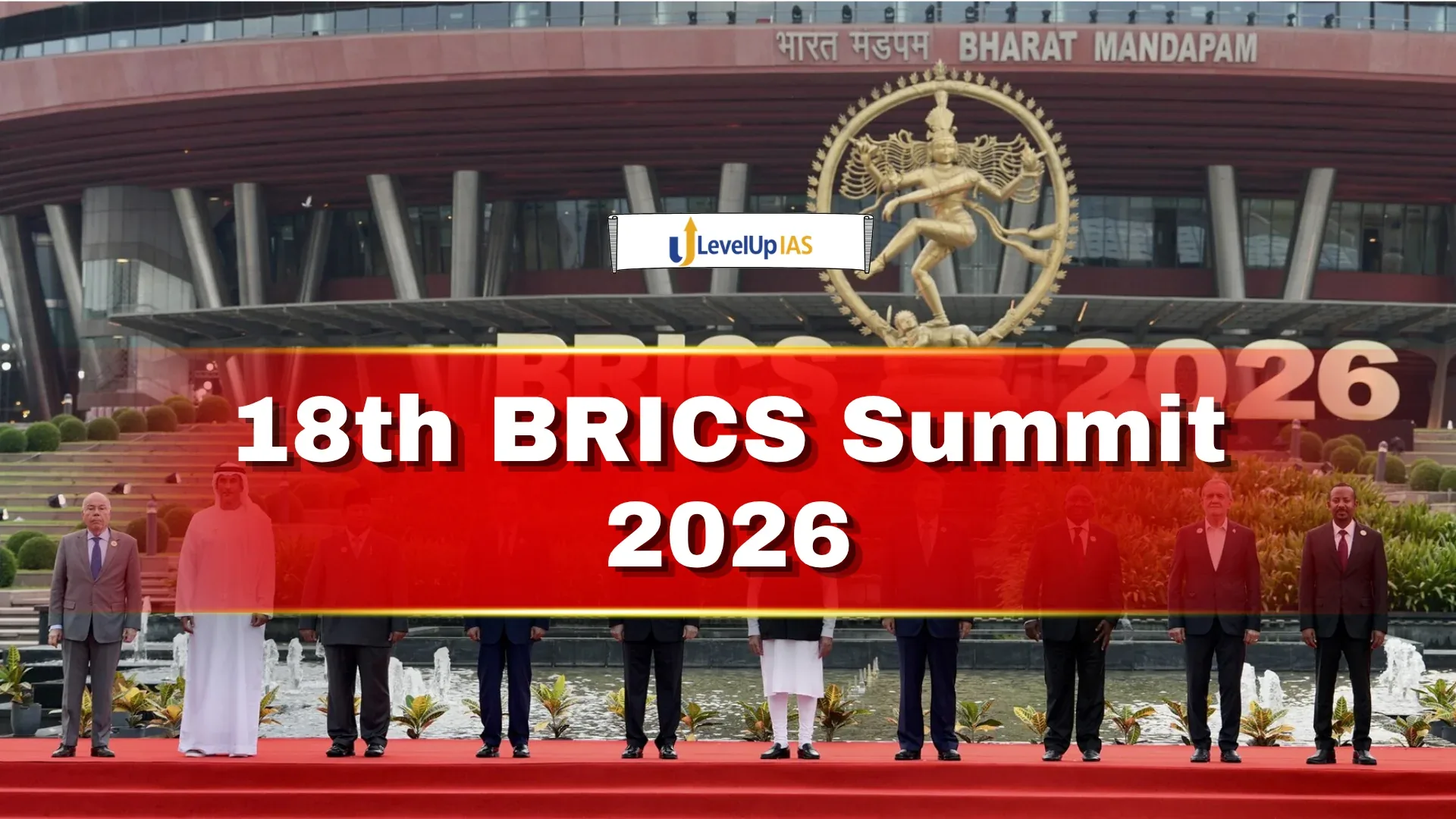
The 18th BRICS Summit was held in New Delhi on 12-13 September 2026 under India’s chairship. The summit adopted the New Delhi Declaration, reaffirming the grouping’s commitment to inclusive global governance, multilateralism, sustainable development and stronger cooperation among emerging economies. The summit was organised under the theme “Building for Resilience, Innovation, Cooperation and Sustainability.” It also marked 20 years since BRICS was established in 2006.
About BRICS
BRICS is a multilateral grouping of major emerging economies that provides a platform for cooperation on global economic governance, development, trade, finance, technology and international political issues.
The grouping seeks to strengthen the voice of the Global South and promote a more representative and equitable international order.
Evolution of BRICS
- 2001: The term BRIC was coined by economist Jim O’Neill in a Goldman Sachs research paper.
- 2006: Brazil, Russia, India and China began cooperating as BRIC.
- 2009: The first BRIC Summit was held in Yekaterinburg, Russia.
- 2010: South Africa joined the grouping, making it BRICS.
- 2024: Egypt, Ethiopia, Iran and the United Arab Emirates joined the expanded grouping. Saudi Arabia has also been associated with the expansion, although its full membership status has remained ambiguous in some reporting.
- 2025: Indonesia became a full member, bringing the number of members to 11.
BRICS Members
As reported by the Government of India in September 2026, the 11 BRICS members are:
- Brazil
- Russia
- India
- China
- South Africa
- Egypt
- Ethiopia
- Iran
- United Arab Emirates (UAE)
- Indonesia
- Saudi Arabia
The grouping spans Asia, Africa, Europe, the Middle East and Latin America. Its members represent a substantial share of the world's population, economic output and international trade.
18th BRICS Summit 2026: Key Details
- Summit: 18th BRICS Summit
- Host country: India
- Venue: Bharat Mandapam, New Delhi
- Dates: 12-13 September 2026
- Chairship: India
- Theme: “Building for Resilience, Innovation, Cooperation and Sustainability”
- Major outcome: New Delhi Declaration
India assumed the BRICS chairship on 1 January 2026, succeeding Brazil. India had previously chaired BRICS in 2012, 2016 and 2021.
Key Outcomes of the Summit
1. New Delhi Declaration
The summit adopted the New Delhi Declaration, which reaffirmed the commitment of BRICS members to:
- Strengthening multilateralism and reforming global governance institutions.
- Promoting a fairer and more representative international order.
- Supporting sustainable development and inclusive economic growth.
- Increasing the participation of emerging markets and developing countries in international decision-making.
- Encouraging cooperation among BRICS members and partner countries.
2. Reform of Global Governance
The declaration called for reforms to make international institutions more representative of contemporary geopolitical and economic realities.
BRICS reiterated its support for reform of the United Nations, including the UN Security Council, to improve the representation of developing countries.
China and Russia reiterated support for the aspirations of India and Brazil to play a greater role in the United Nations, including its Security Council.
3. Trade and Economic Cooperation
BRICS members emphasised stronger intra-group trade, investment and resilient global value chains.
The declaration opposed unilateral economic sanctions and trade-restrictive measures inconsistent with World Trade Organization (WTO) principles. It also supported reform of the WTO and a transparent, inclusive and rules-based multilateral trading system.
Members continued discussions on facilitating trade and investment using local currencies, without committing to a common BRICS currency.
4. Seafarers’ Emergency Support Network
India proposed establishing a Seafarers’ Emergency Support Network to provide timely assistance and improve the safety of people working at sea.
The initiative reflects India's interest in maritime security, safe sea routes and the welfare of seafarers, who play an important role in global trade.
5. Agriculture and Food Security
The summit advanced cooperation in agriculture, including initiatives related to:
- Agroecology and regenerative agriculture for climate resilience and productivity.
- Digital agriculture.
- Sharing agricultural information, genetic resources and agro-input knowledge through collaborative mechanisms.
- Farmers’ rights and seed systems.
These initiatives aim to support sustainable agricultural practices, improve productivity and strengthen food security.
6. Health and Mental Health Cooperation
The declaration supported cooperation in healthcare, including the development of training hubs and Centres of Excellence for mental health.
The National Institute of Mental Health and Neuro Sciences (NIMHANS), Bengaluru, was identified as the coordinating centre for the proposed BRICS mental health cooperation network.
7. Science, Technology and Space
The summit highlighted cooperation in scientific research, digital technology and space-related activities.
Key areas included the proposed BRICS Science and Research Repository, knowledge sharing among member countries and progress on the BRICS Remote Sensing Satellite Constellation. These initiatives can strengthen scientific collaboration and the use of space-based information for development.
8. Counterterrorism
The New Delhi Declaration strongly condemned terrorism in all its forms and manifestations. It specifically condemned the 22 April 2025 terrorist attack in Jammu and Kashmir, in which 26 people were killed.
The declaration reiterated the importance of international cooperation against terrorism and efforts to address terrorist safe havens.
India’s Significance and Priorities
India’s chairship sought to make BRICS more development-oriented, inclusive and focused on practical cooperation.
Its key priorities included:
- Global South: Strengthening the representation of developing countries in global institutions.
- Economic cooperation: Promoting trade, investment, resilient supply chains and technological collaboration.
- Digital public infrastructure: Encouraging the sharing of digital solutions and development experiences.
- Sustainable development: Advancing climate resilience, renewable energy and sustainable agriculture.
- People-to-people ties: Expanding cooperation in education, health, culture and skills development.
- Institutional continuity: India proposed a BRICS Continuity and Implementation Mechanism to follow up on initiatives through the grouping’s Troika of past, current and incoming chairs.
Significance of BRICS
1. Greater Voice for the Global South
BRICS provides emerging and developing economies with a platform to express common concerns on trade, development finance, climate change and global governance.
2. Multipolarity
The grouping supports a more multipolar international system in which global decision-making is not dominated by a limited number of established powers.
3. Economic Cooperation
Its members offer significant markets, natural resources, industrial capacity and technological capabilities. Cooperation can expand trade and investment opportunities.
4. Development Financing
The New Development Bank (NDB), established by BRICS in 2014, finances infrastructure and sustainable development projects. Its headquarters are in Shanghai, China.
5. Cooperation on Shared Challenges
BRICS offers opportunities for collaboration on food and energy security, public health, digital transformation, climate resilience and scientific research.
Challenges Facing BRICS
Despite its growing influence, BRICS faces several challenges:
- Political differences: Members have different strategic priorities and relationships with major powers.
- Divergent economic interests: Differences in economic structures and development levels can complicate common policies.
- Consensus-based decision-making: Reaching agreement among an expanded membership can be difficult.
- Institutional limitations: The grouping needs effective implementation and follow-up mechanisms to translate declarations into action.
- Global geopolitical tensions: Conflicts and disagreements among members can limit collective responses to international crises.
Conclusion
The 18th BRICS Summit in New Delhi reaffirmed the grouping’s ambition to strengthen multilateralism, promote inclusive development and increase the influence of emerging economies in global governance. The New Delhi Declaration and initiatives on trade, agriculture, maritime safety, health and technology reflected an emphasis on practical cooperation.
For India, BRICS remains an important platform for advancing the interests of the Global South while maintaining strategic autonomy and engaging with diverse international partners. Its future effectiveness will depend on whether members can manage their differences and translate shared commitments into tangible outcomes.
Related reads.
Election Commission of India (ECI)
24 Oct 2026 7 min

Thiksey Monastery
23 Oct 2026 4 min

Pradhan Mantri Jan Arogya Yojana (AB-PMJAY)
23 Oct 2026 4 min

Loggerhead Sea Turtle
19 Oct 2026 4 min

West Nile Fever
18 Oct 2026 3 min

Satkosia Tiger Reserve
23 Sep 2026 2 min
Put it into practice
Reading is step one.
Turn what you've just read into exam-ready answers with mentor-led practice and our structured test series.