
Current Affairs
Thiksey Monastery
Why in News?
In August 2026, US Ambassador to India Sergio Gor visited the historic Thiksey Monastery in Ladakh during his official tour of the Union Territory. The monastery is an important centre of Tibetan Buddhism and is renowned for its distinctive architecture, Buddhist art and religious traditions.
About Thiksey Monastery
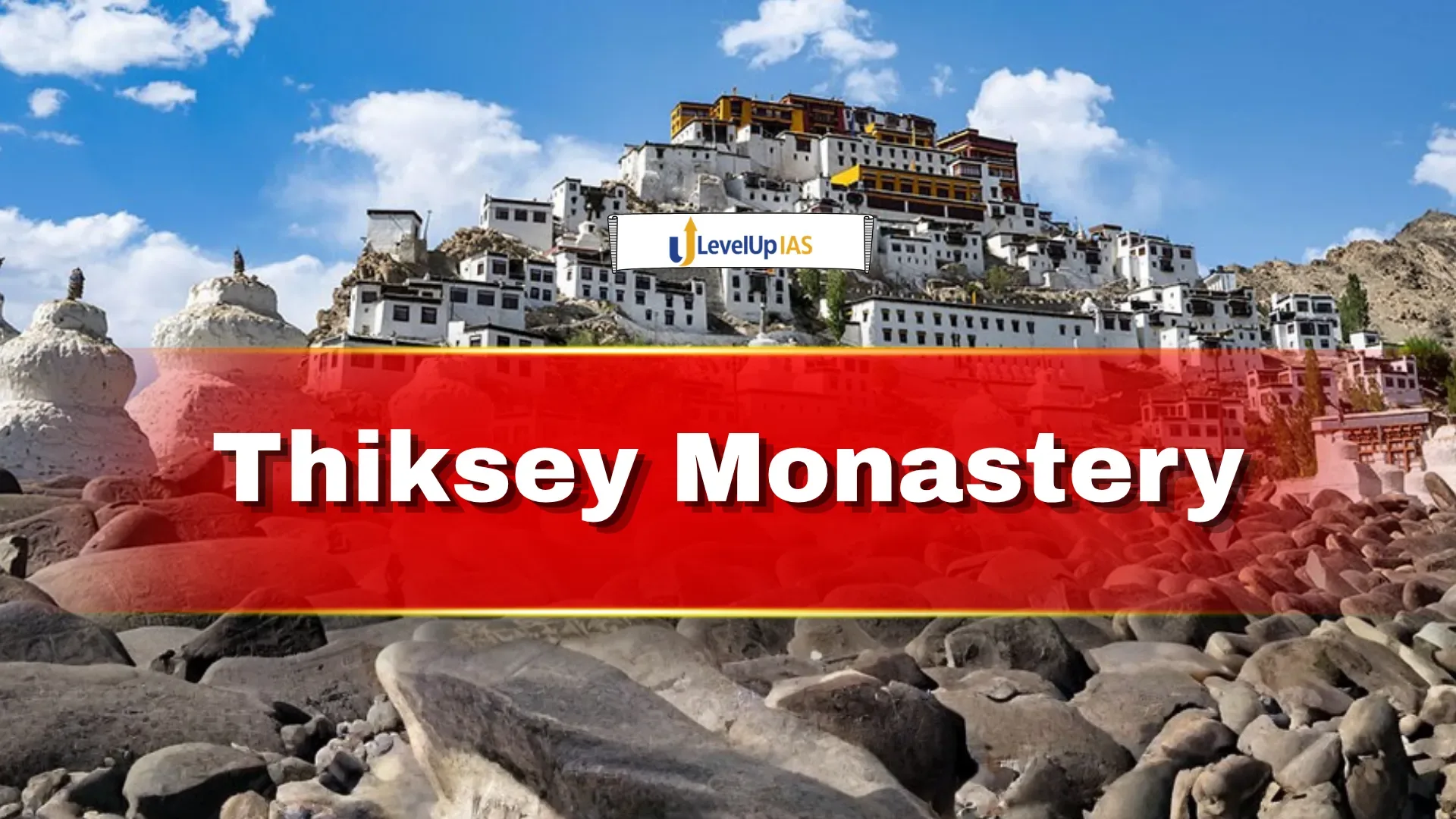
Thiksey Monastery, also known as Thiksey Gompa, is one of the largest and most prominent Buddhist monastic complexes in central Ladakh. It is situated on a hill in Thiksey village, approximately 19 km east of Leh, overlooking the Indus River Valley.
The monastery belongs to the Gelugpa school of Tibetan Buddhism, also known as the Yellow Hat sect. It serves as a centre for Buddhist worship, monastic education, meditation and the preservation of Ladakh's cultural heritage.
Historical Background
Thiksey Monastery was founded in 1433 by Pon Sherab Raspa under the influence of the teachings of Jangsem Sherab Zangpo, a prominent religious teacher associated with the Gelug tradition.
The monastery's establishment was part of the expansion of the Gelug school in Ladakh. Its development was supported by the spread of Tibetan Buddhist teachings and the patronage of regional rulers.
The monastery subsequently developed into an important religious institution, preserving Buddhist scriptures, rituals, artistic traditions and monastic practices.
Architectural Features
1. Twelve-Storey Complex
Thiksey Monastery is particularly famous for its twelve-storey, terraced architectural design. The buildings rise along the slope of a hill, with residential quarters, temples, prayer halls and shrines arranged at different levels.
Its whitewashed structures and red and ochre-coloured religious buildings create a distinctive visual appearance.
2. Resemblance to Potala Palace
The monastery resembles the Potala Palace in Lhasa, Tibet, the historic residence of the Dalai Lamas. Because of this resemblance, Thiksey is often called the Mini Potala of Ladakh.
Its elevated position and tiered layout are among its most recognisable architectural characteristics.
3. Maitreya Buddha Statue
One of the monastery's most prominent features is its 15-metre-high statue of Maitreya Buddha, which extends across two storeys. The statue was installed in the 1980s and consecrated by the 14th Dalai Lama in 1980.
Maitreya is regarded in Buddhist tradition as the Buddha of the future, who is expected to appear in the world to renew the teaching of the Dharma.
4. Prayer Halls and Sacred Structures
The monastery contains several important religious and artistic spaces:
- Dukhang: The principal assembly and prayer hall used for religious gatherings and monastic ceremonies.
- Gonkhang: A temple dedicated to guardian deities.
- Tara Temple: Associated with the 21 manifestations of Tara, a revered figure in Tibetan Buddhism.
- Stupas and prayer walls: Structures used for religious devotion and the expression of Buddhist beliefs.
The monastery also preserves thangka paintings, murals, sculptures and Buddhist manuscripts, including scriptures associated with the Kangyur tradition.
Gelugpa School of Tibetan Buddhism
The Gelugpa school was founded by Je Tsongkhapa (1357-1419), a Tibetan Buddhist scholar and reformer. It emphasises monastic discipline, philosophical study, ethical conduct and the systematic study of Buddhist teachings.
The school is commonly known as the Yellow Hat sect, referring to the distinctive yellow hats worn by its monks during certain religious ceremonies.
Thiksey Monastery represents the historical spread of this school into Ladakh and continues to play a role in religious education and the transmission of Tibetan Buddhist traditions.
Thiksey Gustor Festival
The Thiksey Gustor Festival is an important annual religious festival celebrated at the monastery, generally during October-November according to the Tibetan calendar.
Its major features include:
- Cham dance: Sacred masked dances performed by monks in traditional costumes.
- Ritual performances: Ceremonies that express Buddhist teachings and symbolise the triumph of good over evil.
- Torma rituals: The symbolic use and ritual destruction of specially prepared effigies.
- Community participation: The festival attracts devotees, local residents and visitors, helping sustain Ladakh's cultural traditions.
The festival combines religious practice, performing arts and community participation, making it significant for the study of Himalayan culture and Buddhist traditions.
Cultural and Educational Significance
Thiksey Monastery is more than a place of worship. It contributes to the preservation of Ladakh's tangible and intangible cultural heritage.
Its manuscripts, murals, sculptures and religious buildings provide insights into Tibetan Buddhist art and architecture. Its festivals, chanting traditions and ritual dances help transmit cultural knowledge across generations.
The monastery also supports educational and community initiatives. In September 2026, the Ladakh Administration reported the inauguration of a newly constructed Changsem Sherab Zangpo Hall, guest house and staff rooms at the monastery. The facilities were funded by the Ministry of Culture and constructed by the Central Public Works Department.
Conclusion
Thiksey Monastery is an important religious, architectural and cultural landmark of Ladakh. Founded in the fifteenth century, it reflects the influence of the Gelugpa school of Tibetan Buddhism and preserves a rich collection of Buddhist art, scriptures and ritual traditions.
Its terraced architecture, Maitreya Buddha statue and annual Gustor festival make it significant for understanding India's Himalayan cultural heritage. Its continued role in religious education and community life highlights the importance of preserving historic monastic institutions.
Related reads.

Pradhan Mantri Jan Arogya Yojana (AB-PMJAY)
23 Oct 2026 4 min

Loggerhead Sea Turtle
19 Oct 2026 4 min

West Nile Fever
18 Oct 2026 3 min
Satkosia Tiger Reserve
23 Sep 2026 2 min

EU’s Carbon Border Adjustment Mechanism (CBAM)
22 Sep 2026 4 min
ASEAN: Association of Southeast Asian Nations
16 Sep 2026 6 min
Put it into practice
Reading is step one.
Turn what you've just read into exam-ready answers with mentor-led practice and our structured test series.